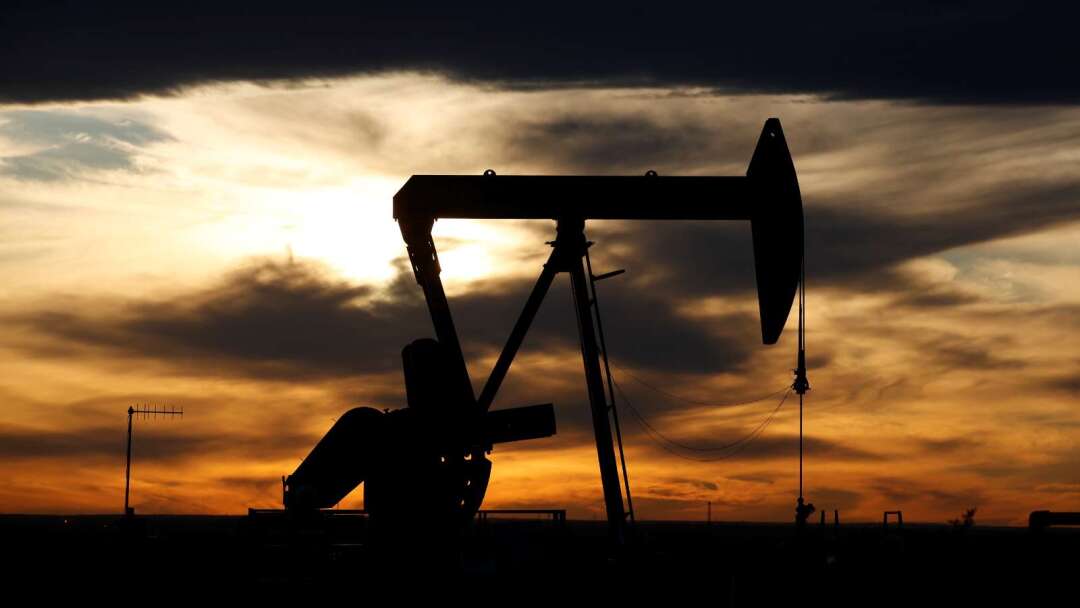
International oil prices dropped sharply on Monday (3rd). U.S. President Trump's last-minute cancellation of new military strikes against Iran boosted market speculation that Washington and Tehran might ease tensions through diplomatic negotiations, raising expectations of increased crude oil supply from the Persian Gulf and driving prices to their lowest levels in nearly three weeks.
Brent crude oil for October delivery fell by $6.35, or 7%, closing at $83.77 per barrel. U.S. West Texas Intermediate (WTI) crude futures dropped $4.33, or 5.1%, to settle at $80.34 per barrel.
Brent's closing price marked its lowest since July 13, though part of the decline was influenced by the futures contract rollover. As the higher-priced September contract expired last Friday, the front-month contract shifted to October, causing the October Brent crude price to fall an additional 4.7% compared to last Friday’s closing.
Trump said he decided to pause military action against Iran, anticipating a swift agreement. On Monday, he reiterated that the U.S. and Iran are “currently negotiating” and warned that if Tehran refuses to reach a deal ending the conflict, Iran would face “decapitation” consequences.
However, Iran immediately denied these claims. Iranian Foreign Ministry spokesperson Esmail Baghaei stated that no negotiations with the U.S. are underway, nor are any meetings scheduled. Iran has no plans to host foreign delegations or send negotiation teams abroad, directly refuting Trump’s statements.
In fact, over the past five months, Trump has repeatedly followed a similar pattern—first announcing a “massive attack” on Iran, then canceling military action at the last minute—causing repeated volatility in market sentiment.
Energy consulting firm Ritterbusch and Associates noted that Monday’s sharp drop in crude prices was likely an overreaction by the market to Trump’s remarks. The firm said that Trump’s weekend warning of a large-scale attack on Iran, followed by his sudden shift to claiming an imminent agreement, has repeatedly suppressed oil prices and prevented U.S. gasoline prices from rising further.
On Monday, Trump again urged oil companies to lower gasoline prices for American consumers and criticized Chevron (CVX-US) and ExxonMobil (XOM-US) for earning excessive profits.
In addition to the sharp fall in crude prices, U.S. gasoline and diesel futures also declined by about 5% on the same day.
Despite market bets on improved diplomacy, shipping risks in the Middle East remain unresolved.
Ship-tracking data shows that due to Houthi, a Iran-aligned armed group in Yemen, threatening to attack Saudi commercial vessels, six Saudi-flagged supertankers have rerouted in recent days, avoiding the Gulf of Aden and instead transporting crude via the southern tip of Africa.
Meanwhile, over the weekend, two oil tankers carrying Saudi crude successfully passed through the Bab el-Mandeb Strait, which connects the Red Sea and the Gulf of Aden. However, vessel transit speeds through the Strait of Hormuz, linking Iran and Oman, have slowed due to reports of ship attacks.
Before the U.S. and Israel conducted airstrikes on Iran on February 28, about one-fifth of the world’s crude oil supply passed through the Strait of Hormuz. Therefore, any disruption in this waterway could significantly impact global energy markets.
In addition to the Middle East, Russia’s energy exports are also affected by ongoing conflict.
Shipping data and trade sources indicate that a Panama-flagged tanker carrying Russian naphtha attempted to cross the Bab el-Mandeb Strait in late July but ultimately rerouted around the southern tip of Africa.
On Monday, Russia announced it would further strengthen maritime security in the Sea of Azov and the Black Sea and develop alternative freight routes to counter rising sea attacks caused by the Russia-Ukraine war.
According to U.S. energy statistics, Russia remains the world’s third-largest crude oil producer in 2025, behind the U.S. and Saudi Arabia, and is also a member of OPEC+. OPEC+ consists of the Organization of the Petroleum Exporting Countries (OPEC) and other allied oil-producing nations.
Market participants noted that since the beginning of the year, conflicts involving Iran and Ukraine have disrupted crude exports from parts of the Persian Gulf, Russia, and Kazakhstan, prompting OPEC+ to gradually increase production over several months. However, the additional output has not fully entered the global market.
OPEC+ approved an increase of approximately 188,000 barrels per day starting in September on Sunday, aiming to gradually boost market supply. However, amid ongoing geopolitical risks and shipping disruptions, global crude oil supply remains highly uncertain.
FACT BOX
- Source: PR Times
- Category: News