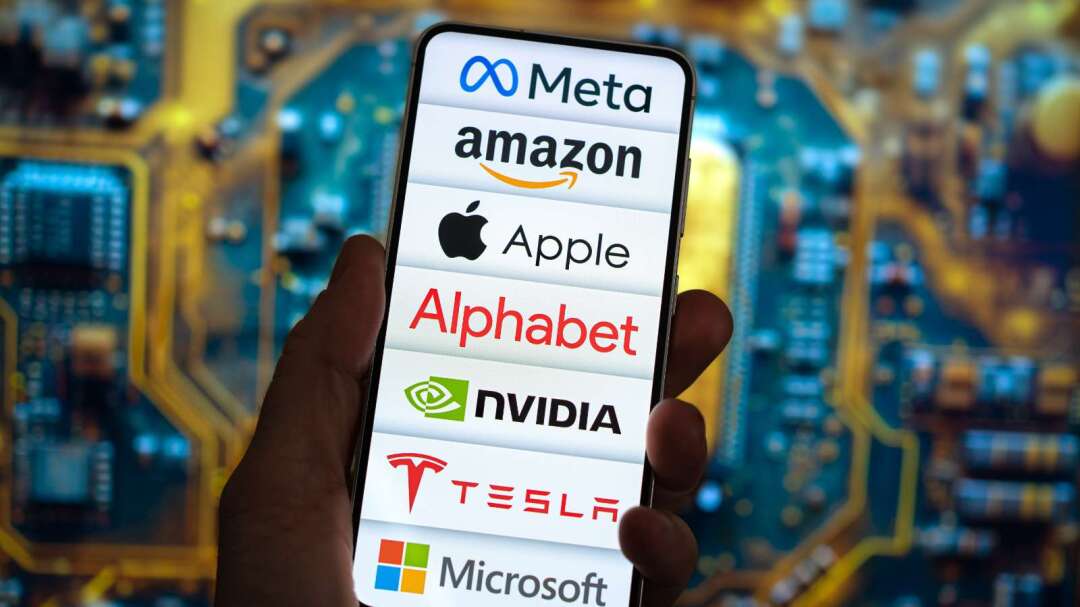
The artificial intelligence (AI) frenzy has entered its next phase, and Wall Street’s evaluation criteria are rapidly changing. The latest round of tech earnings shows that markets no longer care solely about how much capital companies invest in AI infrastructure, but rather who can convert these massive investments into revenue, profit, and cash flow. As cloud giants deliver strong results, cloud computing is increasingly seen as the most mature AI monetization model. In contrast, companies lacking a cloud-based profit engine face stricter scrutiny, signaling a shift in AI investment focus—from 'burning cash' to 'earning cash'.
Microsoft (MSFT-US) saw its stock surge over 13% in a single day following its earnings release, with a weekly gain of 19%. Its share price jumped from $389 to $460. Amazon (AMZN-US) also performed strongly, rising over 15% for the week, climbing from $231 to $271.
Alphabet (GOOGL-US) was not far behind, gaining 7% for the week, with its stock rising from $326 to $356. The market is reevaluating the AI monetization potential behind its accelerating cloud business growth. Oracle (ORCL-US) also benefited from optimistic cloud business outlooks, with its weekly gain exceeding 10%.
However, this rally is not a blind 'buy anything AI' frenzy. Meta (META-US), which has also heavily invested in AI infrastructure, saw its stock fall 6% last week, dropping from $593 to $556. Meanwhile, NVIDIA (NVDA-US), the core AI computing supplier, gained only 2% for the week, trading flat between $195 and $200, as the market awaits its August 26 earnings report.
In short, Wall Street’s logic is converging on one message: the key is no longer who spends the most, but who can turn that spending into real revenue, profit, and cash flow.
Cloud businesses are flourishing, and the AI 'monetization story' is taking shape.
Analysts note that the latest quarterly earnings from tech giants send a clear signal: AI investment is transitioning from a capital-expenditure-heavy phase to one of revenue realization.
Amazon’s AWS, Microsoft’s Azure, and Alphabet’s cloud division all significantly exceeded market expectations in revenue this quarter. AWS revenue grew 37% year-over-year, Azure grew 43%, and the combined growth rate of the three cloud businesses reached 48%.
Analysts argue that amid ongoing debates over viable AI business models, cloud computing has emerged as the most verifiable and persuasive path to profitability.
Tech giants build data centers, purchase chips and computing equipment, and then lease computing power to enterprise clients via long-term contracts—completing a full cycle from infrastructure investment to cash flow recovery.
Notably, AWS achieved an operating margin of 39% this quarter. CEO Andy Jassy revealed that computing equipment typically pays back within three years on average, and most AI-related computing contracts last over five years—meaning current investments enjoy a relatively long and stable profit realization cycle.
Jassy stated, 'The resulting revenue, free cash flow, and return on capital are very compelling.' He also proposed a long-term vision where AWS could grow into a $1 trillion annual revenue business.
For context, FactSet estimates currently project AWS’s annual revenue at around $170 billion.
The core driver behind this cloud boom is AI demand itself. The industry’s bottleneck has shifted from 'whether demand exists' to 'whether computing power is sufficient'.
In April, AWS signed a more than $100 billion, ten-year agreement with Anthropic—a concrete example of the AI computing power acquisition race.
Notably, compared to the three cloud leaders—Microsoft, Amazon, and Alphabet—Meta faces a far tougher market test.
The social media giant has also invested heavily in AI infrastructure but lacks a mature cloud business to generate revenue by leasing computing power externally, unlike AWS, Azure, or Google Cloud.
Since its earnings release, Meta’s stock has declined about 5%. Although the company recently raised its 2026 capital expenditure forecast and CEO Zuckerberg mentioned considering building its own cloud business, he admitted it is still significantly behind the three cloud leaders.
Analysts say Wall Street’s scoring criteria are becoming increasingly clear: the success of AI investment depends not on spending scale, but on whether a company has a business model capable of converting capital expenditure into long-term, stable cash flow.
Meanwhile, cloud computing appears to be the market’s accepted most mature solution, and companies without this monetization path face increasingly strict scrutiny.
The next challenge: the 'quality' of profits
Despite strong overall profit performance this quarter among tech giants, market reactions were clearly divergent.
According to Goldman Sachs, among technology, media, and telecom (TMT) stocks, companies that reported EPS above expectations underperformed the S&P 500 by an average of 192 basis points the day after earnings. In contrast, non-TMT companies with similar strong results outperformed the market by about 75 basis points.
This contrast indicates a shift in how tech stocks are valued. Investors now look beyond whether short-term earnings 'beat estimates'—they care more about whether profit growth is sustainable and where profits originate.
In Q2, the S&P 500’s overall EPS year-over-year growth tracking stood at 45%. However, about 19 percentage points came from 'other income'—approximately $151 billion in equity investment gains from Alphabet and Amazon combined, with Microsoft contributing another $3 billion. Excluding these non-recurring items, core profit growth still reached 26%, the fastest pace since 2021.
Currently, AI infrastructure-related companies contribute nearly one-third of the S&P 500’s EPS growth this quarter. Analysts expect this share could exceed 50% by the second half of 2026 to 2027.
However, cost pressures remain a concern. Over the past few quarters, the median net profit margin of S&P 500 constituents has stagnated, and future margin expectations across most industries have been downgraded.
Goldman Sachs maintains its year-end S&P 500 target of 8,000 points and forecasts S&P 500 EPS to reach $385 by 2027.
Analysts conclude that for this AI-driven market, the focus will shift from 'the speed of capital expenditure' to a deeper test: 'whether profit growth can be sustained'.
FACT BOX
- Source: PR Times
- Category: News
- Organizations: Alphabet / Meta / NVIDIA
- Products / services: AWS / Azure