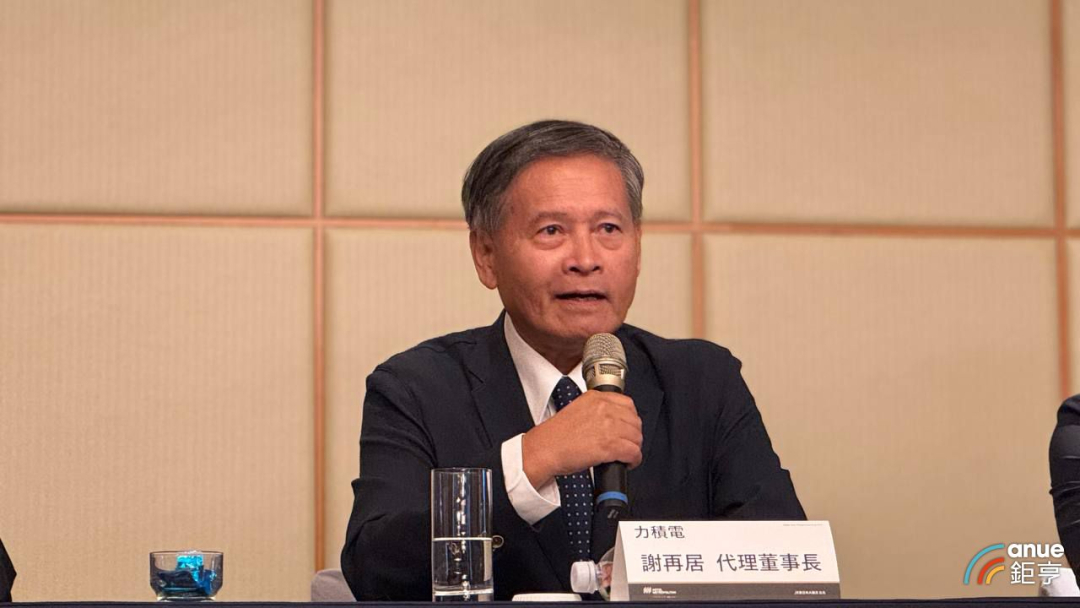
Powerchip Semiconductor Manufacturing Corporation (PSMC, 6770-TW) Acting Chairman Hsieh Tsai-chu today (4th) made his first public statement on the company's future operational direction. Addressing the broad shareholder base, Hsieh emphasized that with the three pillars—memory, logic foundry, and AI-related businesses—taking shape, and with the financial structure significantly improved following the sale of its Tongluo fab to Micron, Powerchip is poised not only for profitability this year but also in the coming two years, provided market momentum remains stable. He pledged to advance toward the goal of 'annual profits and annual dividends.'
Hsieh explained that Powerchip's current operational foundation rests on three core foundry businesses: first, memory foundry, the company's earliest venture, covering DRAM and Flash; second, logic wafer foundry, entered about a decade ago; and third, semiconductor components and process services related to AI and advanced packaging, which have gradually taken shape in recent years.
AI-related business will be a crucial new growth driver for Powerchip, with current progress proving promising. The company will continue expanding its technological and production capacity in this direction, strengthening its role in the AI, high-bandwidth memory (HBM), and advanced packaging supply chains.
Hsieh highlighted the sale of the Tongluo fab to Micron as the company's most significant adjustment this year, expected to generate over NT$50 billion in cash inflow. This will help Powerchip reduce its debt ratio, improve its financial structure, and alleviate depreciation and fixed cost pressures caused by low capacity utilization.
He explained that the Tongluo fab was originally oriented toward logic foundry, but actual operations failed to ramp up as expected, resulting in persistently low capacity utilization. This led to accumulated costs without generating sufficient revenue, prompting the company to reconfigure its resource allocation through the transaction.
However, this transaction is not merely an asset sale—it also opens new collaborative opportunities between Powerchip and Micron. Hsieh emphasized that future cooperation will focus on two key areas: first, PWF (Post Wafer Foundry) backend process manufacturing, including HBM memory stacking services; and second, advancing process technologies with Micron's support to enhance Powerchip's ability to serve key foundry clients.
Hsieh believes that if Powerchip successfully enters HBM backend and stacking-related foundry services, it could not only expand its existing foundry portfolio but also become a major growth engine in the next phase.
Regarding operational outlook, Hsieh stated that the overall market environment for the semiconductor industry will remain relatively favorable in the coming years. Since the beginning of the year, Powerchip's revenue has been growing steadily, with rising market demand and higher average foundry prices expected to gradually reflect in revenue and profitability.
He noted that foundry pricing is typically locked in when customers place orders, and the production cycle—from order placement to product completion—takes two to four months. Therefore, increased demand and higher prices do not immediately impact current revenue but are subject to a time lag. As a result, Powerchip's operations are expected to gradually strengthen over the next six months, with annual revenue peaking toward year-end. The company anticipates strong revenue performance this year and significantly improved profitability.
With profits rebounding, dividend resumption is also on the horizon. Hsieh stated that according to company regulations, dividends are distributed semi-annually whenever profits are generated. The upcoming board meeting next month may discuss and decide on the first-half dividend.
He also expressed deep gratitude for shareholders' long-term patience and support. As long as market conditions remain stable, Powerchip is expected to remain profitable not only this year but also in the next two years.
Hsieh further committed that Huang Chong-ren had urged him to publicly declare at the shareholders' meeting that Powerchip would resume dividend payouts, aiming to implement this starting next year and achieve the goal of 'annual profits and annual dividends' within his current term.
Finally, addressing Powerchip's nearly 700,000 shareholders, Hsieh affirmed that the company's operational foundation, business layout, and future direction are now clearly defined. With improved financials, new business developments, and a recovering semiconductor market, Powerchip is striving to return to a stable profitability trajectory and urged shareholders to maintain confidence in the company's future.
According to the latest data from the Central Depository & Clearing Corporation, as of the end of July, Powerchip had 692,000 shareholders, with 25% holding fewer than 10 shares.
FACT BOX
- Source: PR Times
- Category: News