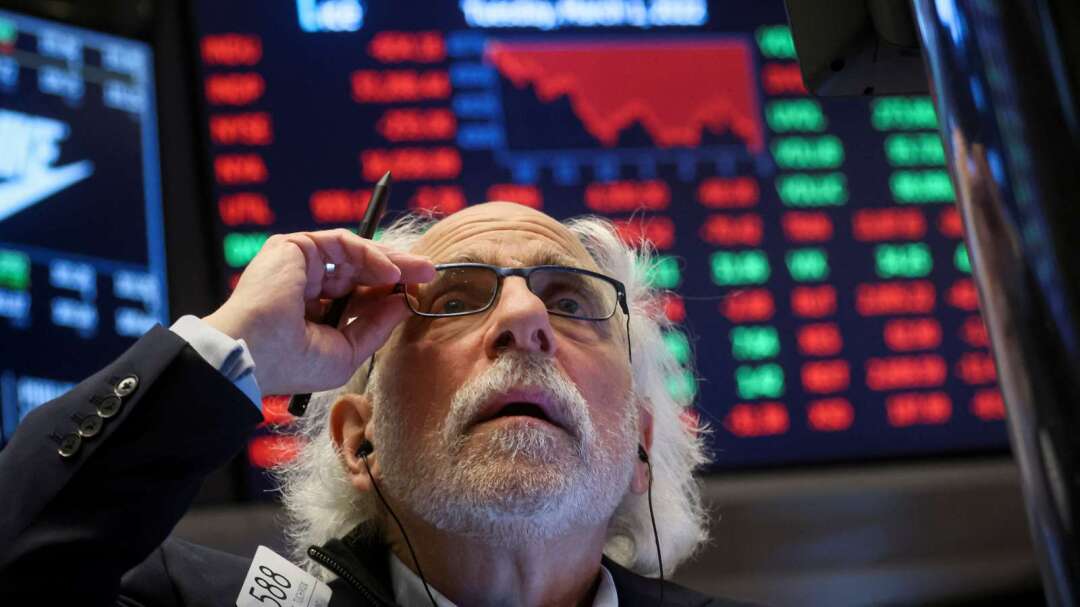
Michael Burry, the real-life inspiration behind 'The Big Short' and a renowned investor, recently issued a warning on his Substack platform about a potential risk in the US stock market that most investors have overlooked — an automated chain reaction of selling triggered by volatility-targeting trading strategy funds, which could lead to a rapid stock market crash.
According to a report by Business Insider, Burry pointed out that if such a sell-off wave erupts, it could result in a 'bloodbath' for related holdings.
He used the recent sharp decline in momentum stocks as an example to illustrate how such a scenario might unfold. Momentum stocks refer to shares that have previously surged rapidly in price. In recent weeks, as investors have taken profits and pulled capital out of high-flying memory and chip stocks, momentum stocks have seen a clear downturn.
The iShares MSCI USA Momentum Factor ETF (MTUM-US), which tracks these stocks, has already dropped 14% from its recent peak.
Burry warned in his post: 'This will leave a bloody mess, but most people didn’t see it coming.'
He believes that Wall Street’s volatility-centric automated trading funds are becoming a major issue in today’s market, as market volatility has clearly increased compared to the past.
Burry specifically noted that the market’s reaction during downturns seems particularly severe. The so-called 'extra panic' indicator — reflecting 'disproportionate overreactions' on down days — has now climbed to its highest level in 98 years.
On the other hand, the market’s rebound speed after sharp sell-offs has also become much faster than in the past. Burry believes this suggests that much of the market’s volatility is now being driven by automated trading algorithms.
He wrote: 'Data shows that today’s investors are more easily unsettled by smaller losses, more inclined to buy the dip intraday, and more likely to experience severe market chaos compared to the past.'
Burry emphasized that no 'real' human investor would operate this way. In other words, he believes the market’s behavior no longer resembles that of human traders, but increasingly reflects algorithmic or automated trading systems taking control.
Burry further outlined several possible scenarios to explain how volatility-focused funds, especially those operating with high leverage, could trigger a significant and sudden market pullback.
He illustrated that even a modest 2.5% decline in the S&P 500 index could prompt volatility strategy funds to reduce their equity exposure from 77% of assets to around 50%, highlighting how downside risks could be greatly amplified.
Based on Burry’s analysis of S&P 500 futures contracts, funds operating on volatility-based strategies currently manage approximately $500 billion in assets.
While this figure appears insignificant compared to the $60 trillion US stock market, Burry warns that if these automated trading programs sell simultaneously, the impact on the market could still be substantial.
He also stated that if traditionally stabilizing passive investors begin selling as well, the downturn could worsen further.
Regarding the potential for volatility strategy funds to unwind positions en masse, Burry wrote: 'This will be an extremely powerful force, releasing various momentum impulses into the market, further amplified by other market participants.'
He added that this selling pressure could trigger a wave of stop-loss orders or risk management mechanisms, exacerbating the market decline. However, based on historical experience over the past decade, the market will ultimately 'recover faster than before.'
Burry, who has recently maintained a bearish stance on chip and AI-related stocks, has repeatedly warned that risks accumulated during this bull market are gradually increasing — especially as more investors begin to question whether the AI investment frenzy is sustainable.
He has also recently highlighted risks lurking in the US private credit market and warned of cyclical trading patterns within the AI industry, particularly transaction structures tied to NVIDIA (NVDA-US), which could become a hidden market concern.
FACT BOX
- Source: PR Times
- Category: News
- Organizations: NVIDIA
- Products / services: MTUM-US ETF