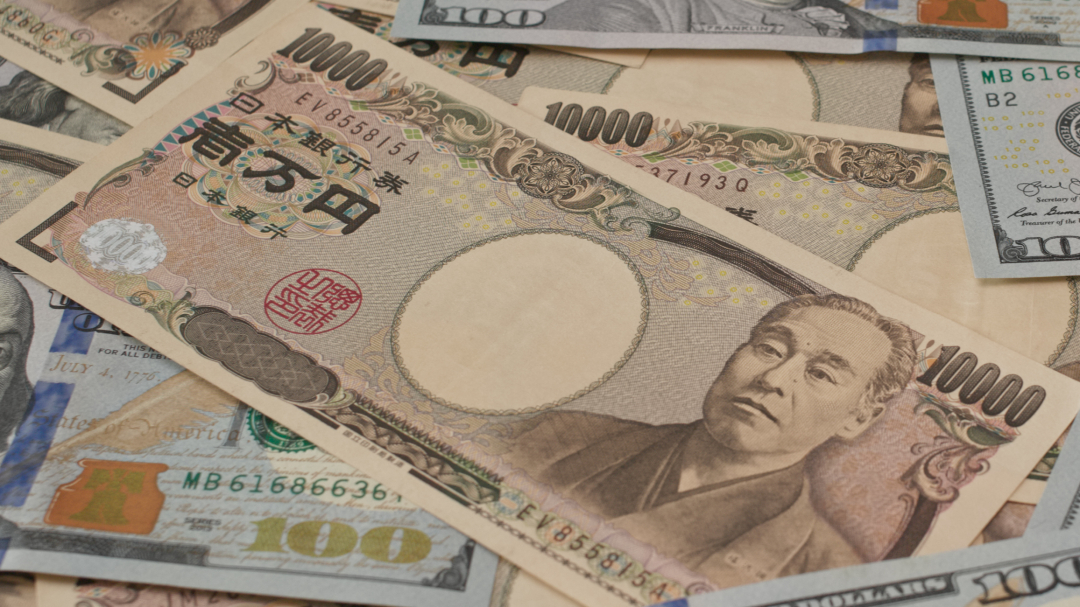
Since the beginning of the year, as the yen continues to weaken and the US-Japan interest rate differential widens once more, the scale of 'borrow yen, buy dollar assets' carry trades has clearly rebounded. Japan's offshore financial account net assets surpassed their end-2024 peak in May, reaching 95 trillion yen.
According to data from the Chicago Mercantile Exchange (CME), non-commercial net short positions on the yen against the dollar were approximately 150,000 contracts at the end of last month, exceeding 80% of the July 2024 high. The concentration level is approaching the extreme levels seen two years ago that triggered a global stock market crash.
Japan recently joined forces with the United States to intervene in the foreign exchange market, deploying an estimated 8.45 trillion yen (over $50 billion), pushing the USD/JPY exchange rate down from a high of 163 to around 157. Shorts were severely hit but not dismantled.
Currently, the market is concerned whether a carry-trade collapse similar to August 2024 might reoccur. Mainstream institutions judge the probability of a short-term reversal as low, but 'triggered unwinding' under excessively concentrated positions remains the biggest tail risk for global capital markets in the second half of this year.
Experts believe three logics support the 'low reversal risk.' First, the macro environment differs from August 2024 (when weak US non-farm payrolls caused a surge in rate cut expectations). Currently, the US economy maintains resilience, and a secondary rebound in oil prices has slowed the decline in inflation. The Federal Reserve (Fed) held rates steady at 3.5%–3.75% last Wednesday (July 29) by a vote of 9 to 3, with hawkish voices within the Fed still strong. The US dollar and long-term Treasury yields remain prone to strength rather than weakness, keeping the carry trade spread (approximately 250–275 basis points between the US and Japan) attractive.
Second, the current pullback in tech stocks reflects valuation digestion after gains and portfolio rebalancing, not the debunking of the AI narrative or deterioration in US fundamentals. Risk appetite has not sharply reversed, so it does not currently create pressure for concentrated unwinding.
Third, yen weakness is not purely due to carry trades. Instead, Japan’s fiscal expansion has heightened concerns over debt sustainability, the market questions the Bank of Japan’s (BOJ) independence, and rising Middle Eastern oil prices are hurting Japan’s terms of trade through higher energy import costs. Structural depreciation momentum exists independently of carry trading.
However, 'low probability' does not mean 'no impact.' On Friday (July 31), the BOJ kept its interest rate unchanged at 1%. Governor Kazuo Ueda frankly acknowledged rising risks of inflation overshooting and enhanced exchange rate pass-through effects. A further rate hike within the year has become the baseline scenario. The European Central Bank (ECB) also stood pat last month, but uncertainty over a September hike remains. The Bank of England also remains divided, with a 6-to-3 hawkish split.
Experts point out that if any of the following three triggers emerge—a weaker-than-expected US economic data dragging down Treasury yields, a sharp drop in AI-related stocks increasing volatility, or a second large-scale intervention by Japan’s Ministry of Finance—highly crowded short positions could instantly reverse in a stampede, reenacting the August 2024-style cross-market deleveraging.
On the geopolitical front, repeated US-Iran conflicts around the Strait of Hormuz—which affects over 90% of Japan’s crude oil imports—could amplify market volatility through the transmission path of 'oil prices → inflation → US Treasury yields → yen'.
Overall, carry trades are currently in a state of 'decent returns, dangerous positioning.' Investors do not need to panic-unwind in the short term, but they should monitor three red flags: the US economic turning point, the BOJ’s pace of rate hikes, and the situation in the Strait of Hormuz, as short positions have already returned to near historical highs.
FACT BOX
- Source: PR Times
- Category: News