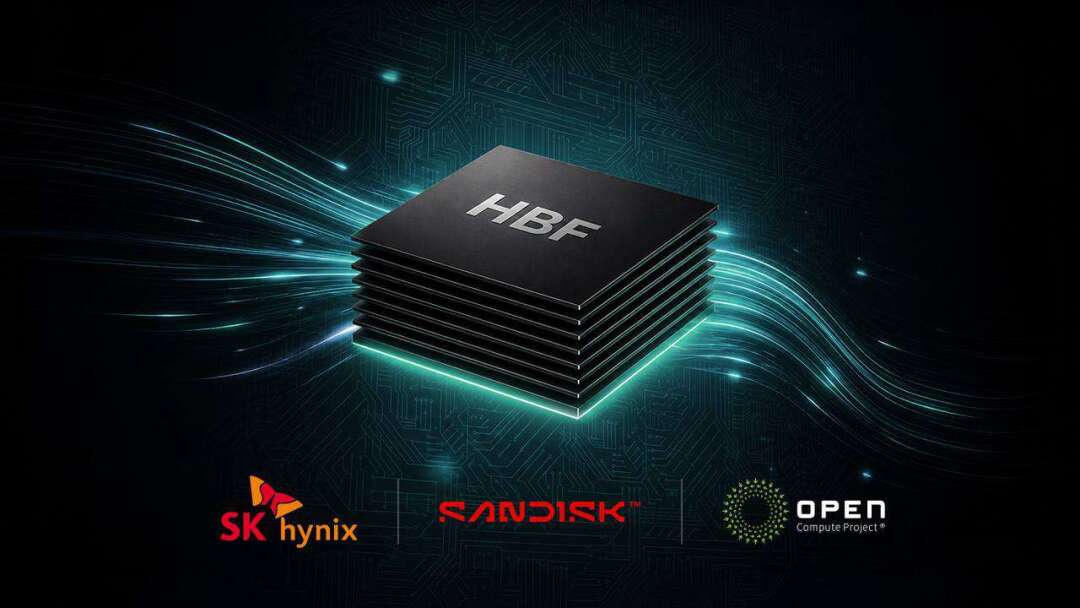
SK Hynix announced today (the 4th) that the company, in collaboration with SanDisk, has jointly released the first standard specification for High Bandwidth Flash (HBF), a next-generation storage technology.
SK Hynix and SanDisk initiated their standardization collaboration on HBF in August last year and formalized their alliance in February this year. After approximately six months of joint development, they have achieved the first specification, defining two capacity configurations using 8-layer and 16-layer NAND chip stacking, supporting up to 512GB of capacity. The bandwidth standard is set across three tiers (Tier 1 to Tier 3), with data transfer capabilities ranging from approximately 0.4TB/s to 3.0TB/s.
Notably, the industry-standard UCIe enables interconnection between HBF and processors, laying the foundation for flexible connections between HBF and various types of processors such as GPUs and CPUs. In addition, the specification covers interconnect interfaces and electrical characteristics, reliability and packaging guidelines for HBF chip stacking processes, and usage guidelines for data read/write software.
This specification has been officially published by OCP (Open Compute Project), the world’s largest open data center technology collaboration organization, becoming an open industry-wide standard rather than a proprietary corporate standard.
According to SK Hynix, HBF represents a new storage tier positioned between HBM and solid-state drives (SSDs), offering high-speed data transfer capabilities similar to HBM while significantly increasing capacity based on NAND Flash. Against the backdrop of widespread AI inference adoption and surging data processing demands, its advantages in high bandwidth and scalable capacity have attracted significant attention.
SK Hynix views this as an opportunity to accelerate the large-scale adoption of HBF in the AI storage market and expedite ecosystem construction. Currently, the HBF Alliance includes Google and Tenstorent. Going forward, the company plans to continue expanding the ecosystem through open collaboration while enhancing technological maturity and market acceptance.
With the rapid commercialization of agentive AI, the volume of data requiring processing is exploding, driving escalating demands for processing speed and efficiency. Under these circumstances, a single memory product can no longer meet requirements, making a 'tiered memory' architecture essential to integrate and optimize multiple memory devices with complementary functions.
Kim Chan-sung, Vice President at SK Hynix, stated, 'The rapid adoption of AI applications is driving a critical period of restructuring across the entire data processing architecture. Through HBF, we will break the boundaries between memory and storage, helping to build a new architecture that enhances overall system efficiency.'
FACT BOX
- Source: PR Times
- Category: Partnership
- Organizations: SanDisk / Google / Tenstorent
- Products / services: HBF (High Bandwidth Flash)