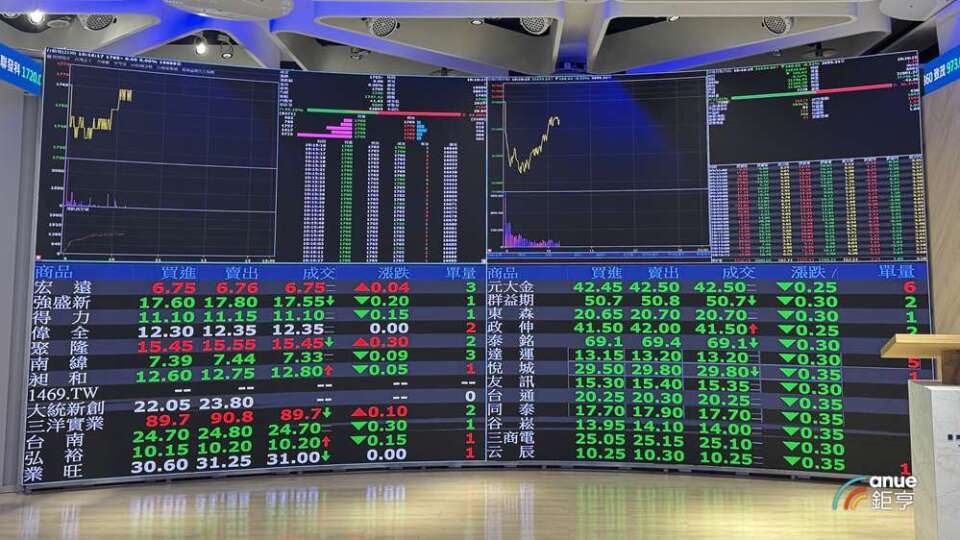
Last month, the Taiwan stock market experienced a sharp correction, briefly falling below the 40,000-point threshold. During this period, certain private platforms published estimated maintenance rates for individual stocks, sparking panic among investors about potential forced liquidations. In response, the Taiwan Stock Exchange (TWSE) issued multiple clarifications, emphasizing that the current regulatory framework calculates margin requirements based on investors’ consolidated credit positions—not individual stocks—and that there is no mechanism requiring margin calls or forced liquidations solely because a single stock’s maintenance rate drops below 130%.
Today (4), the Financial Supervisory Commission (FSC) reinforced this stance, declaring 'no cover-up, only full disclosure.' It has instructed the TWSE to consolidate the most critical data points closely monitored by investors—including margin balances and consolidated collateral maintenance rates—into a publicly accessible 'dashboard.' This platform is scheduled to go live by the end of the third quarter, significantly enhancing market transparency.
Regarding public concerns over credit transaction information and maintenance rate calculations, Huang Chung-hao, Deputy Director-General of the Securities and Futures Bureau, stated that the FSC’s approach to capital market oversight is grounded in the principle of providing investors with accurate, complete, and timely information, guided by the pillars of safety, transparency, and fairness. Key data such as margin balances, consolidated collateral maintenance rates, and short-selling ratios will be fully disclosed for investor reference. The TWSE is currently evaluating technical implementation and aims to launch the dashboard by the end of Q3 this year.
On whether historical data will be made available for retrospective analysis, Huang said this would be further discussed with the exchange after assessing data completeness. As for private institutions like CMoney, which previously removed大盘-level margin maintenance rate information, the FSC expressed respect for their independent decisions on how to compute and release such data.
Recently, some media outlets frequently cited 'collateral maintenance rates' published by private platforms, leading investors to mistakenly believe that any individual stock falling below 130% would immediately face forced liquidation. The TWSE has repeatedly issued press releases clarifying that no such mechanism exists under the current system—there is absolutely no rule stating that a single stock dropping below a 130% maintenance rate triggers automatic margin calls or liquidation.
Under existing regulations, credit transaction maintenance rates are calculated on a 'consolidated account' basis, combining both margin buying and short selling across all listed and OTC securities held by an investor, including all pledged collateral. Brokerages decide whether to issue margin calls or execute forced sales (liquidations) based solely on whether the investor’s overall account maintenance rate meets the required threshold—not on the performance of any individual stock.
Private platforms cannot access investors’ full portfolio composition, including actual holdings, margin/short positions, and other pledged collateral. Therefore, their estimated 'individual stock maintenance rates' do not reflect true credit risk. If investors rely on these figures for trading decisions, they risk misjudging market risks, increasing personal losses, and potentially causing unnecessary excessive volatility in individual stock prices.
FACT BOX
- Source: PR Times
- Category: News
- Organizations: CMoney