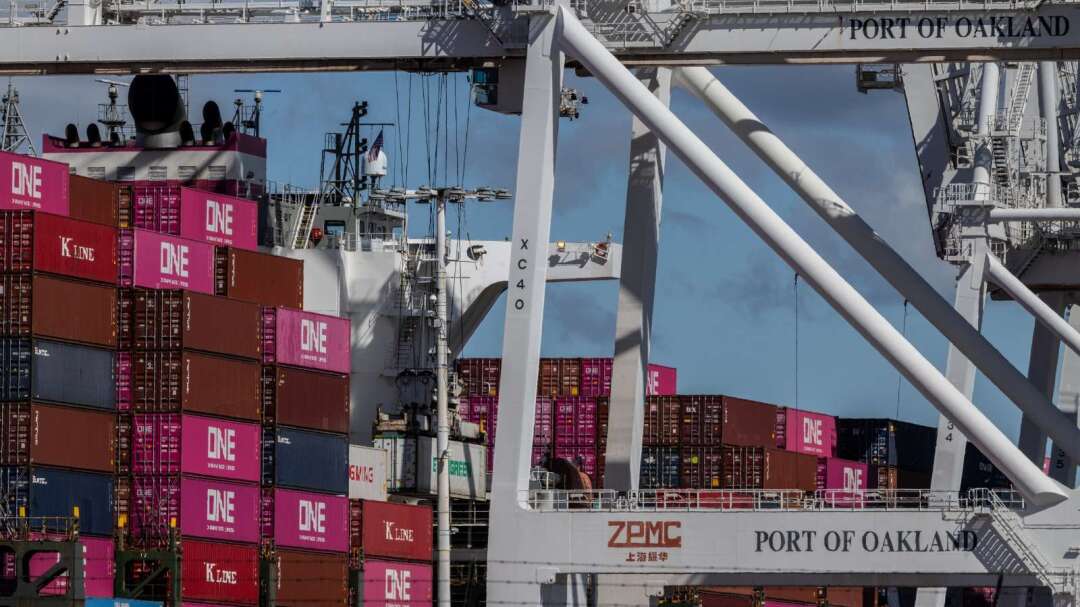
The U.S. trade deficit shrank in June as imports declined more than exports, but economists warn the trend may not be sustainable as companies continue investing in artificial intelligence (AI) infrastructure and depend heavily on overseas equipment. Net exports could continue to weigh on economic growth over the next few quarters.
On Tuesday (July 4), the U.S. Department of Commerce reported that the June goods and services trade deficit narrowed by 5.6% from May to $73.3 billion—slightly higher than the $73.0 billion forecast by Reuters economists. Imports fell 1.8% to $388.0 billion, marking the first decline since the beginning of the year. Exports decreased 0.9% to $314.7 billion.
After inflation adjustment, the real goods trade deficit in June narrowed 5.3% to $94.5 billion. The U.S. government estimated last week that the trade deficit reduced second-quarter GDP growth by a full 1 percentage point. The U.S. economy grew at an annualized rate of 1.5% in the second quarter.
AI Equipment Imports Pause, But Year-to-Date Surge Continues
June goods imports dropped 2.5% to $309.0 billion, with capital goods imports falling $2..1 billion, driven by a $3.0 billion plunge in computer imports. Capital goods—including computers, peripherals, and semiconductors—recorded their first decline since September last year, signaling a slight cooling in corporate demand for AI-related equipment at the end of Q2.
However, U.S. computer imports so far this year are still up $95.4 billion compared to the same period in 2025, reflecting aggressive corporate expansion of data centers and AI infrastructure, and strong ongoing demand for foreign technology products. Telecommunications equipment imports also rose $1.1 billion in June.
Troy Durie, economist at Bloomberg, said the drop in nominal imports in June indicates a slight slowdown in U.S. domestic demand growth at the end of Q2, particularly evident in capital goods and AI-related products. Yet, he noted that rising consumer and corporate spending on AI infrastructure continues to drive domestic demand at its fastest pace since Q1 2023.
Priscilla Thiagamoorthy, Senior Economist at BMO Capital Markets, pointed out that the June deficit reduction was primarily due to weaker imports. While welcome, she expects net exports to continue dragging on GDP growth over the coming quarters.
Sharp Drop in Energy Exports; Widening Deficits with Multiple Countries
June goods exports fell 1.9% to $206.9 billion, with industrial supplies and materials down $3.3 billion, mainly due to weaker petroleum products. Crude oil export revenue dropped $5.7 billion as the average export price fell from $107.82 per barrel in May to $95.82. Fuel oil exports also declined by $1.6 billion.
Capital goods exports fell $0.6 billion, with computer exports down $1.1 billion. In contrast, non-monetary gold exports rose $3.4 billion, continuing the volatility seen since early last year.
Services exports increased $1.1 billion to $107.8 billion, boosted by financial and trade-related services. With the World Cup underway, foreign visitor spending in the U.S. rose for the second consecutive month, lifting travel services exports by 2.4% to their highest level since early 2025. Services imports rose $0.6 billion to $79.0 billion, reflecting higher payments for intellectual property royalties, transportation, and insurance.
By country, the U.S. goods trade deficit with China widened from $14.5 billion in May to $15.3 billion. Deficits with Mexico, Vietnam, and South Korea hit record highs. The U.S. also continued running goods trade deficits with Canada, Germany, India, Malaysia, Japan, Ireland, Italy, France, and Israel.
Despite the Trump administration’s aggressive imposition of import tariffs, trade deficits have not significantly disappeared. With ongoing tariff policy shifts, Middle East conflicts disrupting supply chains, and AI investment boosting import demand, U.S. trade data is expected to remain highly volatile in the near term.
FACT BOX
- Source: PR Times
- Category: News
- Organizations: BMO Capital Markets