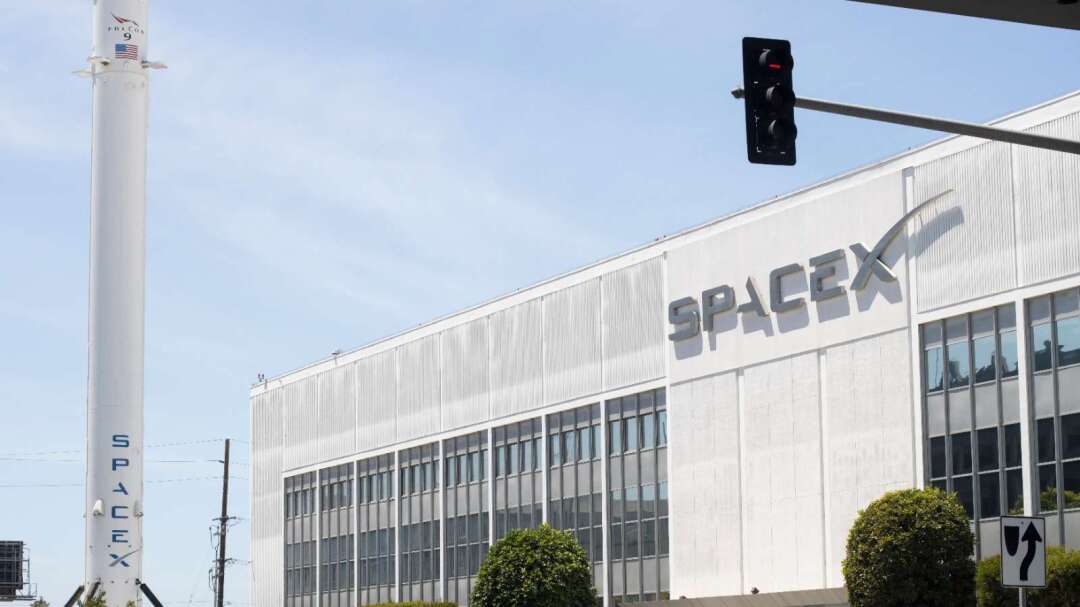
SpaceX (SPCX-US) released its first financial report since its record IPO in June on Tuesday (August 4) after U.S. market close. Second-quarter revenue beat market expectations, but the stock declined after hours due to a significant increase in capital spending. At the time of reporting, shares were down more than 6%.
In a statement released Tuesday, SpaceX reported second-quarter revenue rose 92% year-over-year, increasing from $4.1 billion a year earlier to $7.81 billion. Net losses narrowed from $1 billion to $541 million over the same period.
Q2 Key Financials vs. LSEG Estimates:
Revenue: $7.81 billion vs. $6.93 billion
Loss per share: $0.09 vs. $0.26
This marks the first time Elon Musk’s reusable rocket company has delivered results as a publicly traded entity to Wall Street, and investors have remained cautious. Since its June 12 IPO at $150 per share, SpaceX’s stock has fallen approximately 16% as of Tuesday’s closing price.
All Three Core Businesses Exceeded Revenue Expectations
SpaceX lost $4.9 billion last year, primarily due to heavy investments in AI infrastructure. The company completed a merger with xAI in February, stating its goal was to build data centers in space. However, even its space launch business, which secures major contracts from NASA, remains unprofitable.
SpaceX’s primary source of profit continues to be its satellite internet service, Starlink. The service is offered not only to individual consumers but also to government and military agencies.
Q2 Key Business Revenue vs. StreetAccount Estimates:
Space Launch: $962 million vs. $835 million
Connectivity Services: $4.29 billion vs. $3.83 billion
AI Business: $2.56 billion vs. $2.18 billion
However, space launch operations posted an operating loss of $542 million, and AI operations recorded an operating loss of $1.26 billion. Connectivity services generated an operating profit of $1.66 billion, remaining the company’s only profitable segment.
AI Capital Expenditures Surge Over 6x
Second-quarter capital expenditures reached $18.37 billion, more than six times higher than the same period last year. Of this, $15.83 billion was allocated to AI-related infrastructure.
Total capex also exceeded the $13.22 billion average analyst estimate compiled by FactSet.
Following recent earnings reports from Alphabet (GOOGL-US), Meta (META-US), Microsoft (MSFT-US), and Amazon (AMZN-US), the market is closely watching whether AI investments by tech giants continue to rise rapidly.
Annual Recurring Revenue (ARR) Could Exceed $100 Billion This Year
During the earnings call, SpaceX CFO Bret Johnsen said the company expects its annual recurring revenue (ARR) to surpass $100 billion by year-end.
He revealed that within the first few weeks of the quarter, the company secured $6.7 billion in new cloud service contracts, with a six-month term. Revenue recognition will begin gradually from October this year.
Johnsen noted that the full-year ARR forecast also includes revenue contributions from Cursor.
He added that SpaceX’s capital allocation efficiency is very high, and AI investment payback is extremely fast. "Not all capital expenditures are the same. In the AI compute space, the way we deploy capital results in a payback period of less than one year."
He further explained that due to the extremely rapid pace of equipment upgrades, some capital expenditures may increasingly resemble cost of goods sold (COGS) in the future.
Musk Envisions Starlink as a Global Internet Provider
During the earnings call, Musk passionately promoted Starlink’s future. "It’s not impossible that one day Starlink provides most of the world’s internet services—at least in most countries where we’re allowed to operate."
He believes this goal could be achieved within the next decade.
According to SpaceX, Starlink currently has 12 million subscribers, double the number from a year ago and up 17% from Q1. However, average revenue per user (ARPU) is $66, unchanged from last quarter but significantly down from $85 a year ago.
In its IPO prospectus, SpaceX listed over 20 Starlink competitors, including Amazon, Blue Origin, Viasat (VSAT-US), AT&T (T-US), and T-Mobile (TMUS-US). Some of these competitors are also SpaceX customers, using its rockets to launch their satellites into orbit.
SpaceX President Gwynne Shotwell expressed being "very optimistic" about Starlink’s growth in enterprise and government markets.
Musk also acknowledged that Starlink’s early network quality was indeed unstable but said it now offers "excellent system availability and extremely low latency," allowing enterprises and government agencies to treat Starlink as a primary internet provider, not just a backup.
Partnering with NVIDIA to Build a Space-Based AI Data Center
SpaceX recently announced a collaboration with NVIDIA (NVDA-US) to jointly develop "space computing" technology, aiming to deploy AI models and services on orbital satellites.
The two companies will co-design the Starmind AI1 satellite computing module. SpaceX stated that each satellite will be equipped with "NVIDIA Rubin GPUs and Vera CPUs, delivering data center-class AI computing power in space."
Notably, in January, NVIDIA participated in xAI’s $20 billion funding round, acquiring equity. This stake was converted into SpaceX shares following the merger between SpaceX and xAI.
FACT BOX
- Source: PR Times
- Category: 財務報告
- Organizations: NVIDIA / Alphabet / Meta
- Products / services: Starlink / Space Launch