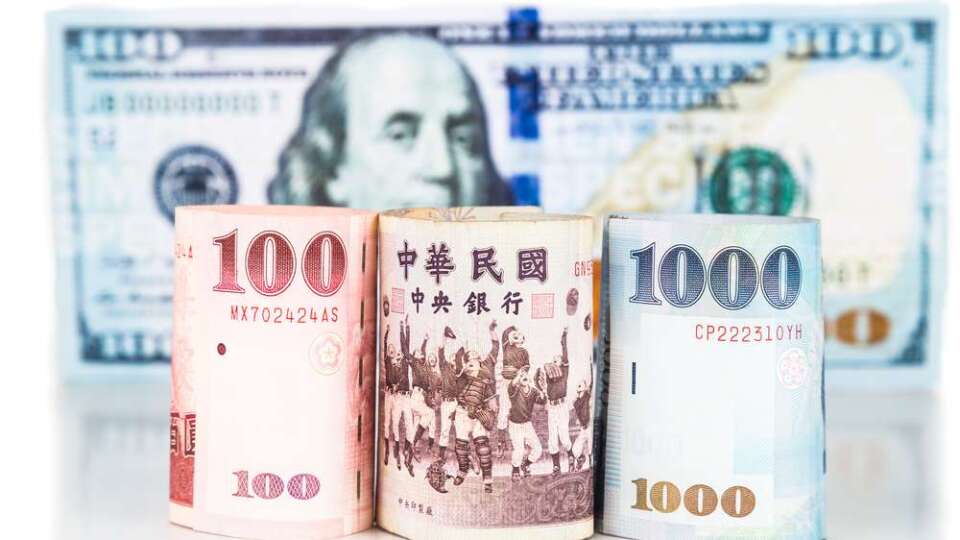
Growing optimism that the United States and Iran may soon reach an agreement to reopen the Strait of Hormuz has led to a sharp decline in international oil prices. As a result, hot money is flowing back into Asia, pushing both Taiwan’s stock and foreign exchange markets upward today (5th). The New Taiwan Dollar (TWD) against the U.S. dollar surged by as much as 1.7 jiao during the session, briefly reaching 32.274 TWD/USD. Though gains narrowed toward the close, the currency ended at 32.315, marking a 1.32-jiao appreciation. Total trading volume in Taipei and Yuanta’s foreign exchange markets reached USD 2.8395 billion.
With geopolitical tensions in the Middle East showing signs of easing, the U.S. dollar weakened and foreign institutional investors returned to buy a net TWD 90.3 billion worth of Taiwanese stocks—the third-largest single-day purchase in history. The weighted index rose 1,250.94 points to close at 44,611.6. TSMC, the market heavyweight, gained TWD 85 to end at TWD 2,405.
Amid the influx of capital, the TWD/USD rate broke through key resistance levels of 32.4 and 32.3 during the day, peaking at 32.274—more than a 1.7-jiao gain. It settled at 32.315, appreciating by 1.32 jiao.
Looking at major Asian currencies’ performance against the U.S. dollar today, according to central bank data, the South Korean won led with a 0.5% gain, followed by the New Taiwan Dollar at 0.41%, the Singapore dollar at 0.13%, the Chinese yuan up 0.08%, and the Japanese yen rising slightly by 0.06%. Most Asian currencies strengthened across the board.
Following coordinated intervention by the U.S. and Japan in the forex market, the Japanese yen surged over 2% on Monday. After a slight pullback yesterday, it traded sideways today. On Tuesday, U.S. Treasury Secretary Bessent stated that prolonged weakness in the yen could destabilize markets across Asia and potentially trigger competitive devaluations among other currencies. Therefore, the Trump administration would 'spare no effort' to support Japan in stabilizing its currency, provided it benefits the U.S. economy.
FACT BOX
- Source: PR Times
- Category: News