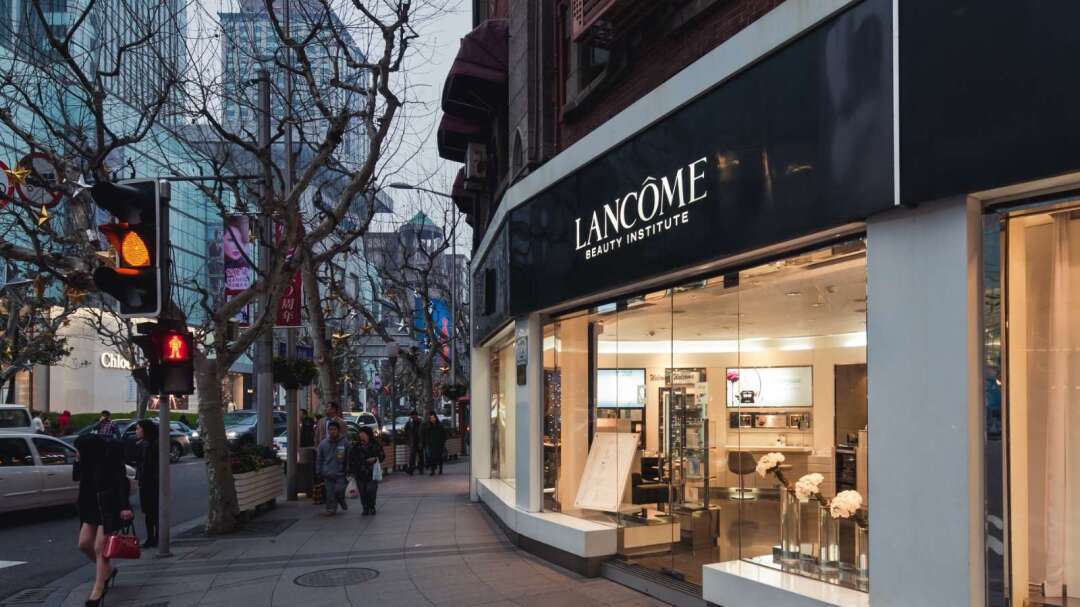
The former Lancôme global flagship store on the first floor of Beijing's Wangfujing APM is now sealed shut, with its 320-square-meter space completely vacated. Only dismantled display racks and cables remain inside.
Adjacent to the storefront, construction barriers bearing the outdoor brand SALOMON's logo have been fully erected, signaling that this once high-profile beauty landmark is about to change hands.
Lancôme China's official customer service confirmed on Wednesday the 5th that the store is indeed no longer operational and officially closed at the end of July. Whether the brand will open another store of similar scale at a different location has not yet been disclosed.
According to Jiemian News, information about the Beijing APM store can still be found on Lancôme's official WeChat account. However, calling the phone number listed on the page results in no answer or a disconnected line. Selecting 'Add Beauty Consultant' yields no contact information. In contrast, choosing another Wangfujing store shows multiple beauty consultants available for WeChat consultation.
The Beijing APM store was Lancôme’s second global flagship store after the Champs-Élysées store in Paris and the first in the Asia-Pacific region. From its official opening during China’s National Day in 2020 to its closure, it operated for less than six years.
However, apart from the APM store, Lancôme continues to operate normally at counters in major Beijing malls such as Han Guang Department Store, SKP, and New World Mall. Across China, Lancôme maintains an extensive offline counter network. Its membership system and after-sales services operate independently from individual stores, allowing customers to enjoy equal benefits at any counter or official online channel nationwide using their membership accounts.
Compared to regular mall counters, ultra-large standalone flagship stores incur significantly higher rental costs. The number of beauty consultants required is two to three times that of standard counters, and ongoing expenses for space renovations and operational materials add to the burden. Sustaining operations long-term requires bearing substantial fixed costs.
As more and more consumers shift to online shopping, the sales function of large physical stores is inevitably weakened, leaving only brand display value. The return on investment continues to decline.
Analysts believe that the future of high-end beauty retail will move beyond the era of blindly pursuing large-scale flagship stores. Brands will place greater emphasis on sales per square meter and customer conversion rates when selecting locations. Store formats will transition toward smaller experiential counters, with landmark flagship stores selectively established only in a few core cities.
Moreover, offline store performance will no longer be measured solely by foot traffic or social media check-in popularity. Metrics such as online-offline member integration, private domain customer retention, and conversion from new product experiences will become more important.
FACT BOX
- Source: PR Times
- Category: News
- Organizations: SALOMON