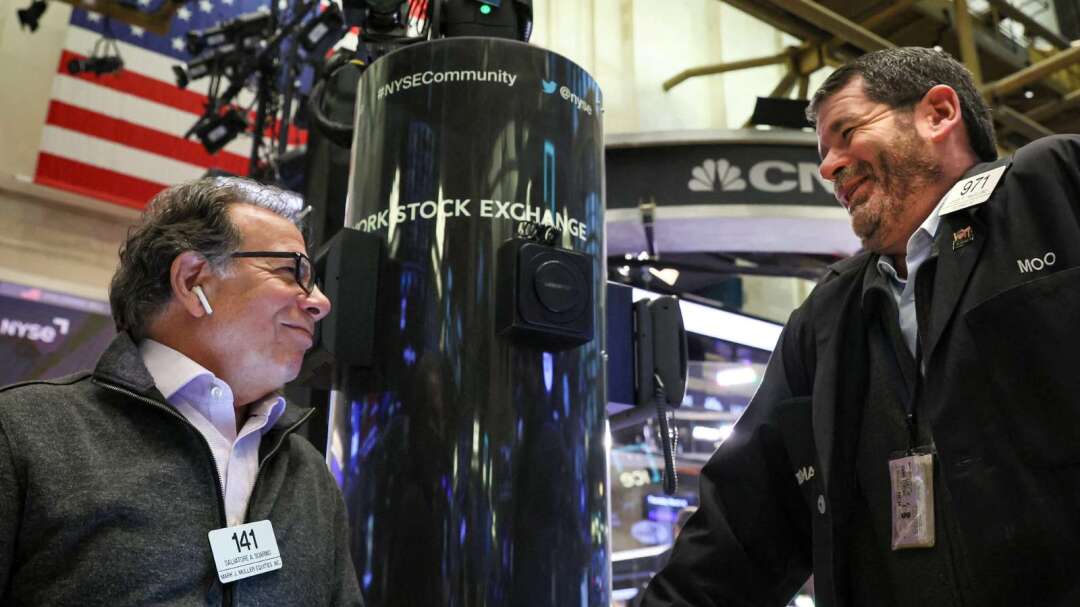
Wall Street surged on Tuesday (August 4), with the S&P 500 index hitting 7700 for the first time. Experts say this rally wasn't driven by a single factor, but by five positive catalysts aligning simultaneously.
The Dow Jones Industrial Average jumped over 900 points on Monday, marking its best single-day performance in nearly two months. The S&P 500 surged nearly 2%, closing at another record high — one of the strongest daily gains so far this year.
Paul Hickey, co-founder of Bespoke Investment Group, said: "This rally isn't driven by a single event, but by a series of positive catalysts reinforcing each other. When multiple favorable factors converge, the rally tends to be more sustainable."
CNBC outlines the five key reasons behind Tuesday's strong U.S. market rally:
1. Yellen Signals Progress in Iran Talks
U.S. Treasury Secretary Scott Bessent, in a CNBC interview before Tuesday's market open, said the U.S. and Iran could reach an agreement as early as Tuesday or Wednesday to reopen the Strait of Hormuz.
He stated: "We are negotiating with Iran, and an agreement to reopen the Strait of Hormuz and move toward normalization of tensions could happen today or tomorrow."
Following the news, Dow futures immediately rose, crude oil prices plunged, and U.S. Treasury yields declined, further supporting the equity rebound.
Jeff Krumpelman, Chief Investment Strategist at Mariner, said the market is betting that even if the Strait reopens, global energy supply will recover smoothly, and oil prices will stabilize in the long term.
However, he warned that if the Iran conflict escalates and oil prices rise to $150 per barrel, it could still pose significant pressure on markets.
Larry Tentarelli, Chief Technical Strategist at Blue Chip Daily Trend Report, also noted that markets will remain highly sensitive to Iran's situation. If tensions worsen again, investors should expect significant volatility.
2. Strong Earnings Season Performance
Corporate earnings have continued to serve as a key pillar supporting the U.S. bull market, with Q2 results far exceeding expectations.
Bank of America data shows that, excluding one-time factors from Alphabet (GOOGL-US) and Amazon (AMZN-US), S&P 500 companies are expected to report 27% year-over-year profit growth in Q2 — 4 percentage points above the initial market consensus at the start of earnings season.
Jay Woods, Chief Market Strategist at Freedom Capital Markets, said: "The negative impact of war risks has largely been priced in. What's now driving the market is corporate earnings."
Including Alphabet and Amazon, S&P 500 Q2 earnings growth reaches an even higher 45% year-over-year.
Krumpelman of Mariner added: "The market shouldn't focus only on tech stocks. Healthcare, industrials, financials, and consumer staples are all delivering strong double-digit profit growth, which will continue to support broader market gains."
Although Charles Schwab data shows that S&P 500 stocks on average still declined 0.2% the day after earnings, indicating some market caution, stocks like Caterpillar (CAT-US) and Palantir (PLTR-US) surged after their reports on Tuesday, signaling a shift in market sentiment.
3. Broad Tech Sector Rebound
AI-related stocks have shown clear divergence in recent months. Chipmakers led the rally earlier due to surging AI demand, while large cloud providers and software firms lagged due to high AI investment costs. In July, the trend reversed as chip stocks corrected sharply due to overheating valuations.
By August, investors began repricing the entire AI supply chain as beneficiaries. Tech stocks rose in unison: iShares Semiconductor ETF (SOXX-US) jumped over 6%, and iShares Expanded Tech-Software ETF (IGV-US) surged nearly 5%, pushing the Nasdaq Composite up over 2.5%.
The "Magnificent Seven" tech giants, which had lagged, rejoined the rally, with the Roundhill Magnificent Seven ETF (MAGS-US) rising nearly 1%.
However, MAGS is up only about 5% year-to-date, trailing the S&P 500's 13% gain, indicating relatively weak performance among large tech stocks recently. Analysts say the sharp correction attracted bargain hunters.
4. S&P Breaks Key Technical Resistance
Technical factors are now a major driver. Markets closely watched whether the S&P 500 could sustain above June's peak of 7620. On Tuesday, it opened above that level and closed above 7700 for the first time, setting a new record high.
Hickey of Bespoke noted that the Nasdaq rising over 1% for four consecutive days historically signals real capital inflow, not just a short-term bounce.
Krumpelman of Mariner forecasts the S&P 500 could reach 8100 by year-end and even challenge 8400 by mid-2027. He said: "As long as fundamentals like corporate earnings, inflation, employment, GDP, and credit spreads remain positive, I won't change my target."
5. The 'Aschenbrenner Effect' Fades
Market participants also attribute the rebound to the liquidity crisis at AI hedge fund Situational Awareness, founded by Leopold Aschenbrenner. The fund's assets peaked near $45 billion in July, heavily invested in memory and AI momentum stocks.
However, under pressure, Aschenbrenner was forced last week to sell leveraged holdings to Citadel.
Overall, momentum investors significantly de-leveraged by late July, completing a technical cleansing. With capital reallocation, the Nasdaq-100 attracted bargain-hunting inflows after correction.
Jeff Kilburg, CIO of KKM Financial, dubbed this low point the "Leopold Bottom."
He said: "Over the past two weeks, before Aschenbrenner was forced to sell, AI momentum stocks faced algorithmic selling unlike anything I've ever seen. Now those disruptive factors are gone, and the market focus has returned to corporate earnings growth — which is at its best pace in decades."
After Tuesday's surge, the S&P 500 is up 3.3% for the month, and the Nasdaq Composite has soared nearly 5% in just two trading sessions.
FACT BOX
- Source: PR Times
- Category: News
- Organizations: Alphabet / Amazon / Palantir