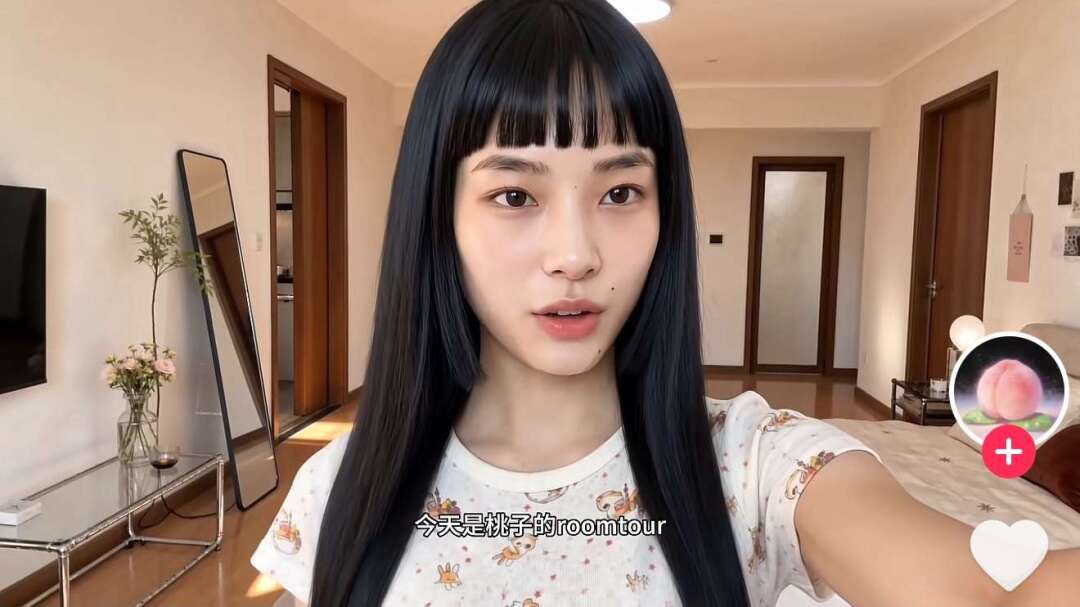
In the summer of 2026, the biggest game-changer in China's entertainment industry is a girl who has never truly existed.
"Is this really AI?" Similar comments repeatedly appear in Fang Taozi's Douyin comment section.
On screen, the girl shares snippets of her new home, work routines, cooking sessions, and her pet puppy with fans. Each lifestyle video easily garners over 10,000 likes, with fans interacting in the comments, discussing plot developments, and urging for updates.
Without the "AI-generated" label beneath the captions, she would appear indistinguishable from any ordinary content creator.
Fang Taozi, the female lead of the AI short drama 'The Girl Who Got Laid Off,' has gained 412,000 followers on Douyin in less than two months. The male lead, Zhou Yiheng, has also surpassed 130,000 followers. The hashtag #TwoAIActorsMorePopularThanChina'sRisingStars even trended on Weibo.
According to Ke Chuang Ban Daily on Wednesday the 5th, follower count is merely superficial. What truly shocks the industry is Fang Taozi's commercial value. Data from Xingtu shows her pricing: RMB 168,000 (approx. USD 23,000) for 1–20 second videos, RMB 208,000 (USD 28,500) for 21–60 seconds, and RMB 258,000 (USD 35,300 / NT$1.23 million) for videos over 60 seconds. These rates exceed those of numerous real influencers with millions of followers—and even surpass some with tens of millions.
Fang Taozi has already completed a commercial shoot for a colored contact lens brand, marking her transition from fictional character to independent commercial IP.
Virtual idols are not new. Names like Hatsune Miku, Luo Tianyi, and A-SOUL have existed for over a decade. Their operational logic is largely consistent: born on stage or in livestreams, they build fan relationships through fixed personas and performances.
But Fang Taozi’s path is different. She debuted as the protagonist of an AI short drama, then extended her in-character persona into real social media spaces. In the story, she’s a dream-chasing girl navigating a big city alone; outside the narrative, she shares breakfasts, workouts, and exhibition visits just like any regular influencer.
Dark circles and facial imperfections—these "imperfections" actually enhance the AI character’s realism. Fans aren’t just following a storyline—they’re following this person.
Data confirms the explosive power of this AI stardom model. By late July, 'The Girl Who Got Laid Off' had surpassed 220 million views on a single platform, with over 800 million related topic discussions across the web.
As of the 4th, Fang Taozi’s Douyin followers reached 412,000, while Zhou Yiheng exceeded 130,000. Many market voices believe this phenomenon symbolizes the arrival of the "Virtual Idol 2.0 era."
Zhang Chenkai, Managing Director at CIC Thinker, stated that the key difference between AI short drama characters and traditional virtual idols lies in character development and user connection: "Traditional virtual idols mainly rely on stage performances and fixed personas to build fan relationships. AI short drama characters, however, attract users through storytelling and emotional resonance, and maintain ongoing operations via social accounts, transforming user relationships from one-way following to interactive, participatory, and companion-like connections."
"AI not only enhances content production and operational efficiency but also drives virtual characters from relatively static images toward more personalized, interactive roles. This enables deeper connections with users and expands into diversified commercial scenarios such as advertising, brand collaborations, and gaming," Zhang added.
FACT BOX
- Source: PR Times
- Category: News