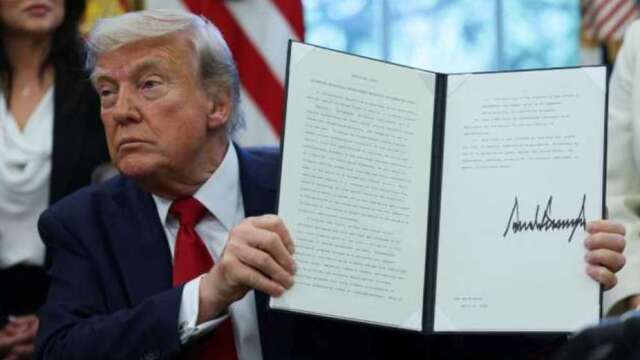
U.S. President Donald Trump signed a proclamation on Thursday (6th), invoking Section 232 of the Trade Expansion Act of 1962 to impose a 15% tariff on imported polysilicon (polysilicon) derivative products, while simultaneously establishing minimum import prices, arguing that U.S. overdependence on foreign supply poses a threat to national security.
The new measures will take effect on December 4. According to the proclamation, imported polysilicon derivative products—including silicon wafers, solar cells, and solar modules—will be subject to the 15% tariff.
The proclamation also sets minimum import prices: $21 per kilogram for polysilicon, $100 per kilogram for polysilicon ingots and silicon wafers, $0.22 per watt for solar cells, and $0.38 per watt for solar modules.
Polysilicon is an ultra-high-purity silicon material and serves as the upstream raw material in the supply chains of both the semiconductor and solar energy industries. Manufacturers first process it into silicon wafers, then into solar cells, and finally assemble them into solar modules.
Following the announcement, shares of U.S. solar manufacturers rose after hours. First Solar (FSLR-US), the largest U.S. solar manufacturer, surged up to 8%, while T1 Energy (TE-US) gained 6.3%.
Trump's move primarily targets competition with China, aiming to support domestic U.S. production of polysilicon and related products and build a complete American solar supply chain.
The U.S. was once a major global producer of polysilicon during the early to mid-2000s, but Chinese companies rapidly rose thereafter, becoming the world’s largest supplier by the late 2010s. Over the past decade, the U.S. has repeatedly attempted to rebuild its solar manufacturing capacity, with limited success.
In recent years, the U.S. has imposed multiple anti-dumping and countervailing duties on solar equipment from China and some Southeast Asian countries, accusing overseas producers of circumventing tariffs by shifting production locations.
However, the new tariffs may increase the cost of solar modules, adding further pressure on renewable energy developers who are already facing the expiration of federal subsidies and having to adapt to Trump administration policies favoring fossil fuels.
Providing Investment Incentives to Encourage Onshoring of Manufacturing
Trump also directed the Department of Commerce to establish an investment incentive mechanism to encourage companies to set up polysilicon and derivative product factories in the U.S.
Under the executive order, the Secretary of Commerce may enter into individual investment agreements with companies to provide incentives. Companies proposing and approved for 'onshoring' plans may also be exempted from new tariffs on certain production equipment and raw materials.
Jon Toomey, President of the Coalition for a Prosperous America, said: 'This is the first time the U.S. has protected the entire solar supply chain through a single policy while rewarding companies investing in U.S. manufacturing—a crucial step toward strengthening the domestic semiconductor supply chain.'
However, the delay in implementation until December has drawn criticism from some U.S. manufacturers. They argue that this window allows renewable energy developers to import large quantities of low-cost products and build up tariff-free inventories.
In response, Trump stated in the proclamation that the government will continue monitoring trade flows and will take restrictive measures if companies are found stockpiling polysilicon or related products.
FACT BOX
- Source: PR Times
- Category: News
- Organizations: First Solar / T1 Energy