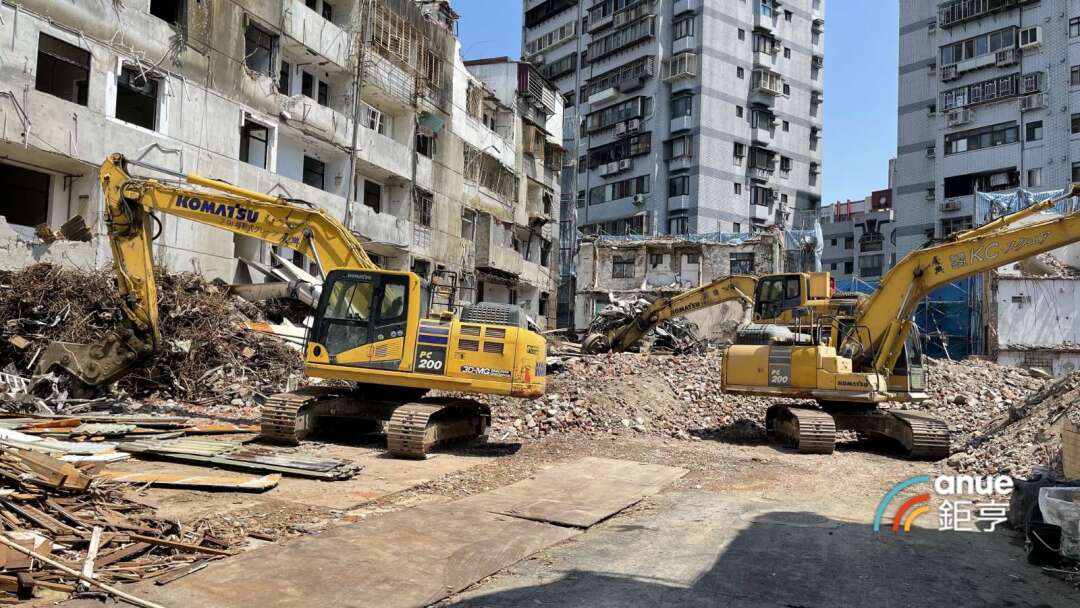
Housing transactions across Taiwan have clearly contracted, and urban renewal progress has noticeably slowed. According to real estate agencies compiling the latest statistics, a total of 1,846 residential demolition permits were issued across Taiwan in the first half of the year, a 17.8% decline year-on-year and the lowest for the same period since 2021. However, Taichung City issued 218 residential demolition permits in the first half, a 60.3% increase compared to the same period last year, leading all six major cities in growth.
Lai Chih-chang, Assistant Public Relations Manager at Da-Jia Housing’s Planning and Research Department, analyzed that as the Urban Renewal and Disaster-Prone Building Reconstruction Act (commonly known as the 'Dangerous and Old Buildings Act') approaches its sunset date, combined with a weak housing market outlook and soaring construction costs, developers’ willingness to consolidate urban renewal projects has declined, leading to a gradual cooling of the residential demolition and reconstruction boom.
Data shows that the peak for residential demolition permits across Taiwan in the past decade occurred in 2023, when 2,726 units were demolished in the first half alone. However, the momentum gradually weakened afterward. Although there was a brief resurgence in 2025, the first half of this year saw another significant downturn. As of June, only 1,846 residential demolition permits were issued, 400 fewer than the 2,246 issued in the same period last year—a 17.8% decrease. Compared to the 2023 peak, the decline reaches 32.3%.
Lai believes the sharp drop in demolition permits is due to several factors: the 'Dangerous and Old Buildings Act' is set to expire at the end of May 2027, gradually reducing incentives; housing market demand has weakened; construction costs remain high; and financing conditions for construction projects have tightened. These factors have collectively reduced landowners’ and developers’ willingness to pursue urban renewal and dangerous building reconstruction projects. Although some local governments have recently proclaimed the arrival of a 'new era of large-scale urban renewal,' current conditions continue to keep demolition volumes low.
Examining data from the six major cities, New Taipei, Taipei, and Taichung together accounted for 1,429 residential demolition permits in the first half, representing 77.4% of the national total—indicating that urban renewal momentum remains concentrated in northern and central metropolitan areas. New Taipei City issued 731 demolition permits, a 31.2% year-on-year increase, marking the highest first-half figure since 2017 and surpassing Taipei City for the first time in the first half. In contrast, Taipei City issued 480 demolition permits, a 32.5% year-on-year decrease and the lowest for the same period since 2019.
Lai notes that Taipei City was long a leader in urban renewal, with over 1,200 residential demolition permits issued in the first half of both 2022 and 2023, clearly outpacing other metropolitan areas. However, integration challenges in Taipei’s prime areas have intensified, and most large-scale development sites suitable for redevelopment have already been consolidated, leading to a rapid decline in demolition permits over the past three years. Meanwhile, New Taipei City’s government has actively promoted urban renewal in recent years, adopting a more proactive stance in project approvals. The city also has numerous aging residential clusters in prime areas, increasing developers’ interest in redevelopment. Especially as Taipei’s integration efforts have cooled, the urban renewal landscape has gradually shifted toward New Taipei City.
In Taichung, data shows 218 residential demolition permits were issued in the first half, a 60.3% increase year-on-year—the highest growth rate among the six major cities. Lai Wan, Executive Assistant Manager at Jhong Shang Real Estate’s Central Region Office, believes Taichung has a large base of aging buildings. As central city development becomes saturated and prime land remains scarce, urban renewal has become a key focus for developers. Rising demand has gradually elevated Taichung’s status as a major urban renewal hub.
Lai Chih-chang warns that the real estate market currently faces stagnation, with cautious construction financing and persistently high construction costs, making smaller-scale projects with insufficient integration or lower profitability more likely to be delayed. However, despite the overall decline in demolition permits, large-scale urban renewal projects in prime locations—with complete site conditions, strong-brand developers, or high integration levels—will continue progressing as planned. This indicates the current reconstruction market has entered a phase dominated by regional concentration and large-scale projects, rather than a complete halt in urban renewal. In the future, if the housing market resumes an upward trend, construction cost increases moderate, or central and local governments introduce supportive policies, urban areas with urgent redevelopment needs could reignite the urban renewal market.
FACT BOX
- Source: PR Times
- Category: Survey