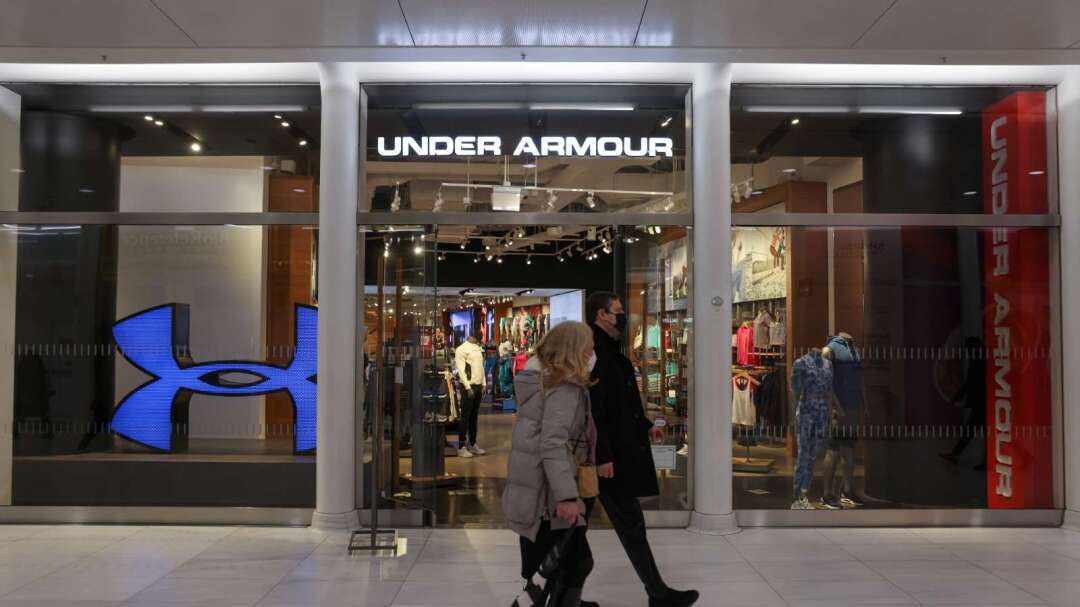
Athletic apparel brand Under Armour (UAA-US) released its first-quarter financial results for fiscal year 2027 (ended June 30) before U.S. market open on Friday (July 7). Despite declining revenues driven by weak demand in North America and the Asia-Pacific region, the company achieved profitability, and adjusted earnings surpassed expectations. However, due to challenging consumer conditions, the company revised its full-year revenue forecast downward, leading to a nearly 5% drop in pre-market stock price.
As of press time, Under Armour (UAA-US) shares were down 4.84% in pre-market trading, temporarily priced at $6.09 per share.
First-quarter revenue declined 3% year-over-year to $1.1 billion, slightly below the LSEG-analyst consensus estimate of $1.11 billion but broadly in line with FactSet forecasts. Wholesale segment revenue fell 1.6% to $638.5 million. Revenue in North America, the company’s largest market, plunged 9% to $609.8 million, offsetting a 5% increase in international revenue.
Net income for the quarter was $545,000, turning profitable compared to a net loss of $2.61 million in the same period last year. Diluted earnings per share (EPS) were zero. Excluding one-time items, adjusted EPS reached $0.05, exceeding FactSet’s forecast of $0.02. Gross margin surged 590 basis points to 54.1%, primarily boosted by tariff refunds.
Under Armour now expects fiscal 2027 revenue to decline by a mid-single-digit percentage, a more pessimistic outlook than the previously anticipated 'slight decline,' reflecting weakening demand across major markets including North America, Asia-Pacific, and Europe/Middle East. CEO Kevin Plank stated the company is facing a challenging consumer demand environment.
Nonetheless, the company maintains its full-year adjusted operating profit forecast of $140–160 million and projects adjusted EPS of $0.08–$0.12, aligning with analyst expectations of $0.11. These forecasts include approximately $70 million in tariff refund benefits and about $35 million in adverse impacts from Middle East conflicts.
Since returning as CEO in 2024, Kevin Plank has continued driving brand transformation by reducing product variety by around 25%, minimizing discounts, and focusing on higher-priced categories such as training, running, and team sports. The company has launched new training shoes, baseball cleats, and athletic apparel aimed at attracting Gen Z consumers.
To date, Under Armour has spent $266 million on restructuring and transformation costs, with plans set for completion by year-end. However, Morningstar analyst David Swartz noted there is still insufficient evidence that the transformation strategy has delivered significant results. Tariff impacts and the recent termination of the partnership with NBA star Stephen Curry add further pressure to the brand’s recovery efforts.
FACT BOX
- Source: PR Times
- Category: News