The global new energy vehicle (NEV) market continues to expand, with China firmly holding its position as the largest market. According to an analysis of the global NEV market from January to June 2026 released by Cui Dongshu, Secretary-General of the China Passenger Car Association, global NEV passenger vehicle sales reached 11.22 million units in the first half of this year, a 13% year-on-year increase. June alone saw 2.38 million units sold, up 25% year-on-year, returning growth to historical normal levels. Chinese NEV passenger vehicles accounted for 62% of the global market, continuing to dominate the global NEV landscape.
Looking at the overall automotive market, global car sales reached 91.77 million units in 2024, of which 17.88 million were new energy vehicles. In 2025, global car sales further increased to 96.89 million units, with NEVs reaching 22.89 million units.
From January to June 2026, global car sales reached 47.86 million units, with NEVs accounting for 11.22 million units. During this period, conventional hybrid electric vehicles surpassed plug-in hybrids to become a key growth driver.
In the first half of this year, broad-sense NEVs accounted for 31.4% of the global automotive market, with battery electric vehicles (BEVs) at 16.3%, plug-in hybrid electric vehicles (PHEVs) at 7.1%, and conventional hybrids at 8%.
In comparison, in 2025, broad-sense NEVs accounted for 30% of total global car sales, up 4 percentage points from 2024, indicating that the trend toward electrification continues to advance.
China accounts for 62% of global NEVs
China remains the most significant force in the global NEV market. Data shows that in 2021, Chinese NEV passenger vehicles accounted for 52% of the global market, exceeding 62% in 2022, rising to 64% in 2023, and further surging to 69% in 2024. In 2025, it remained at 68.3%, and in the first half of 2026, it stood at 62%.
Further analysis by powertrain type reveals that in 2026, China accounted for 58% of the global BEV market and an even higher 71% in the global PHEV market, with particularly strong dominance in the plug-in hybrid segment.
Regarding BEVs, China maintained a global market share of around 63% from 2023 to 2025, dropping to 58% in the first half of this year.
The regional structure of the global NEV market continues to shift. Europe briefly surpassed China in 2020 and has maintained steady high-level growth from 2021 to 2026, but China's NEV market has continued its strong momentum in recent years.
The relatively sluggish performance of the Chinese market in the first half of this year is seen as a temporary phenomenon, while the U.S. NEV market has clearly underperformed compared to China.
Diverging Trends in European and U.S. Markets
This year's NEV market shows clear divergence. Outside of China, NEV sales from January to June reached 4.27 million units, up 28% year-on-year, close to the average growth rate of the previous two years. The large scale of the European market supports the overall overseas NEV performance.
The European market continues to show strong growth this year. In 2025, European NEV passenger vehicle sales reached 3.86 million units, an increase of 960,000 units from the previous year, up 33% year-on-year. Preliminary statistics for June 2026 show sales of approximately 470,000 units, up 31% year-on-year, with cumulative sales from January to June reaching 2.34 million units, also up 31% year-on-year.
Despite facing economic and consumer weakness in Europe, the NEV market continues to achieve significant growth.
In contrast, the U.S. market has clearly weakened. In 2025, U.S. NEV sales totaled 1.72 million units, down 2% year-on-year. Affected by high tariffs and the cancellation of NEV subsidies, June 2026 sales dropped to 108,000 units, down 20% year-on-year, and cumulative sales from January to June reached 610,000 units, down 27% year-on-year.
Global Asynchronous Development Trends in NEVs
In terms of penetration rate, the global NEV market continues its long-term upward trend. The global NEV penetration rate rose from 13.1% in 2022 to 15.9% in 2023, 19.5% in 2024, and further reached 23.6% in 2025. The cumulative penetration rate in 2026 stands at 23.4%.
The gap between countries is significant. This year, Germany's NEV penetration rate reached 32%, Norway 81%, the UK 35%, the U.S. only 7%, and Japan just 3.5%.
As China continues to strengthen its NEV development, the U.S. weakens its NEV incentives, and Europe gradually restarts NEV subsidies, the global NEV market is entering a more fragmented development phase.
Rapid Rise of Chinese Brands in Overseas Markets
In addition to China's domestic market accounting for over 60% of global NEV sales, the penetration speed of Chinese自主品牌 in overseas markets has also accelerated significantly. In 2023, Chinese自主品牌 NEVs accounted for 7.1% of overseas markets, rising to 9.6% in 2024, an increase of 2.5 percentage points. In 2025, it further increased to 15.8%, and by June 2026, it surged dramatically to 26.5%.
From January to June this year, Chinese自主品牌 NEV passenger vehicles accounted for 24% of overseas market sales, up 10 percentage points from the same period in 2025.
As Chinese自主品牌 NEV exports strengthen and the U.S. NEV market clearly contracts, Chinese brands' overseas market share is rapidly increasing. Currently, Chinese自主品牌 NEVs have captured over 79% of the South American market and reached 45% in Southeast Asia.
BYD Leads, Geely Rises Rapidly
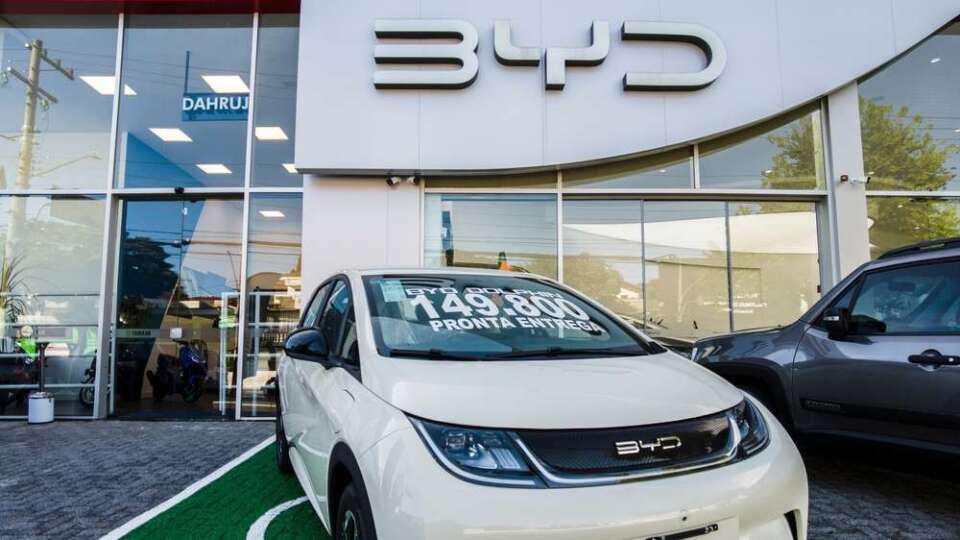
In terms of the global NEV manufacturer competition landscape, Chinese automakers' influence continues to grow. Based on historical sales share, BYD (002594-CN) currently leads globally, Geely Automobile (00175-HK) is rapidly rising, while Tesla (TSLA-US) has relatively weak performance and has dropped to third place. Recently, SAIC Motor (600104-CN) passenger vehicles and SAIC Wuling have also performed notably in overseas markets.
Geely Automobile and Chery New Energy have shown particularly significant recent growth. Volkswagen's NEV business in Germany has remained relatively stable, while BMW Group and South Korea's Hyundai have declined to the third tier. The competition for electrification in the luxury segment is also intense, with Tesla's growth slowing, and recent trends for BMW and Mercedes-Benz being relatively average.
Looking solely at the BEV market, BYD's global market share rose steadily from 7% in 2021 to 17% in 2023, reaching 18% from 2024 to 2025, and then dropping to 15% in the first half of 2026. Tesla's BEV market share declined from about 23% in 2021 to the current 13%.
Geely Group's global BEV market share has steadily increased from 4% in 2019 to 8.9% in 2026. SAIC's recent BEV performance has also been strong, while GAC Group and Changan Automobile remain relatively stable.
Overall, as global NEV sales continue to expand, China maintains its position as the largest market with a 62% share of global NEV passenger vehicle sales, and Chinese自主品牌 are also continuously increasing their share in overseas markets. The global NEV industry landscape is further fragmenting.
FACT BOX
- Source: PR Times
- Category: Survey
- Organizations: BMW