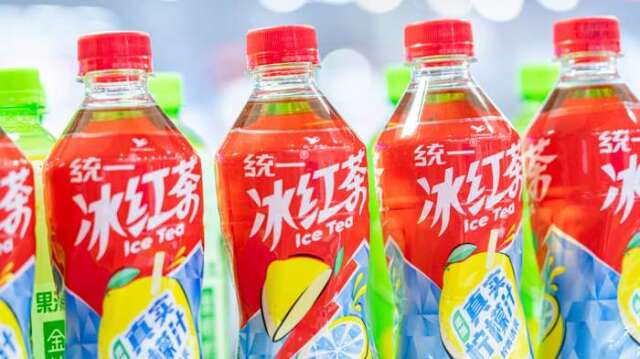
Recently, Uni-President China (00220-HK) released its financial report for the first half of 2026. While overall operations maintained positive growth, its two core businesses showed divergent trends, with the revenue base from its beverage segment declining—the first drop in nearly five years.
The financial report shows that Uni-President China achieved total revenue of RMB 17.321 billion in the first half of this year, a slight year-on-year increase of 1.4%. Net profit attributable to shareholders reached RMB 1.402 billion, up 9%, with the overall gross margin improving to 35%.
The beverage business, which accounts for over 60% of total revenue, generated RMB 10.751 billion in the first half, down 0.3% from the previous year, ending years of continuous growth in the first half period. The beverage segment's gross margin rose 0.5 percentage points to 39.9%.
Breaking down beverage categories, traditional sugary bottled drinks were the main drag on performance. Tea beverages, a core product line, generated RMB 4.889 billion in revenue, down 3.5% year-on-year, accounting for nearly half of total beverage revenue. Juice sales also declined, with revenue of RMB 1.721 billion, down 5.5%.
Classic products such as Iced Tea, Uni-President Green Tea, and Fresh Orange, once dominant in offline refrigerators, have seen slowing terminal sales. Many distributors report slower inventory turnover for standard large-sized beverage bottles.
Under overall market pressure, the milk tea segment emerged as a growth pillar. Milk tea revenue reached RMB 3.645 billion in the first half, up 7.3% year-on-year. The long-standing bestseller Assam Milk Tea maintained stable sales, while low-sugar Jasmine Milk Green became the new growth driver. Other beverage categories, including coffee and packaged water, saw slight declines.
According to a report by Jiemian News on the 10th (Monday), changing consumer preferences and shifting industry conditions are behind the cooling of Uni-President's beverage sales. Public data shows that in the first half of 2026, China's output of designated-size beverage producers declined 0.5% year-on-year—the first decline in the first half in five years—marking the bottled beverage sector's entry into a phase of market saturation and competition for existing shares.
Nielsen IQ monitoring data shows that in May 2026, China's beverage sales across all channels declined 8.7% year-on-year. Health-conscious consumer preferences are reshaping the beverage landscape, with sugar-free tea drinks experiencing rapid expansion, while sugary bottled teas and ambient-temperature juices face shrinking consumer bases.
Market fragmentation is also squeezing the survival space of Uni-President's traditional beverages. On one hand, competitors have taken early leadership in the sugar-free tea segment, while freshly made tea chains capture young consumers' leisure drinking occasions. On the other hand, the rise of snack discount stores and membership supermarkets has introduced low-priced private-label beverages that undermine traditional distribution channels.
FACT BOX
- Source: PR Times
- Category: News