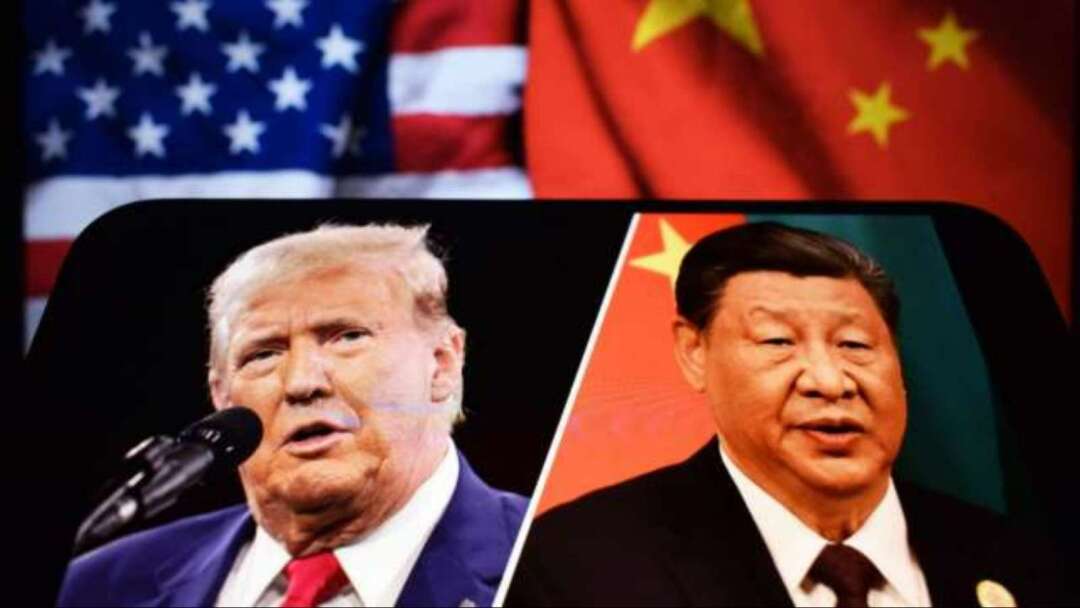
The U.S. White House released a new report on Thursday (13th), accusing China of rerouting exports through third countries and regions such as Mexico, Malaysia, and Taiwan to circumvent U.S. tariffs. The report estimates that this practice costs the U.S. government approximately $19 billion to $26 billion in lost tariff revenue annually.
The Trump administration stated it will include anti-circumvention clauses in future trade agreements and use artificial intelligence (AI) to enhance detection and enforcement.
The report indicates that after the U.S. imposed additional tariffs on Chinese goods in 2018, Chinese companies began shipping products to other countries, performing minimal assembly or repackaging, and then exporting them to the U.S. as products of the third country. This practice, known as "illicit transshipment," creates the illusion that U.S. imports from China are decreasing, while in reality, Chinese manufacturing continues to expand, putting pressure on American factories and employment.
Peter Navarro, White House trade advisor, stated that China is using over 40 countries to "launder" the origin of its goods. He emphasized that the report's focus extends beyond China to include trade partners that assist in tariff evasion.
"For years, this massive transshipment fraud has allowed China to conceal the true origin of its exports through other countries," Navarro said.
Citing various estimates from U.S. government and private institutions, the report suggests that globally, between $34.2 billion and $303 billion worth of goods may be evading U.S. tariffs annually through transshipment. The White House used a midpoint estimate of approximately $75 billion to calculate the U.S. tariff loss of $19 billion to $26 billion per year.
The Trump administration also warned that illicit transshipment is not exclusive to China.
Navarro cited India as an example, noting that other countries may also use third territories to bypass new tariffs. The U.S. is pushing for a new trade framework that includes punitive mechanisms to penalize trade partners involved in or facilitating transshipment.
To strengthen enforcement, U.S. Customs and Border Protection (CBP) has begun testing AI technology through a prototype program to identify abnormal trade patterns and suspicious cargo flows. If importers are found to have falsified the origin of goods, the U.S. can retroactively assess tariffs on import records going back about one year.
The report's release coincides with the expected visit of Chinese President Xi Jinping to the U.S. in September. While the Chinese government describes U.S.-China relations as being in a "strategic stability" state, the White House argues that China's policies supporting manufacturing exports have negatively impacted the automotive, metal, and electronics industries in the U.S., Europe, and Japan.
The second-term Trump administration imposed high tariffs on many countries globally to protect American manufacturing. However, these measures have also increased domestic inflationary pressures, and some tariffs face legal challenges. In February, the U.S. Supreme Court overturned parts of these measures.
Although the U.S. remains in a trade deficit, the deficit so far this year is approximately $371 billion, down by about $189 billion compared to the same period last year. The White House contends that further curbing illicit transshipment is crucial to maintaining the effectiveness of tariff policies and reducing trade imbalances.
FACT BOX
- Source: PR Times
- Category: Survey