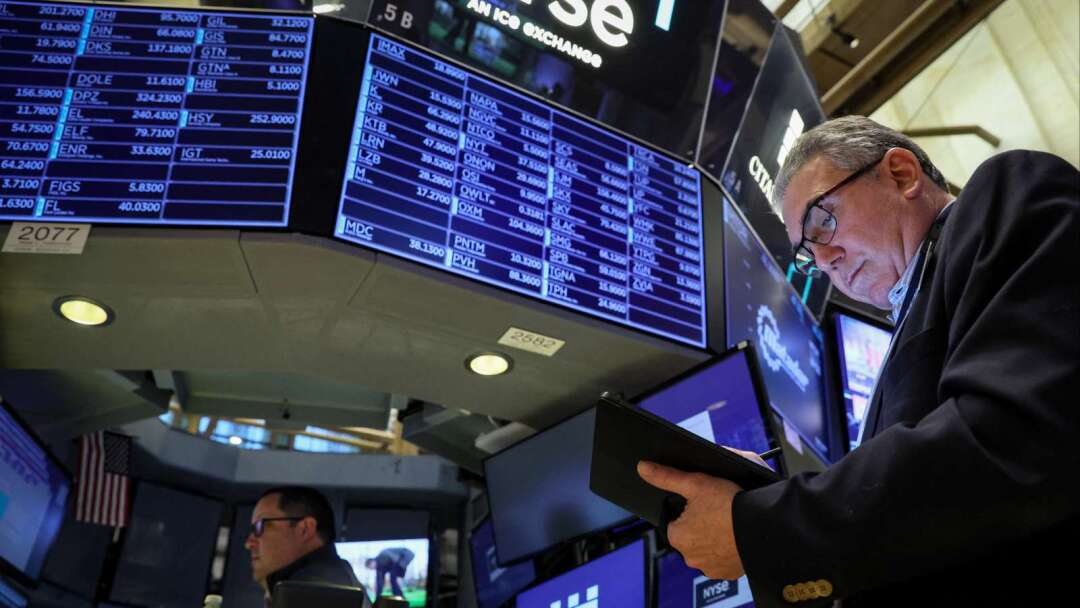
Major U.S. stock indices opened higher on Thursday (13th), as a lower-than-expected Producer Price Index (PPI) further alleviated inflation worries, while declining oil prices boosted market risk appetite, driving the S&P 500 index toward a new all-time high.
Cisco (CSCO-US) weighed on tech stocks. The yield on the U.S. 2-year Treasury note fell 5 basis points to 4.15%. Market expectations for a Federal Reserve (Fed) rate hike in September declined from around 50% earlier this week to 35%. The dollar weakened, and international oil prices dropped to around $81 per barrel.
At press time: - Dow Jones Industrial Average rose over 110 points or nearly 0.2% - Nasdaq Composite Index gained nearly 150 points or almost 0.6% - S&P 500 Index rose nearly 0.5% - Philadelphia Semiconductor Index climbed nearly 0.9% - TSMC ADR rose nearly 0.4%
The cooling of the U.S. July PPI indicated that inflation is not broadly accelerating, reinforcing market expectations for the Fed to hold rates steady in September. U.S. stock futures rose Thursday, while Treasury yields declined, potentially allowing the S&P 500 to post its second consecutive day of gains.
The previous session saw the S&P 500 close near its all-time high. The yield on the two-year U.S. Treasury note, sensitive to monetary policy, fell 4 basis points to 4.16%. International oil prices retreated to around $81 per barrel as traders continued assessing the volume of oil transported through the Strait of Hormuz. With no progress made on an agreement to end the Iran war, energy market prospects remain uncertain.
U.S. July PPI rose 4.7% year-over-year, a slower pace than expected and significantly below June’s 5.5%. On a month-over-month basis, it was flat, driven by further declines in energy and food costs.
Glen Smith, Chief Investment Officer at GDS Wealth Management, stated that although inflation remains well above the Fed’s 2% target, price pressures have shown signs of stabilizing after the sharp rise in oil prices triggered by the Iran war. He noted this is good news for both consumers and the Fed, as policymakers attempt to balance inflation control with a cooling labor market.
This report may give the Fed more room to assess inflationary pressures and recent slowdowns in hiring when discussing whether to raise rates at its September meeting. Several economic data releases are still due before the meeting, and investors will closely watch remarks from Fed Chair Powell at the Jackson Hole global central bankers’ symposium later this month.
Another data point showed initial U.S. jobless claims for the prior week rose to 209,000, previously near historic lows, adding further evidence of a cooling labor market.
Persistent inflation above the Fed’s target, combined with widening U.S. budget deficits, has kept long-term Treasury yields elevated. The U.S. government is set to auction 30-year bonds, potentially at the highest rate in 25 years. Following a historic sell-off in Treasuries, markets are speculating the U.S. government may further increase the proportion of short-term debt in its funding structure.
Richmond Fed President Tom Barkin stated inflation is cooling, supporting a temporary pause in rate hikes, but warned some price pressures could become entrenched, eventually forcing policymakers to tighten policy. He noted much of the current high inflation stems from tariff impacts and oil price shocks caused by the Iran war—factors expected to gradually fade.
As of approximately 9:00 PM Taipei time on Thursday (13th): - Dow Jones Industrial Average: +152.40 points (+0.28%), temporarily at 53,922.67 - Nasdaq Composite Index: +29.55 points (+0.11%), temporarily at 26,618.04 - S&P 500 Index: +16.50 points (+0.21%), temporarily at 7,765.00 - Philadelphia Semiconductor Index: +17.05 points (+0.14%), temporarily at 12,416.43 - TSMC ADR: +0.29% to $430.30 per share - 10-Year Treasury Yield: Fell to 4.64% - NY Light Crude Oil: -2.70% to $81.02 per barrel - Brent Crude Oil: -2.36% to $86.88 per barrel - Gold: -0.37% to $4,450.90 per ounce - U.S. Dollar Index: Dropped to 99.85
Key Stocks: - Cisco (CSCO-US): Pre-market drop of 6%, then fell 8.85% in early trading to $112.92 per share. Q4 adjusted gross margin was 66.3%, slightly above analyst expectations of 66%, but failed to meet higher investor hopes. - Coherent (COHR-US): Rose 0.58% in pre-market to $357.70 per share despite a 5% pre-market dip. Q4 non-GAAP gross margin was 40.2%, roughly in line with analyst expectations of 40%. While margins were unremarkable, Q1 revenue and earnings guidance exceeded market expectations. - Cerebras (CBRS-US): Plunged nearly 18% pre-market, then fell 10.32% in early trading to $235.01 per share. AI chipmaker Cerebras Systems reported Q2 revenue of $180 million, below LSEG analyst expectations of $194 million.
Today's Key Economic Data: - U.S. July PPI YoY: 4.7% (Expected: 4.9%, Prior: 5.5%) - U.S. July PPI MoM: 0.0% (Expected: 0.2%, Prior: -0.1%) - U.S. July Core PPI YoY: 4.2% (Expected: 4.2%, Prior: 4.7%) - U.S. July Core PPI MoM: 0.2% (Expected: 0.3%, Prior: 0.4%) - U.S. Weekly Initial Jobless Claims: 209,000 (Expected: 202,000, Prior: 200,000) - U.S. Weekly Continuing Claims: 1.777 million (Expected: 1.8 million, Prior: 1.799 million)
Wall Street Analysis: Citigroup strategists raised their full-year earnings forecast for S&P 500 constituents, stating that revenue trends among companies investing in AI capital expenditures 'should help support the AI-affected segments of the index.'
A team led by strategist Scott Chronert raised their S&P 500 EPS target by about 4% to $365. They noted revenue growth at the index level has accelerated, along with further margin expansion. The team maintained their year-end S&P 500 target of 8,100 points, implying about 5% upside from current levels.
FACT BOX
- Source: PR Times
- Category: News
- Organizations: Cisco / Coherent / Cerebras