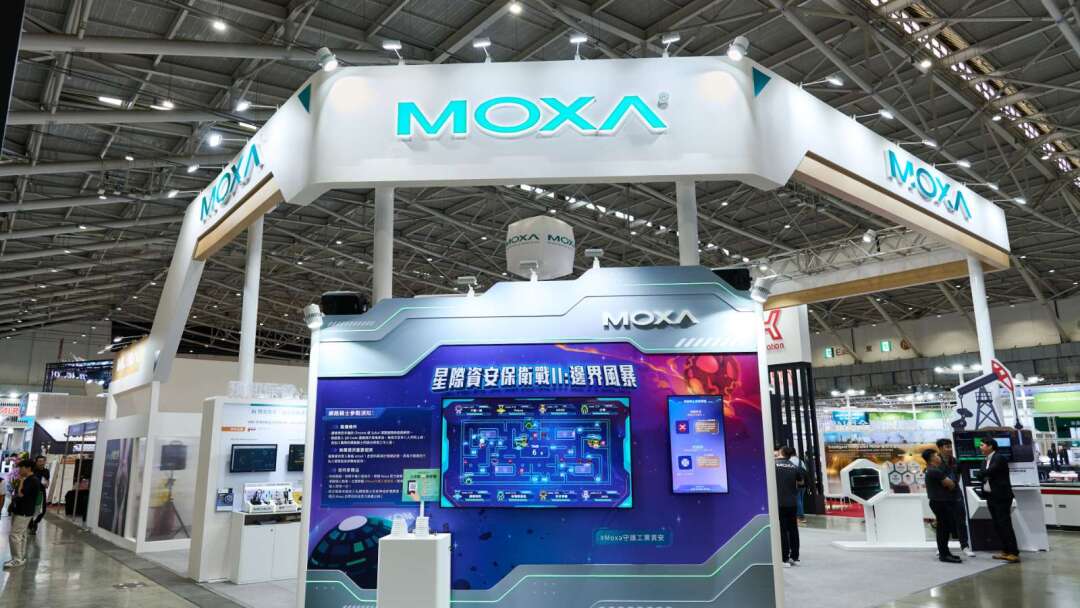
Industrial networking pioneer Moxa (Four Zero Four Technologies) will participate in the 2026 Taipei International Industrial Automation Show under the theme “Robust Connectivity, Intelligent Collaboration for the Future.” The exhibition will present Moxa’s foundational capabilities required for the era of industrial intelligence and smart manufacturing, showcasing a complete suite of network infrastructure and services—from industrial networking, wireless communications, and edge computing to internationally compliant cybersecurity governance and OT operations support.
In recent years, AI applications have rapidly entered manufacturing environments, ranging from Autonomous Mobile Robots (AMRs) and automated inspection systems to edge AI inference. These intelligent systems all rely on stable and reliable industrial networks. Any communication interruption not only affects production efficiency but may also lead to line stoppages and operational losses.
Therefore, Moxa centers its exhibit around “Robust Connectivity,” demonstrating a resilient network architecture built on high-speed transmission and secure, stable connections. Through comprehensive solutions—including highly reliable wired and wireless communications, full-network visibility, industrial edge computing platforms, and internationally standardized cybersecurity governance—Moxa helps enterprises build the critical infrastructure needed to support industrial AI and smart manufacturing, enabling safe, stable, and highly resilient smart factories.
As unmanned factory applications accelerate, AMRs, robotic dogs, and intelligent inspection devices are becoming essential for on-site operations, inspections, and real-time monitoring. Consequently, wireless networks have evolved from auxiliary tools to mission-critical production infrastructure. At Moxa’s wireless application zone, Turbo Roaming technology—with seamless handover under 50 milliseconds—will serve as the communication foundation. Combined with autonomous mobility applications from partners Solomon and Lüjie, this setup demonstrates the advantages of high-speed Wi-Fi roaming in precise motion control and intelligent inspection. Solomon’s Autonomous Mobile Manipulator (AMM), integrating AI vision and digital twin technologies, enables high-accuracy automated defect detection and rapid deployment. Lüjie focuses on critical sites such as semiconductor production lines and equipment server rooms, showcasing real-time transmission of inspection images and sensor data to enhance on-site monitoring and maintenance efficiency.
Additionally, Moxa will unveil Taiwan’s first officially certified CC-Link IE TSN Wireless industrial wireless communication solution. This wireless transmission achieves industrial-grade real-time performance with packet latency below 100 milliseconds and jitter under 50 milliseconds, meeting the stringent requirements for timeliness and reliability in industrial control systems.
Another highlight is the technological evolution of AeroMesh, Moxa’s robust wireless backbone. Utilizing a multi-path redundancy architecture, it enables self-organizing and self-healing networks. Even if network nodes fail, wireless access points (APs) can restore communication within 2.5 seconds.
This technology is crucial for the stable deployment of physical applications such as AMRs, AGVs, robots, and robotic dogs in smart factories. Only with uninterrupted, stable communication can equipment be precisely controlled, ensuring operational safety in human-machine collaboration environments and directly impacting the success of intelligent manufacturing transformation.
As more AI devices are deployed on factory floors, factory managers’ ability to monitor overall network status has become a critical challenge for smart factories. Moxa’s industrial network management platform, MXview One, provides real-time monitoring of device statuses and anomaly alerts across the entire network, significantly improving network visibility and operational efficiency.
In the field of edge computing, Moxa exhibits its full series of Arm-based low-power industrial computers certified to IEC 62443-4-2 Security Level 2 (SL2), along with x86 industrial computers powered by Intel’s 14th-generation processors. Both product lines offer a 10-year supply commitment, meeting the long lifecycle deployment needs of industrial manufacturing.
Moxa’s industrial computers not only deliver stable edge computing performance but also support partner innovation in AI applications. At this exhibition, Moxa collaborates with partners to demonstrate an industrial edge AI collaboration framework that integrates OT data governance, Edge AI inference, and AI Agents—building a closed-loop Physical AI system from data management to intelligent decision-making and execution.
In June this year, Moxa announced it had obtained dual certification for IEC 62443-4-1 ML3, awarded separately by IECEE and ISASecure. Unlike single-product security validation, ML3 emphasizes whether an enterprise has institutionalized a Secure Development Lifecycle (SDL) and integrated it into daily operations. This reflects Moxa’s organizational capability and process maturity in meeting global cybersecurity regulations, signaling its strategic shift from a device supplier to a secure infrastructure provider.
This year, Moxa’s exhibition focus extends beyond individual products to a comprehensive network architecture centered on “Robust Connectivity,” designed to enable intelligent collaborative operations for future manufacturing. By integrating highly reliable wired and wireless communications, full-network visibility, edge computing platforms, and internationally compliant cybersecurity governance, Moxa demonstrates the foundational capabilities required for the industrial AI era.
FACT BOX
- Source: PR Times
- Category: Event
- Products / services: Turbo Roaming / AeroMesh