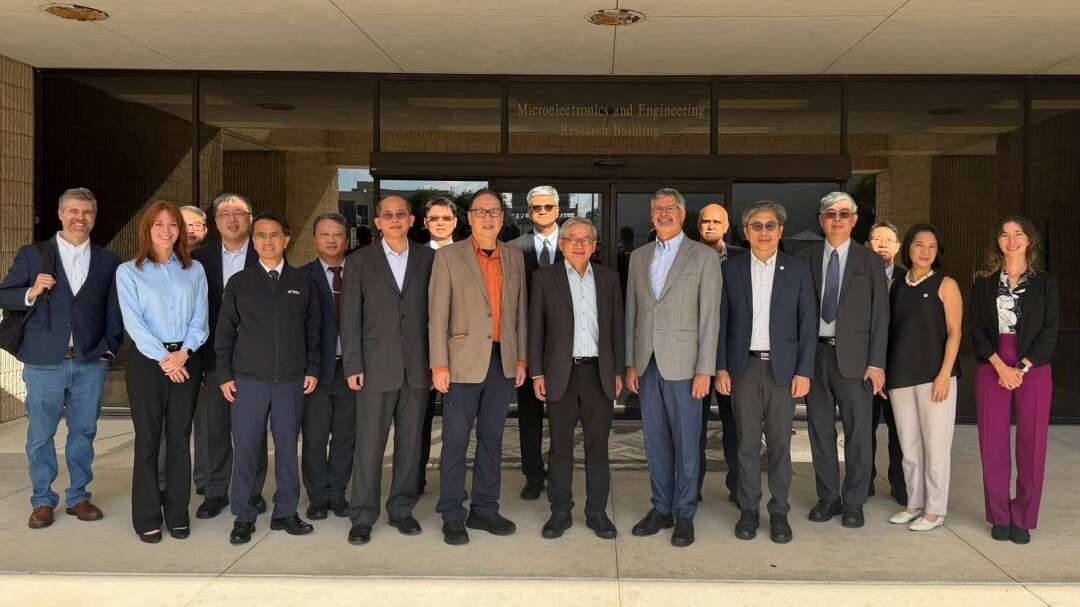
National Science and Technology Council (NSTC) Chairperson Wu Cheng-wen recently led a delegation to Texas, USA, engaging in high-level discussions with Texas officials, the Space Commission, renowned academic institutions such as the University of Texas at Austin, and local industry leaders. The NSTC stated today (the 14th) that Chairperson Wu's visit focused on connecting Taiwan and Texas in core strategic areas including advanced semiconductors, silicon photonics, space technology, and high-level talent cultivation, aiming to establish deep collaborative channels between Taiwan and the U.S. in technology supply chains and academic research ecosystems.
According to the NSTC, the delegation held talks with Texas government officials and senior representatives from academia and industry at the Texas State Capitol on August 11 (Central Time). The U.S. side presented briefings on Texas' space industry development, Texas A&M University's semiconductor initiative, the North Texas semiconductor ecosystem, and AI and physical computing. The Taiwanese delegation provided detailed explanations of Taiwan's semiconductor R&D strategies and space technology roadmap.
In his remarks, Wu emphasized that Taiwan possesses a globally leading semiconductor manufacturing and ICT ecosystem, while Texas is renowned for its strengths in advanced packaging, space industries, and robust research capabilities. He noted that both sides have highly complementary advantages, and deeper collaboration will inject strong momentum into global technological innovation.
On August 12, the delegation visited the Microelectronics Research Center (MRC) at the University of Texas at Austin and the Texas Institute for Electronics (TIE), which receives funding from the U.S. Defense Advanced Research Projects Agency (DARPA).
The NSTC highlighted that MRC has a solid foundation in nanoelectronics and cleanroom facilities, while TIE focuses on advancing packaging and heterogeneous integration technologies, establishing pilot lines bridging R&D and mass production. Additionally, the delegation engaged with UT Austin’s Department of Aerospace Engineering and the Center for Space Research (CSR), initiating dialogues on satellite remote sensing, orbital mechanics, and space data applications, exploring possibilities for future multinational research collaborations and technical exchanges with Taiwan’s National Space Center.
As part of key industrial linkages, Chairperson Wu also visited the headquarters of AAOI (Applied Optoelectronics Inc., NASDAQ: AAOI), a major player in optical communications. With the recent surge in demand for AI servers and large-scale data centers, high-speed optical transceiver modules and silicon photonics technology have become critical to overcoming computing bottlenecks. Both sides held in-depth discussions on integrating Taiwan’s semiconductor ecosystem with AAOI’s production footprint in Taiwan and the U.S., exploring ways to jointly enhance the resilience and security of next-generation optical communication equipment supply chains.
The NSTC emphasized that this visit not only deepens substantive connections between Taiwan and Texas in technology policy, academic research, and industrial collaboration but also establishes long-term cooperative channels for both sides’ academic, research, and industrial communities, helping connect Taiwan’s key technologies and research capabilities with the global stage.
FACT BOX
- Source: PR Times
- Category: Partnership