TAITRA today (14th) released the results of the first 2026 'TAITRA Trade Index,' finding that under the geopolitical shock triggered by the U.S.-Iran Middle East conflict, over half of surveyed enterprises—approximately 56.2%—are experiencing negative impacts. In response to shifting global geopolitical and economic conditions and rising cost pressures, businesses embracing 'digital transformation' and 'AI empowerment' demonstrate high operational resilience and more optimistic outlooks compared to peers yet to transform.
The survey shows that due to the U.S.-Iran Middle East conflict, as high as 56.2% of enterprises assess the overall impact as 'negative.' The ripple effects of geopolitical tensions have gone beyond mere economic fluctuations. Enterprise concern over 'operational costs' has significantly increased by 10 percentage points from the previous survey's 67.7% to 77.5%, ranking highest among all risk indicators.
Among affected enterprises, a staggering 85.4% identify 'rising costs' as their core challenge, followed by 'shortages of raw materials or components' (49.9%). Facing mounting financial burdens and potential supply chain disruptions lasting over six months, companies are responding not only by continuously enhancing 'product value competitiveness' but also actively accelerating 'supply chain and market diversification' and 'business model adjustments' to mitigate logistics risks and seek breakthroughs.
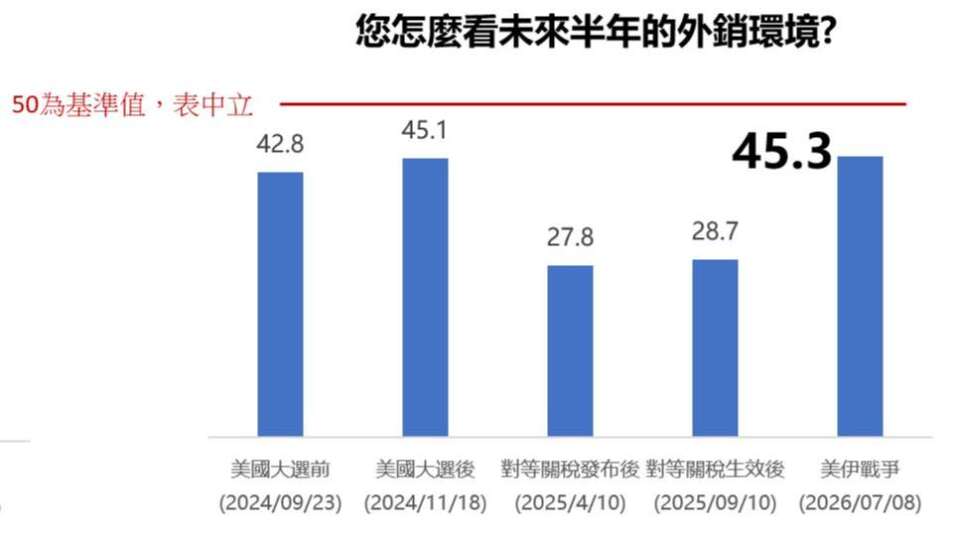
This round highlights that while the tech sector thrives, traditional raw material industries suffer severely. TAITRA notes that enterprise confidence in current export environments has fallen into a low range at 36.05, yet the 'expectation index' for the next six months has rebounded to 45.25, indicating that despite short-term pressure, businesses anticipate the worst may be over, showing cautious signs of recovery.
Notably, there is significant 'temperature variation' across industries: benefiting from the global AI and semiconductor boom, electronics, ICT, and optics sectors achieved a future expectation index of 53.7—the only sector surpassing the 50 breakeven line. In contrast, traditional raw material industries such as petrochemicals, rubber, plastics, and basic metals, most deeply affected by cost volatility from geopolitical conflicts, saw expectation indices of only 33.8 and 30.3, making them the hardest-hit sectors in this shift.
The survey further reveals a strong positive correlation between depth of AI adoption and export confidence. A deep dive into AI implementation shows most enterprises have begun using AI, yet as high as 42.2% remain at the stage of 'free chat AI,' with tangible quantifiable benefits still needing breakthroughs.
Crucially, the level of AI integration strongly correlates with future export confidence. Pioneering firms that have allocated budgets for 'AI Agents' show a future expectation index as high as 59.41; those using 'paid AI Agents' reach 51.84. In contrast, enterprises using only free chat AI or none at all show低迷 confidence indices between 40.9 and 42.3, confirming that amid macro geopolitical and economic fluctuations, companies effectively leveraging AI for cost control possess greater resilience.
TAITRA emphasizes that this first-round survey highlights Taiwanese enterprises’ high operational resilience despite ongoing U.S.-Iran war and geopolitical shocks. In facing rising operational costs, companies are flexibly shifting strategies, prioritizing 'enhancing product value competitiveness' and 'diversifying supply chains and markets.'
Despite short-term pressures, resilient firms are countering challenges by 'opening new markets' (48.7%) or 'gaining order shifts' (34.4%). Looking ahead three years, the U.S. (56.4%) and Southeast & South Asia (52.2%) remain the most favored target markets for Taiwanese enterprises.
TAITRA stresses that tightly integrating innovative technologies, market agility, and core strengths while enhancing multi-risk adaptability is key for Taiwanese enterprises to break through. Actively embracing digital transformation and AI empowerment has become the best defensive strategy against macroeconomic fluctuations and geopolitical risks.
TAITRA launched the 'TAITRA Trade Index' as a key tool for insights into global market trends. Leveraging its domestic and international business intelligence networks, it analyzes real-time, reliable first-hand information to help industry, government, and academia swiftly grasp global market dynamics. This survey was conducted post-U.S.-Iran Middle East conflict, covering representative Taiwan-based enterprises, with 1,678 valid responses collected from business owners and senior managers.
FACT BOX
- Source: PR Times
- Category: Survey
- Products / services: AI Agents