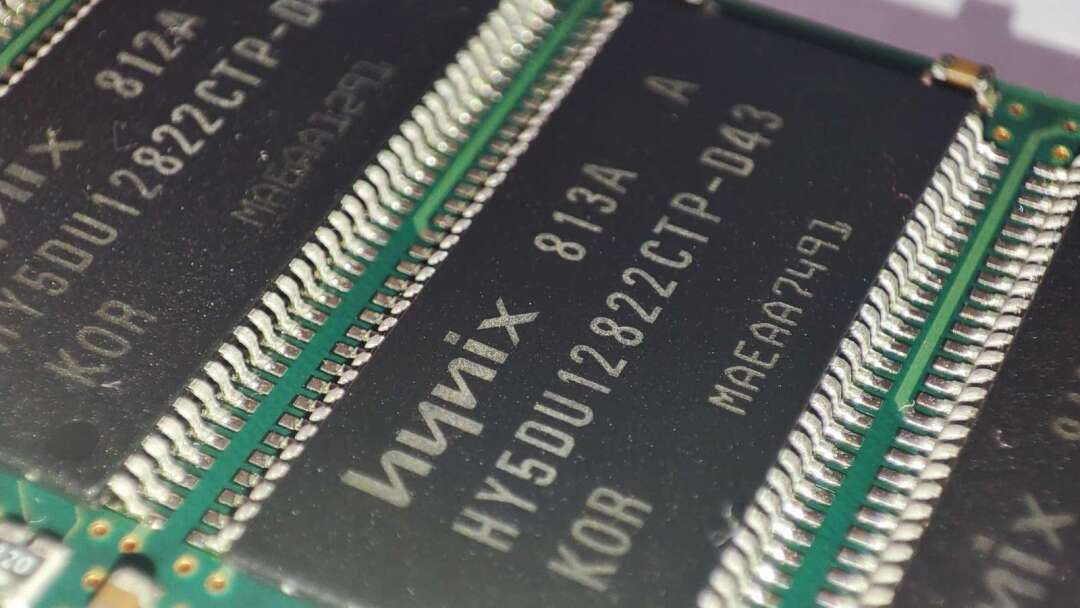
South Korean SK Group Chairman Choi Tae-won recently sat down with CNBC for an exclusive interview, discussing the company’s $720 billion bet on capacity expansion, his personal relationship with Jensen Huang, HBM supply bottlenecks, pressure to build fabs in the U.S., and the profound impact of AI on human society. Rarely candid for a chaebol leader overseeing more than 100 subsidiaries, he admitted: "2027 could be the year memory shortages are most severe. Everyone wants more chips, but we can’t deliver."
While SK Group owns over 100 subsidiaries, Choi made it clear that SK Hynix is currently the group’s core engine. He offered an analogy: "We’re in the AI era. AI is like a four-year-old child. As it grows, it needs more functions, more experience, and more knowledge—and all of that must be stored somewhere."
To support this demand, SK Hynix has announced plans to invest up to $720 billion over the next five years to expand production capacity. Choi forecasts that the number of global AI agents will surge 77-fold from 2025 levels over the next five years, and total memory demand will approach five times current production capacity within a decade. "We must expand rapidly, or supply will fall short."
He further pointed out that DRAM (including HBM) currently accounts for about three-quarters of SK Hynix’s revenue. However, this expansion is not merely about volume. HBM production consumes more than four times the wafer capacity of standard DRAM, significantly squeezing overall wafer space.
SK Group is aware of the risk of oversupply and is mitigating it through long-term agreements (LTAs), joint-venture wafer fabs, and the "Memory as a Service" (MaaS) model. "Every time we expand, we verify whether the demand is real. We don’t want oversupply, nor do we want undersupply," said Choi.
One of the most alarming parts of the interview was Choi’s candid admission of "chip inflation." He revealed that memory prices have already risen 40% to 50% this year, forcing even consumer electronics giants like Apple to pass costs on to consumers.
"Chip prices are so high that they end up pushing up price levels across society. I don’t want this to happen, but it already has," Choi said.
Even more severe is the supply gap. Choi noted that building a wafer fab takes at least four to five years of preparation, and "next year could be the toughest year." No memory company is ready to expand capacity, yet demand is expected to double from this year. "It’s like a war—everyone wants more memory chips." He even confirmed that hotels across South Korea are already packed with senior executives from global tech giants coming to sign LTAs.
Choi revealed an astonishing "relationship map" during the interview. He displayed a wafer signed by Jensen Huang and disclosed that he is friends with top cloud executives, including Microsoft CEO Satya Nadella, Google CEO Sundar Pichai, and Meta CEO Mark Zuckerberg, with whom he frequently discusses industry outlooks.
When asked about TSMC, Choi said he met with CEO C.C. Wei about a month ago. "Without a base die, you can’t produce AI products. I believe he will certainly manufacture for us."
He emphasized that TSMC and SK Hynix have a complementary relationship—without sufficient memory, even TSMC’s GPUs can’t be fully utilized, and vice versa.
On the concentration risk of NVIDIA as its biggest customer, Choi didn’t shy away: "Without NVIDIA, today’s AI ecosystem wouldn’t exist. I must do everything I can to support them." But he added that customers like Google and Microsoft are also designing their own chips, so it’s not a single dependency.
Regarding recent U.S. pressure on SK Hynix and Samsung to build full memory wafer fabs in America, Choi acknowledged that U.S. customers do want SK Hynix to build locally, but stressed that such decisions can’t be rushed. "A wafer fab requires an industrial ecosystem of 600 to 700 suppliers of materials, chemicals, and services. Beyond water, electricity, and land, the ecosystem itself is critical."
Currently, SK Hynix is advancing a project in Indiana and has established an "American AI Company," investing $10 billion to combine U.S. software strength with Asian hardware manufacturing advantages. Additionally, SK Hynix has entered U.S. capital markets to raise funds, opening a new financial pipeline for global expansion and talent incentives.
At the end of the interview, Choi offered profound insights into the cyclical nature of the memory industry. He said past memory cycles depended on global population and hardware device counts—"People don’t buy ten phones a day"—but the AI era is different. "One person might simultaneously have ten different AI agents, each requiring massive memory."
"The cycle won’t disappear, but its dynamics will inevitably change. It could become a much longer cycle," Choi said.
From near-bankruptcy during the 1997 financial crisis to the tough adjustments of 2023, Choi sees the biggest difference now as "this newborn—AI." While he recognizes AI’s challenges in consuming vast energy, water, and materials, he believes it will liberate human labor and narrow social gaps.
"We won’t have to work so hard anymore. If the differences between people also shrink, we’ll have a better chance of building a happier society," Choi said.
On the race track called "modern oil," Choi is betting SK Hynix’s entire future. His judgment boils down to one sentence: "At least in the near future, I see demand remaining very strong. That much is certain."
FACT BOX
- Source: PR Times
- Category: News
- Organizations: Google / Meta
- Products / services: HBM / DRAM