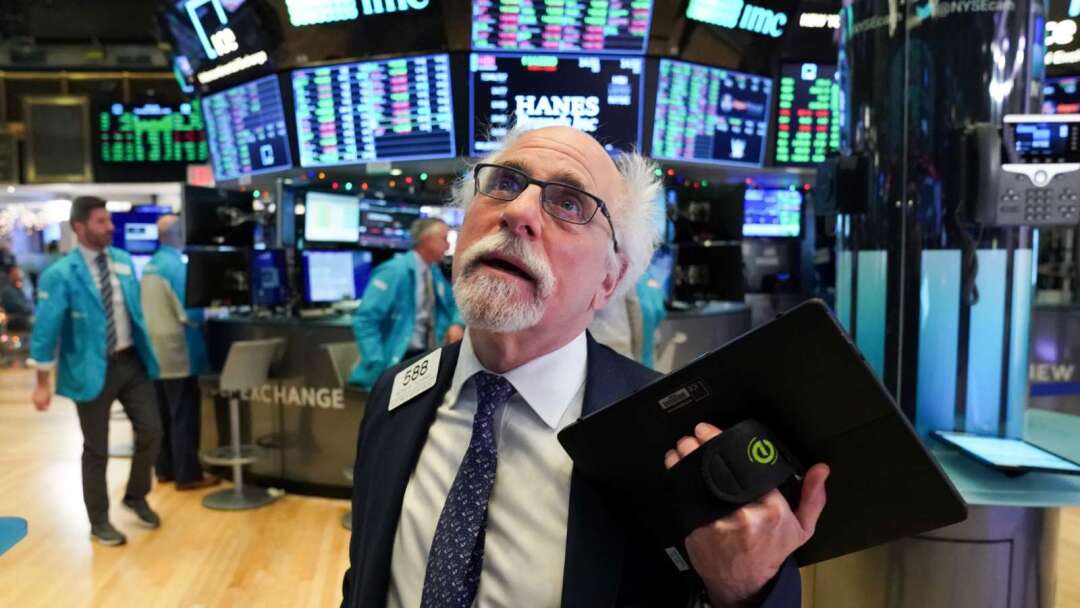
Peter Tuchman, a trader at the New York Stock Exchange (NYSE), has experienced multiple market crashes, including the 1987 'Black Monday,' and has been active on the trading floor for 41 years. Facing recent concerns about an artificial intelligence (AI) bubble, this market veteran remains optimistic, believing that the current stock market differs significantly from past speculative peaks, and that investors still have valid reasons to participate.
According to a report by Business Insider, Tuchman is one of the most recognizable traders on the NYSE floor, known for decades for his exaggerated facial expressions and striking gray hair, earning him the nickname 'Wall Street Einstein.'
As a floor broker, Tuchman executes stock trading orders and has analyzed every market crash since the 1987 'Black Monday,' when the S&P 500 index plummeted 20% in a single day.
Recalling that day, Tuchman described chaos on the trading floor, pulling stacks of trade tickets from printouts of stock tickers—almost all of them sell orders—while he scrambled to execute trades.
He said, 'I just remember chaos, fear, and screaming—so much screaming.'
However, regarding current discussions about an AI bubble, Tuchman does not believe another disaster is imminent. He states that there are at least three key differences between today’s market and previous speculative peaks, and even as stock prices approach record highs, there are still strong reasons to remain bullish.
Tuchman said, 'I see an extremely strong market, and I see a market that is preparing itself for a bright future.'
Tuchman’s Key Observations:
1. AI Stocks Are Not as Overvalued as During the Dot-com Bubble
Tuchman first examines market valuations. He believes that today’s popular AI stocks are not as extremely valued as tech stocks were during the peak of the dot-com bubble around 2000.
For example, NVIDIA (NVDA-US), currently the world’s most valuable company by market capitalization, has a forward price-to-earnings (P/E) ratio of approximately 24.8. In contrast, during the early 2000s dot-com bubble peak, tech giant Cisco had a forward P/E ratio that exceeded 100 at one point.
2. AI Companies Are More Profitable
The second key difference lies in corporate financial health.
Tuchman points out that many companies symbolizing the dot-com boom were not profitable. Take the well-known Pets.com, which reached a market valuation of about $400 million during the bubble but collapsed in November 2000 with only $28 million in revenue and a net loss of $94 million.
In contrast, today’s major tech companies continue to generate profits, and strong earnings growth has been a key driver of recent stock market gains.
According to FactSet data, S&P 500 companies are expected to report a 50% year-over-year profit increase this quarter—the highest earnings growth rate in five years.
Regarding current AI companies, Tuchman said, 'They are making a lot of money.' Therefore, he believes today’s market has stronger structural and fundamental support.
3. Retail Investor Capital Remains a Pillar of the Market
Tuchman identifies the third difference as the continued presence of retail investor capital.
At the start of the pandemic, a surge of retail investors entered the stock market, becoming a crucial support for market stability. He believes this capital is unlikely to vanish suddenly, partly because U.S. stock ownership is highly concentrated among high-income households, who are less likely to panic-sell during market downturns.
According to the latest available data from the Federal Reserve (Fed), the top 10% wealthiest U.S. households own 87% of all stocks and mutual fund shares in the country.
Moreover, despite several market downturns in recent years—such as the 2025 sell-off driven by tariff concerns—many retail investors who had opportunities to lock in profits ultimately returned to the market.
A recent JPMorgan analysis shows that retail investors bought $270 billion worth of stocks in the first half of 2026, indicating strong ongoing willingness to buy the dip.
Tuchman even stated, 'To me, this market is almost too big to fail.'
Tuchman’s Advice: 3 Common Investor Mistakes to Avoid
In addition to his bullish outlook, Tuchman shares insights from decades of trading experience and highlights three common mistakes investors make.
First, lacking a clear trading strategy. Tuchman notes that too many investors are influenced by 'fear of missing out' (FOMO) and market hype, investing without a predefined plan.
Second, failing to set stop-loss orders. A stop-loss mechanism automatically exits a position when losses reach a predetermined threshold, helping to control downside risk.
Third, overtrading and revenge trading. Revenge trading refers to attempting to recover previous losses with the next trade. However, such behavior often fails to recoup losses and may instead amplify them.
For the current market environment, Tuchman’s best advice to investors is to avoid trying to time the perfect entry and to stop waiting for the next market crash.
He said, 'Don’t try to pick the perfect timing, and don’t wait for the next crash. If you keep waiting to hit a home run, you’ll end up losing money.'
FACT BOX
- Source: PR Times
- Category: News
- Organizations: NVIDIA / Cisco / Pets.com