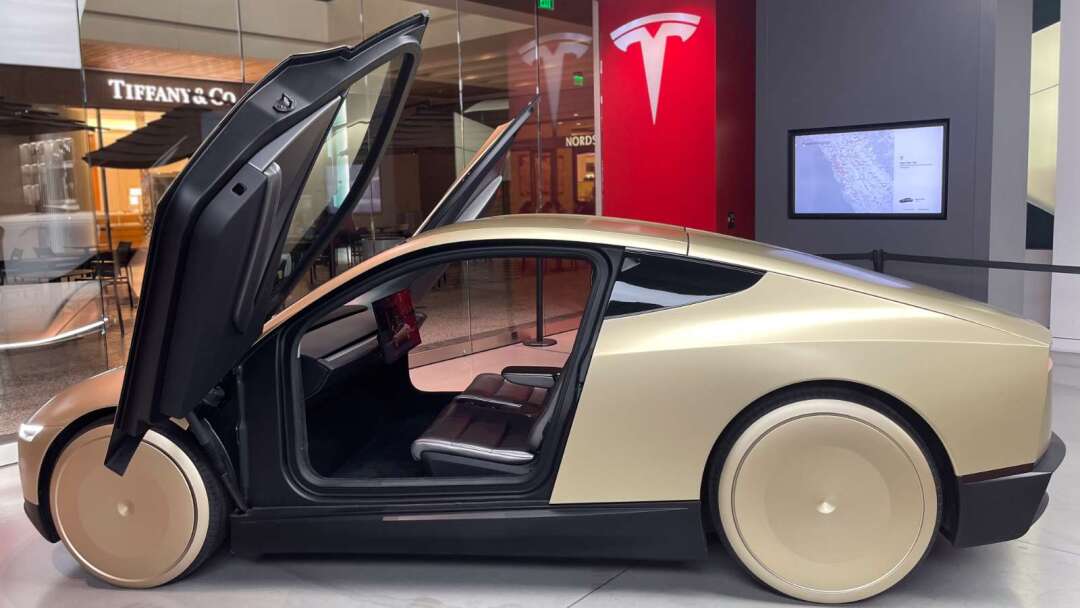
Tesla (TSLA-US) is accelerating the commercialization of its next-generation autonomous taxi, Cybercab. According to The Information on Monday (17th), citing sources familiar with the matter, Tesla has informed employees that the company is preparing to publicly deploy Cybercab as early as August in Austin, Texas. Initially, employees will ride Cybercabs operating on public roads, with the possibility of integrating the vehicle into the local Robotaxi service within days.
If the plan proceeds as scheduled, this will be a significant step for Cybercab to transition from production and engineering testing to actual Robotaxi service. Tesla currently positions Cybercab as a vehicle specifically designed for full autonomy, with its most distinctive feature being the complete removal of the steering wheel and brake pedals. The ultimate goal is for the vehicle to perform passenger transport tasks without any human driver intervention.
Tesla has not immediately responded to Reuters' request for comment. The report indicates that the company has recently conducted multiple pre-launch preparations, including test drives, allowing employees to ride Cybercabs on private roads, and training with local first responders.
Training with emergency personnel has drawn particular attention. According to reports, Tesla has recently conducted operational training for Cybercab with first responders in Austin, covering procedures for handling accidents or emergencies and moving the vehicle. This reflects Tesla’s shift from purely engineering testing to the safety and emergency preparedness phase prior to actual deployment.
Tesla began testing production-version Cybercabs on public roads in Austin as early as June. At that time, the vehicles already featured the final design without a steering wheel or pedals, but a safety supervisor remained seated in the front passenger seat during testing. TechCrunch reported that these tests come nearly two years after Tesla first unveiled the Cybercab design, with the ultimate goal of offering a fully autonomous ride-hailing service via the Tesla app.
Tesla also announced at the end of June that the first production-version Cybercab had begun engineering testing in Austin. The vehicle operated on public roads, but with a safety supervisor in the front seat, meaning this phase was still engineering validation, not truly driverless passenger service.
In terms of production progress, Tesla has already begun manufacturing Cybercab at its Texas factory. First-quarter data shows that Cybercab production at the Texas factory remains in the pilot production phase. Tesla stated that once Cybercab enters mass production, it is expected to gradually replace the current Model Y vehicles in the Robotaxi fleet and eventually become the most numerous vehicle in the fleet.
However, Tesla adjusted market expectations for Cybercab’s production speed following its second-quarter earnings report. The company had previously stated that Cybercab would enter mass production in 2026, but has since refrained from committing to achieving 'volume production' this year. Tesla is currently increasing 4680 battery output to support the scaled production of Cybercab and Tesla Semi, indicating ongoing production ramp-up challenges on the manufacturing side.
Elon Musk had previously warned that new products typically follow an elongated S-curve during initial production, with early output for Cybercab and Semi likely to be very slow, gradually accelerating toward the end of the year. Tesla must therefore simultaneously address multiple challenges in manufacturing, battery supply, autonomous driving software, and regulation to make Cybercab the core vehicle of a large-scale Robotaxi fleet.
Meanwhile, Tesla’s Robotaxi service itself has already begun expanding across multiple U.S. cities. First-quarter data shows that the Robotaxi service in Austin is expanding, with unsupervised rides launched in Dallas and Houston, while Phoenix, Miami, Orlando, Tampa, and Las Vegas are in preparation or permitting stages. Tesla also stated that paid Robotaxi mileage in Q1 nearly doubled compared to the previous quarter.
Currently, the Austin Robotaxi service primarily uses Model Y vehicles equipped with Full Self-Driving software, and the addition of Cybercab means Tesla will begin introducing a hardware platform specifically designed for autonomous driving into actual commercial service. With no steering wheel or pedals, Cybercab fundamentally differs in product positioning from the current Model Y Robotaxi, which still allows human takeover.
Tesla is also accelerating production and deployment preparations for Cybercab vehicles. Recent external observers have spotted large numbers of Cybercabs parked together at Gigafactory Texas, indicating that production ramp-up has entered a more visible phase. Business Insider recently reported over 100 Cybercabs discovered in Dallas, and Tesla’s related vehicles have also been observed in San Antonio, Phoenix, Las Vegas, and the San Francisco Bay Area, suggesting the company is conducting broader-scale validation, mapping, and deployment preparations.
However, Tesla still faces real regulatory constraints in the Robotaxi sector. Axios recently reported that Tesla applied to deploy 5,000 Robotaxis in Clark County, Nevada, but was only approved for 10 vehicles, with licensing conditions requiring 'appropriate human supervision.' It remains unclear whether this means a safety driver must be present in the vehicle or if remote monitoring suffices.
This restriction highlights Tesla’s core challenge: while Cybercab production can rapidly increase at the factory, the true determinant of commercialization speed may not be factory output, but whether the autonomous system meets regulatory requirements and whether Tesla can prove the vehicle—without a steering wheel or pedals—is sufficiently safe in real-world road environments.
Moreover, Tesla is positioning Cybercab as a key pillar in its transformation from a traditional EV manufacturer into an AI, autonomous driving, and robotics company. The company’s second-quarter revenue rose 23% year-on-year to $28 billion, but operating profit was weighed down by increased R&D spending. As Tesla continues investing in AI chips, autonomous driving, robotics, and new vehicle platforms, the speed at which Cybercab can generate new high-margin software and service revenue will become a key focus for investors.
Cybercab’s business model also differs from Tesla’s past reliance on one-time vehicle sales. If vehicles can be deployed at scale in Robotaxi services, Tesla could theoretically generate recurring revenue through per-ride fees, fleet operations, and autonomous driving software. This is one reason Musk has long viewed Robotaxi as a future growth engine for Tesla.
Latest reports indicate Tesla plans to first allow employees to ride Cybercabs on public roads, then integrate the vehicles into Austin’s existing Robotaxi service within days. If the timeline remains unchanged, late August could become a pivotal moment for Cybercab’s transition from testing to commercial service.
Nonetheless, this deployment should be viewed as a limited initial rollout, not an immediate large-scale launch of a fully driverless fleet. Whether Cybercab can expand in numbers, reduce human supervision, obtain regulatory approvals in other states, and achieve true mass production will determine whether Tesla’s Robotaxi bet can transform from a technological showcase into substantial commercial revenue.
FACT BOX
- Source: PR Times
- Category: New Product
- Organizations: Tesla / The Information / TechCrunch
- Products / services: Cybercab