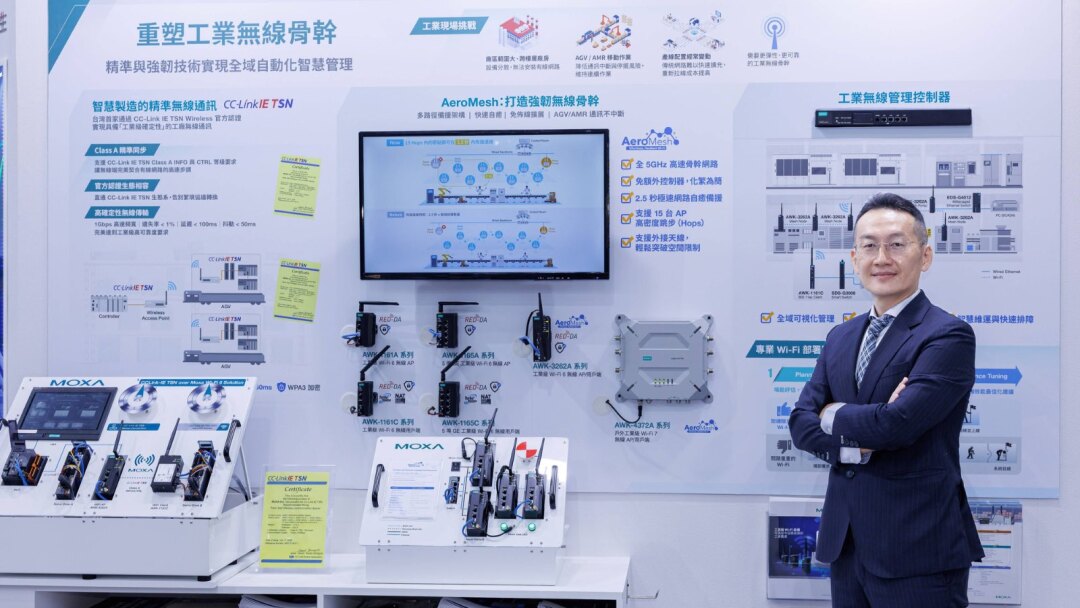
Industrial communications manufacturer Moxa has partnered with Solomon (2359-TW) and Lüjie to exhibit at the Taipei International Industrial Automation Fair, demonstrating robust industrial wireless networking technologies tailored for applications such as autonomous mobile robots (AMRs) and intelligent inspection. Moxa highlights that as AI algorithms migrate from enterprise-level systems down to field control equipment, factory architectures are undergoing revolutionary transformation. Stable, high-bandwidth communication networks have become the core foundation enabling the realization of smart factories.
Moxa analyzes that traditional factory architectures were divided into three layers: management, monitoring, and field control. Today, AI integration is expanding from top-tier ERP and MES systems down to AMRs and collaborative robots at the operational level. Since AI model training and deployment rely heavily on data, Moxa leverages its 40-year expertise in OT data acquisition. Amid growing IoT and sensor adoption trends, the company is directly capturing significant opportunities in industrial communications.
Facing stringent network transmission demands from AI-powered image analysis, Moxa notes that intermediate-layer wired networks have evolved from 1G to 10G bandwidth, with its flagship models capable of integrating up to 16 channels. To address thermal challenges arising from high-bandwidth communication and edge servers equipped with GPUs, Si Ling Si Technology has fully prepared fanless, high-heat-dissipation core networking equipment and edge computing inference servers.
In wireless communications, demand for Wi-Fi in high-tech manufacturing plants and rail transit environments is surging. At the exhibition, Moxa unveiled the world’s smallest access point (AP) and a new series of Wi-Fi 7 products. The company transfers its proven anti-interference expertise from high-speed rail and ground train communications into factory settings, effectively resolving wireless signal interference issues on production floors and preventing mobile units from halting due to disconnections requiring manual intervention.
For production line mobile equipment, Moxa emphasizes three key advantages: robustness, precision, and centralized management. On-site demonstrations by Solomon featured an AMR integrated with 3D vision recognition and digital twin technology. Equipped with an embedded AWK module and Turbo Roaming technology, it achieves wireless handover in just 50 milliseconds, ensuring uninterrupted transmission of large volumes of images and control packets per second. Another technology, AeroMesh, supports multi-AP self-forming mesh networks and multipath redundancy, automatically restoring failed paths within 2.5 seconds—significantly reducing rewiring costs during production line reconfiguration.
FACT BOX
- Source: PR Times
- Category: Partnership
- Products / services: Wi-Fi 7 AP / Turbo Roaming