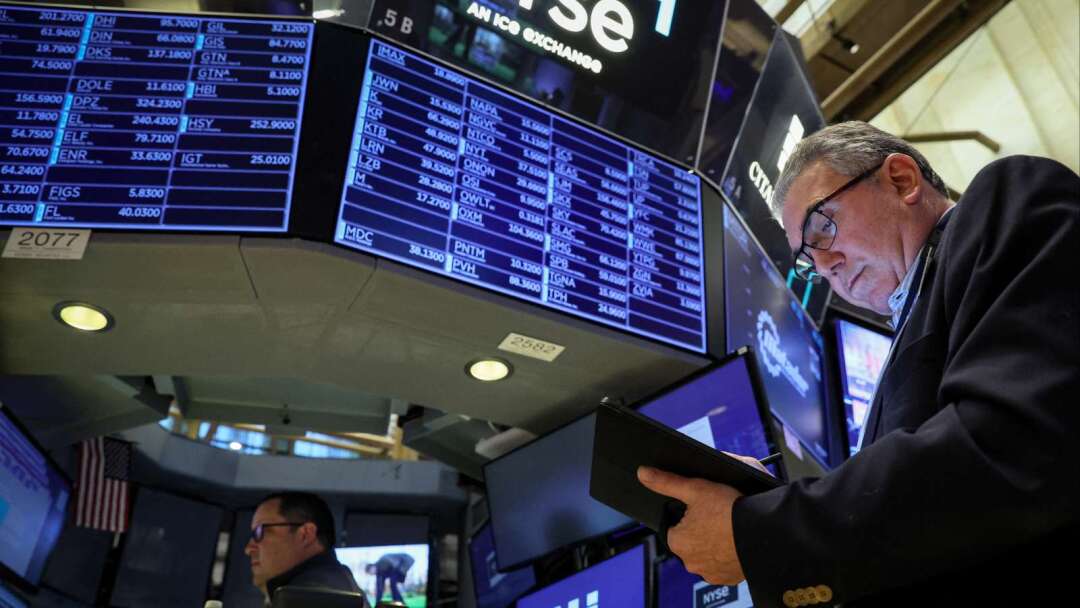
Major US stock indices opened lower on Thursday (20th), with the Dow Jones Industrial Average briefly dropping around 400 points. The bond market rally driven by the US Treasury’s unexpected expansion of long-term government bond repurchases quickly reversed, pushing 30-year US Treasury yields back to pre-announcement levels. Meanwhile, Brent crude oil surpassed $93 per barrel, reigniting market concerns over inflation and elevated borrowing costs.
Retail giant Walmart (WMT-US) missed sales expectations—an unusual occurrence—causing its share price to fall and dragging down the broader market. The S&P 500 Index extended its weekly decline. Former President Trump’s threat of further economic sanctions against Iran dimmed hopes for an early resolution to Middle Eastern conflicts and a return to normalcy in energy markets.
At press time, the Dow Jones Industrial Average was down over 320 points, or nearly 0.6%; the Nasdaq Composite Index fell nearly 80 points, or 0.3%; the S&P 500 Index declined nearly 0.2%; while the Philadelphia Semiconductor Index rose nearly 0.7%. TSMC ADR gained close to 0.7%.
International oil prices continued to climb, renewing inflation fears. US stock futures traded lower on Thursday, and long-term US Treasuries gave up their previous day’s gains. S&P 500 futures dropped 0.6%. Retail giant Walmart (WMT-US) plunged 6% in pre-market trading due to disappointing earnings, pulling other retail stocks lower and deepening market concerns about US consumer momentum.
US bonds resumed their decline, with 30-year Treasury yields rising 7 basis points to 5.26%. The dollar remained largely flat; Bitcoin surpassed $70,000 for the first time since June; gold prices dipped below $4,500 per ounce.
Brent crude oil rose for the fifth consecutive trading session, breaking above $94 per barrel. US President Trump announced a series of measures aimed at economically isolating Iran, further diminishing hopes for a short-term de-escalation between the US and Iran and a normalization of Middle Eastern oil supply.
Treasury Secretary Bennet unexpectedly announced an expansion of long-term bond buybacks earlier this week in an effort to curb yields approaching 20-year highs. The news initially boosted bond prices, but the rally quickly reversed. Analysts warn that given massive fiscal deficits and inflationary pressures driven by oil prices, such buyback measures may only provide temporary relief.
Graham Secker, Head of Equity Strategy at Pictet Wealth Management, stated that if yield increases stem from structural factors, short-term interventions can only buy time and may not alter long-term trends.
European markets also faced pressure, with the Dow Jones Europe 600 Index extending its longest losing streak since 2026. European government bonds declined, natural gas prices hit a five-month high, and the British pound advanced toward its highest level against the dollar since February.
Persistently high yields continue to suppress stock valuations. After hitting a record high last week, the S&P 500 Index has turned negative this week. Chip stocks have recently faced selling pressure, giving back some of their rebound following July’s volatility.
Initial jobless claims in the US for the week ended August 15 came in slightly below expectations. With no major economic data releases for the remainder of the week and low trading volumes during the holiday period, investors await NVIDIA’s (NVDA-US) upcoming earnings report to reassess demand for AI infrastructure.
Markets are also closely watching Federal Reserve Chair Wacher’s speech at the Jackson Hole global central banking symposium next week. Wacher has not clearly indicated whether or when the Fed might adjust interest rates, adding to policy uncertainty.
Bloomberg strategists noted that Wacher previously said rising long-term yields have already performed part of the Fed’s tightening function. If the Treasury lowers yields and eases financial conditions, the Fed may need to compensate with higher policy rates. Failing to act could undermine market confidence in the Fed’s inflation-fighting credibility, potentially pushing long-term yields even higher.
As of approximately 9:00 PM Taipei time on Thursday (20th):
Dow Jones Industrial Average: Down 370.52 points, or 0.69%, temporarily at 53,092.53
Nasdaq Composite Index: Up 41.38 points, or 0.16%, temporarily at 26,331.09
S&P 500 Index: Down 25.40 points, or 0.33%, temporarily at 7,682.58
Philadelphia Semiconductor Index: Up 26.16 points, or 0.22%, temporarily at 11,764.39
TSMC ADR: Down 0.25% to $411.25 per share
10-year US Treasury yield: Rose to 4.70%
NY Light Crude: Up 2.48% to $86.48 per barrel
Brent Crude: Up 2.19% to $93.63 per barrel
Gold: Down 0.32% to $4,530.90 per ounce
Dollar Index: Fell to 99.75
Key individual stocks:
Coinbase (COIN-US): Pre-market shares rose 6.30% to $170.29 per share
Following President Trump’s call for Congress to pass legislation favorable to the cryptocurrency industry, Bitcoin and Ethereum prices surged, lifting related stocks in pre-market trading. Coinbase (COIN-US) rose nearly 7%, Strategy (MSTR-US) jumped 10%, Circle Internet (CRCL-US) gained 7.5%, while MARA Holdings (MARA-US) and American Bitcoin (ABTC-US) each rose about 5%.
Moderna (MRNA-US): Pre-market shares fell 17.79% to $143.36 per share
Pharmaceutical giant Moderna plunged 7% in pre-market trading after soaring 177% the previous session on positive late-stage trial results for its cancer vaccine. The trial showed that the experimental vaccine co-developed by Moderna and Merck (MRK-US), used in combination with Keytruda, achieved its primary endpoint in high-risk or advanced melanoma patients whose detectable cancer cells had been completely removed via surgery.
Wolfspeed (WOLF-US): Pre-market shares fell 6.20% to $27.29 per share
Semiconductor component manufacturer Wolfspeed plunged 10% in pre-market trading. The company reported last quarter’s revenue of $149.6 million, slightly below the $150 million consensus estimate from analysts surveyed by FactSet. Its loss per share was $2.26, better than the expected $2.45 loss.
Today’s key economic data:
US initial jobless claims last week: 206,000 (forecast 210,000, prior 212,000)
US continuing jobless claims last week: 1.799 million (forecast 1.79 million, prior 1.781 million)
Wall Street analysis:
JPMorgan issued a new warning that overlapping risks of global fertilizer supply disruptions and a super El Niño event could push global food prices up by 5% in the first half of 2027. While strategic petroleum reserves can buffer energy shocks, there is no similar backup for fertilizer supplies. Missing the fertilization window means crop losses cannot be recovered even if supply resumes later.
FACT BOX
- Source: PR Times
- Category: News
- Organizations: Wolfspeed / Coinbase / Strategy