The Executive Yuan held a press conference today (20th) on the 2027 central government budget proposal, with Premier Cho Jung-tai attending alongside Vice Premier Cheng Li-chun and Secretary-General Chang Tun-han. In his opening remarks, Premier Cho emphasized, "Reviewing and passing the budget is a shared duty of the Executive and Legislative Yuen, not a favor granted by anyone!" He sharply criticized the severe 351-day delay in the 2026 budget review by the Legislative Yuan, along with numerous extreme and unreasonable cuts.
Cho expressed deep regret over the past year's budget review process. He cited the government's ongoing anti-fraud efforts, which have already reduced both case numbers and financial losses, yet the Legislative Yuan slashed promotional funding by "50% or more across the board." He warned, "If, as the Ministry of the Interior stated, anti-fraud funding is completely eliminated, this work will effectively stall for the coming months—an outcome that is deeply regrettable."
Additionally, the Ministry of Culture has faced consecutive years of intense scrutiny, severe cuts, and fund freezes by specific agencies. Even the presidential office's budget for purchasing holiday gifts from protected workshops serving vulnerable groups faced execution difficulties, severely impacting these groups' livelihoods. "Even the Executive Yuan's own promotional expenses were deleted. We are striving upstream against the current!" Cho strongly urged that economic development, national security, and people's welfare cannot wait, and both branches must fulfill their constitutional duties on time.
Addressing the tense relationship between the executive and legislative branches, Cho revealed that after submitting the budget, he and the Secretary-General will personally visit Legislative Yuan President Han Kuo-yu. Quoting classical wisdom, he said, "In practice, harmony is most valuable. But harmony without ritual is not viable." Cho stressed that this "ritual" and "reason" are grounded in the Constitution.
Cho solemnly declared that Taiwan operates under a "dual executive system," neither a presidential nor a cabinet system. He warned that if unconstitutional legislative actions go unchecked, the nation could slide into "opposition dictatorship." "The Legislative Yuan's role is to review the budget, not to increase it during review, nor to force the Executive Yuan to include budget items through legal means!" Cho pointed out that legislators often ignore Article 70 of the Constitution and Article 91 of the Budget Act. If the legislature passes laws to insert budget items and then reviews them itself, "this is meaningless—no constitutional design in the world works this way."
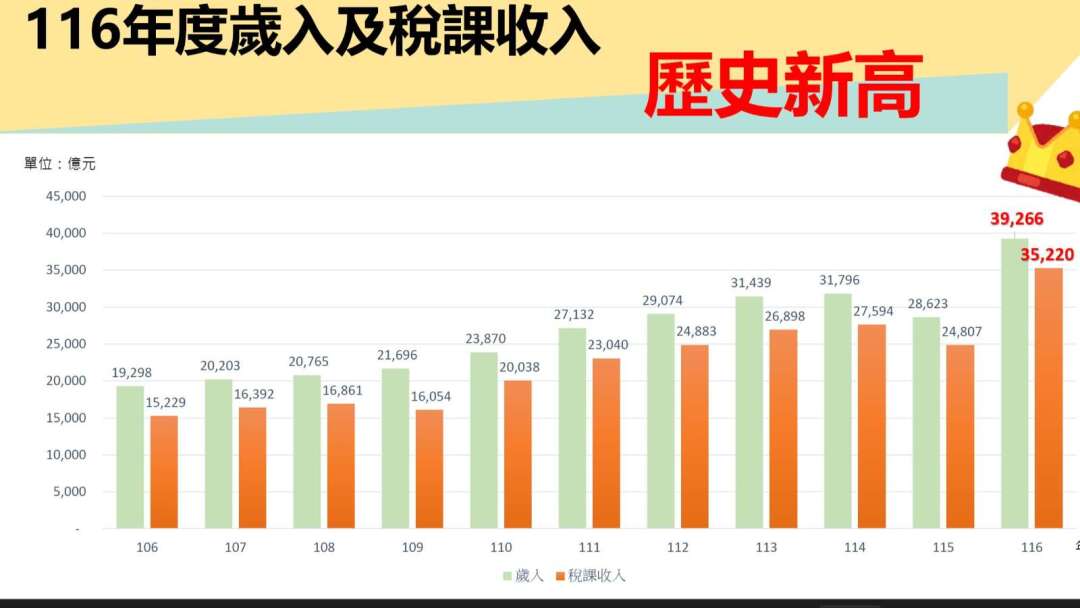
Under the premise of excluding unconstitutional and crowding-out expenditures, Secretary-General Chang Tun-han then presented the macro framework of the 2027 budget. Compared to NT$1.9 trillion in 2016, the NT$3.92 trillion expenditure scale has nearly doubled, symbolizing Taiwan's growing national strength.
Three 'Trillion-Plus' Budgets:
- Defense Budget: NT$1.1225 trillion (meeting the 3% of GDP target), demonstrating firm national defense commitment. - Social Welfare Budget: NT$1.438 trillion, covering the full life cycle from birth to old age. - Local Government Financial Support: NT$1.3579 trillion, triple the 2016 level, supporting all regions regardless of political affiliation.
Ten Key Funding Increases:
- Universal cash disbursement of NT$10,000 (NT$235.7 billion) - New population strategy (NT$373 billion, including NT$5,000 monthly child development allowance) - Public infrastructure and flood control (NT$72.8 billion) - Science and technology budget (NT$229.2 billion) - SME and micro-enterprise transformation (NT$100 billion over 8 years, with NT$25 billion increase next year) - Education funding (NT$957.8 billion) - Labor Insurance Fund top-up (NT$130 billion) - Cultural budget (NT$65.9 billion) - Sports funding (NT$27.6 billion) - Salary increases for military, civil servants, and teachers
Regarding opposition calls to raise the universal cash disbursement to NT$20,000, Premier Cho gave a fiscally disciplined response. He explained that doubling the amount would require an additional NT$244.2 billion in budget. "This would mean we must cancel or freeze all funding for elderly allowances (increasing from NT$8,000 to NT$10,000), National Pension (from NT$4,000 to NT$5,000), nine major social welfare subsidies, childcare allowances, and workplace support programs—just to cover the increase. This is absolutely unacceptable!" Cho emphasized that the government has made reasonable financial planning, launching people-centered policies under record-high budgets and a record-low debt ratio (22.4%, the lowest since 1999), and urged the legislature to conduct rational reviews so that domestic economic stimulus can smoothly take effect next year.
FACT BOX
- Source: PR Times
- Category: News