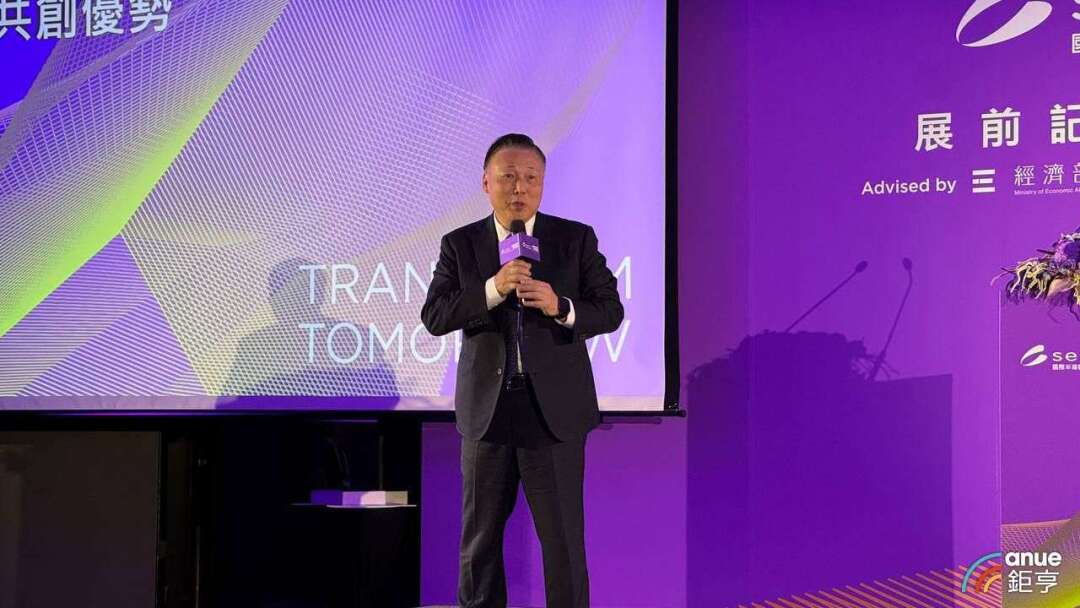
Wu Tianyu, Chief Operating Officer of ASE Group (3711-TW)(ASX-US), stated today (31st) that AI development has only just begun. Currently, AI is primarily built upon thousands of years of human experience and knowledge. However, if it can further integrate across domains and scale infinitely, the scope of imagination could be "hundreds, thousands, or even tens of thousands of times" greater than today. As such, Taiwan's entire semiconductor ecosystem is accelerating efforts to build AI infrastructure, aiming to propel AI into its next stage of development.
Wu explained that if AI were to be defined in the simplest terms, it would be the digitization of human experience and knowledge, quantifying accumulated knowledge, modeling successful experiences, and ultimately accelerating the entire innovation process. Human civilization has historically gone through three stages: knowledge accumulation, replication of successful experiences, and innovative progress. AI is now dramatically accelerating all three processes.
However, he acknowledged that the early stages of AI inevitably bring about displacement effects. In Taiwan, rapid increases in AI-related investments have already triggered competition over land, talent, capital, and electricity. Globally, countries may perceive geopolitical impacts due to industrial and resource concentration, feeling that their own development space is being squeezed.
Wu noted that the current public concern about AI "replacing humans" stems mainly from the fact that today's AI still operates based on existing human experiences—such as shifting from manned to unmanned factories and from human-operated to autonomous equipment—leading to automation of certain jobs. This naturally creates a noticeable sense of displacement in the short term.
Nevertheless, he emphasized that in the long run, AI's true purpose is not to replace what humans already know or can do, but to accomplish what humans have "never seen, never thought of, cannot do, are unwilling to do, or do not know how to do," thereby creating entirely new value.
Wu cited examples where AI is already being applied across pharmaceuticals, cancer research, healthcare, chemistry, physics, and the humanities. By continuously expanding knowledge bases, extracting successful patterns, and integrating across disciplines, AI could achieve large-scale knowledge fusion that humanity has never accomplished in thousands of years.
He pointed out that AI will truly transition from its current stage—relying mainly on existing human knowledge—to a new phase of innovation when it can help the pharmaceutical industry develop breakthrough cancer drugs previously unattainable, or create technologies and applications that never existed before.
Wu stressed, "AI has truly just begun." The knowledge base currently in use is essentially the accumulated experience of humanity over the past approximately 5,000 years. But if AI can cross domains and continuously amplify knowledge and innovation capabilities in the future, its development potential will far exceed today's levels—possibly reaching hundreds, thousands, or even tens of thousands of times greater.
He noted that Taiwan's entire semiconductor and electronics industry ecosystem is now accelerating investment to rapidly complete AI infrastructure, helping AI advance to the next stage. Taiwan has already established a complete industrial ecosystem—from IC design and wafer fabrication to photomasks, equipment, materials, and electronics manufacturing. Amid surging global AI demand and strained supply chains, the industry must consider how to provide the right capacity and work together to complete AI infrastructure under difficult conditions.
Regarding whether Taiwan's supply chain should raise prices, accelerate expansion, or adopt other strategies amid global supply constraints, Wu emphasized that the key lies in understanding when AI's true value will emerge. If one believes AI's long-term contribution to humanity far outweighs short-term gains, the most critical task now is to accelerate investment and improve efficiency to help AI quickly enter its next innovative phase.
However, he also stressed that the industry cannot ignore the short-term impacts of AI, including competition over human resources, capital, land, and electricity within Taiwan, as well as global concerns over industrial concentration. Therefore, collaboration and connectivity between Taiwan and other countries will be essential moving forward.
Wu stated that Taiwan's semiconductor industry must clearly communicate to the public, media, investors, and global partners that while AI may cause short-term resource displacement, its greater value lies in cross-domain innovation and large-scale replication of successful models.
He also expressed gratitude, noting that Taiwan's semiconductor industry has reached its current status thanks to global clients placing their IP, experience, development direction, investment, and trust in Taiwan for nearly 40 years. Therefore, going forward, Taiwan must not only accelerate investment but also clearly demonstrate its commitments to the world.
In closing, Wu emphasized that Taiwan's industrial chain must let the world know: "We know what we are doing. We know what we have committed to. We know what we must deliver." By continuously driving investment and innovation while managing short-term pressures and conflicts, AI can truly advance to its next stage.
FACT BOX
- Source: PR Times
- Category: News