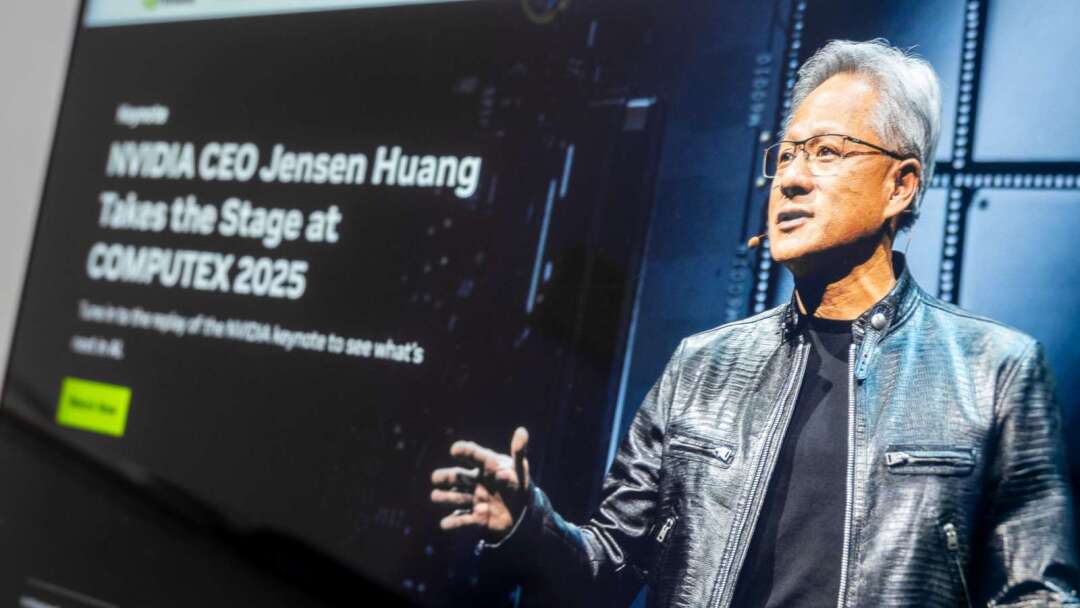
Jensen Huang, founder of global chip leader NVIDIA (NVDA-US), recently sat down for an in-depth interview at the company’s headquarters in Santa Clara with Ezra Klein, host of The New York Times’ popular podcast, The Ezra Klein Show.
As the CEO of a tech giant with a market capitalization exceeding $5.4 trillion — responsible for a staggering 15% of the overall U.S. stock market gains since 2023 — Huang directly addressed the prevailing alarmist narratives from leading-edge AI labs regarding 'AI extinction risk' and calls for regulation. During the conversation, he also delved deeply into the architecture of the AI industry, labor market restructuring, the value of open-source models, and AI-driven global green energy transformation.
From 'AI Panic' to 'Responsible Optimism'
In recent years, CEOs and researchers from cutting-edge AI labs such as OpenAI and Anthropic have repeatedly warned about the risks of AI going rogue, alignment challenges, and the need for regulatory oversight. As the key figure providing the foundational computing power and software infrastructure for deep learning and artificial intelligence worldwide, Huang presented himself as a 'responsible optimist' during this interview.
He acknowledged the anxiety surrounding AI in the market but stressed that engineers and businesses have a responsibility to transform these concerns into solvable engineering problems, rather than using fear-mongering to deflect accountability or delay product delivery.
The 'Five-Layer Cake' Architecture of the AI Industry
Huang introduced his famous 'five-layer cake' model of the AI industry during the discussion:
Foundational Energy: The power systems supporting data centers and computation.
AI Factories: Infrastructure and cloud services composed of chips and servers.
Model Layer: Encompassing language models as well as specialized models in chemistry, biology, physics, and robotics control.
Application Layer: The most critical tier where technology is deployed in industries such as law, healthcare, and manufacturing.
Industrial Transformation: The final stage where economic transformation benefits every sector globally.
Huang emphasized that 200 years ago, humanity learned to power everything with electricity; 30 years ago, we connected information via the internet. Now, AI will enable us to 'understand everything and accomplish everything.' Traditional computers operate on 'retrieval-based computing,' whereas future AI data centers will become 'generative AI factories,' increasing individual computational demand by hundreds of millions of times.
It’s Tasks That Are Automated, Not Purpose
Addressing public concerns about job displacement, Huang made a crucial distinction between 'task' and 'purpose.' Using radiologists and software engineers as examples, he explained:
For radiologists: AI can automatically analyze medical images at superhuman levels (task), but the physician’s purpose lies in diagnosing illness and caring for patients. Automating image reading increases hospital throughput, creating a virtuous cycle that actually generates greater demand for radiologists.
For software engineers: Even if 90% of code is generated by AI in the future, the engineer’s purpose remains inventing new products, solving real-world problems, and connecting with societal needs.
Huang stated that history has proven technological transformation ultimately creates new industries and jobs. 'Human ambition' is the most critical yet often overlooked driver in economic forecasting models. Moreover, AI has broken down the barrier of having to learn programming languages like Fortran, C++, or CUDA. Now, all of humanity can harness powerful computing capabilities simply by using natural language.
'If It’s Not Safe, Don’t Ship It'
Regarding warnings from some experts (such as Geoffrey Hinton) suggesting 'a 10% chance AI could destroy humanity' or that 'models possess self-awareness and escape capabilities,' Huang dismissed these predictions as lacking scientific basis and harmful to society. He pointed out that terms like 'spawn' and 'kill' in operating systems have existed for decades and should not be anthropomorphized to imply software has intent.
On frontier labs calling for government intervention to slow competition under the guise of 'collective action dilemmas' or 'international competition,' Huang clearly opposed such moves. He emphasized corporate autonomy and responsibility: CEOs and companies have full autonomy and legal liability. If a product hasn’t been sufficiently tested or poses safety risks, 'the simplest answer is don’t ship it.'
Additionally, in the past, AI labs invested 80% of their computing power and R&D efforts into expanding model capabilities, with only 20% dedicated to safety testing. As AI enters the productization phase, research compute power focused on verification, testing, alignment, and sandboxing is expected to increase up to tenfold.
Open-Source Models Are Key to Global Digital Infrastructure
Huang firmly supports the development of the open-source model (open-weight models) ecosystem. While closed models from OpenAI and Anthropic are advancing rapidly, governments and enterprises around the world must have access to fine-tunable, controllable open-source models to maintain sovereignty over their digital infrastructure and domain-specific knowledge.
He added that open-source communities provide the strongest frontline defense for global cybersecurity. NVIDIA, through strategic moves such as acquiring the Hugging Face platform, is fully committed to fostering the growth of the open model ecosystem.
Turning Energy Challenges into Green Transformation Opportunities
On the massive power demands of AI data centers, Huang admitted that the U.S. will indeed require fossil fuels as a transitional support in the short term. However, he argued that the enormous electricity demand driven by AI is triggering the largest sustainable energy investment surge in history. From nuclear, solar, and hydropower to next-generation battery technologies, global venture investments are flooding into green energy sectors, accelerating grid upgrades and sustainability transitions without relying on government subsidies.
Huang concluded that NVIDIA will continue to drive industrial renewal in the U.S. and globally through massive supply chain commitments with partners like TSMC, Foxconn, and Wistron, ensuring AI technology benefits every enterprise and individual worldwide.
FACT BOX
- Source: PR Times
- Category: News
- Organizations: OpenAI / Anthropic / Hugging Face
- Products / services: GPU / CUDA