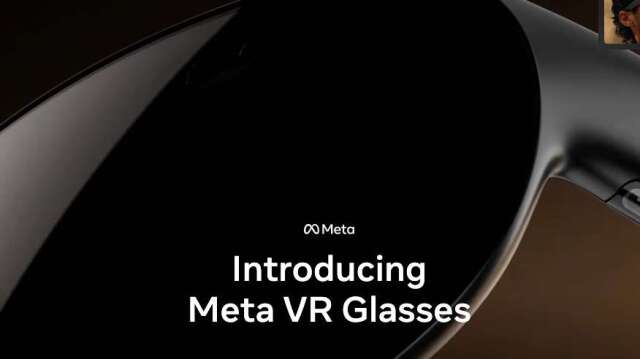
Meta (META-US) has recently unveiled a new virtual reality (VR) headset priced at $1,299, undercutting Apple’s (AAPL-US) Vision Pro in both price and weight. The company has dramatically redesigned its VR headset by moving primary computing components—such as the processor, cooling fan, and battery—from the headset itself to an external module, marking a significant shift in VR hardware architecture and advancing its goal of making its headset business profitable.
According to Bloomberg, the product, named Meta VR Glasses, features a groundbreaking design that removes heavy computational elements from the head-mounted unit and consolidates them into an external box that can be clipped to a user’s pocket or placed on a desk.
In previous Meta products, these components were fully integrated into the headset. Apple’s Vision Pro only moves the battery to an external pack.
Functionally, Meta VR Glasses shares many similarities with both Vision Pro and Meta’s existing Quest series, including immersive video playback, office applications, use as an external display for Mac or PC, web browsing, gaming, video conferencing, and voice assistants.
Notably, by significantly reducing hardware on the headset side, Meta VR Glasses weighs approximately 100 grams—about one-sixth the weight of Apple’s Vision Pro and one-fifth that of the Meta Quest 3S.
In hands-on demonstrations, this lightweight design enables extended wear. Use cases showcased included watching immersive NBA game highlights, navigating Meta’s redesigned operating system, and working from a computer.
Meta’s Chief Technology Officer, Andrew Bosworth, expressed gratitude toward Apple in an interview. He noted that many entertainment partners initially became interested in immersive computing because of Vision Pro, and credited Apple with enabling the industry to “explore split architectures,” which inspired Meta’s decision to adopt an external compute box.
Bosworth stated, “I think, in some ways, they [Apple] were our pioneers and did the hardest part for us.” However, he emphasized that the two products are otherwise not directly comparable, especially in terms of price and weight.
He further added, “We all know they [Apple] didn’t meet expectations because that device simply can’t be worn for long periods. It doesn’t look like glasses, and wearing it makes you look ridiculous.”
Beyond weight, there is also a stark difference in pricing. At $1,299, Meta VR Glasses costs roughly one-third of Vision Pro’s $3,699, though it remains more than double the price of Meta’s Quest 3 at $599.
Meta VR Glasses offers three hours of battery life on a single charge—slightly longer than Vision Pro—and up to twice the maximum runtime of Quest 3. The device can also be used while continuously plugged in.
In display specifications, Meta VR Glasses falls short of Vision Pro, offering around 2.5K resolution per eye compared to Apple’s 4K. However, in actual usage, text and images remain quite sharp, and the difference between the two is not particularly noticeable.
Additionally, Meta VR Glasses is powered by Qualcomm’s (QCOM-US) latest Snapdragon Reality Elite processor, whereas Vision Pro uses a dual-chip setup, including the M5 chip.
Another major new feature of Meta VR Glasses is a novel realistic video conferencing mode that combines holographic technology and artificial intelligence (AI) to generate lifelike avatars of users. In product demos, the virtual characters appeared nearly identical to real people—a significant leap from the cartoonish avatars Meta previously used in VR environments. This functionality will also be integrated into Meta’s Ray-Ban smart glasses line and will support display capabilities.
Bosworth and other Meta executives indicated that the launch of this new headset signals a shift in the company’s business model. Previously, Meta anticipated offsetting Quest hardware losses through profits from its app store and virtual goods.
Now, however, Meta believes the $1,299 price point allows the VR Glasses to move toward breaking even on a per-unit basis. The company aims to transform VR into a profitable ecosystem within the next few years.
Bosworth noted that Meta’s wearable computing division, Reality Labs, has now passed the long-term investment and capability-building phase and can advance operations more efficiently.
Moreover, Meta VR Glasses introduces a touch typing function. The glasses project a virtual keyboard and touchpad onto a surface, enabling computer-like input—distinct from the mid-air virtual keyboards used in past Quest models and Vision Pro. During Meta’s demonstration, the typing experience closely resembled typing on an iPad, allowing users to enter text quickly.
FACT BOX
- Source: PR Times
- Category: New Product
- Organizations: Apple / Qualcomm
- Products / services: Meta VR Glasses / Quest 3