Oxford Economics (Headquarters: Oxford, UK; Japan Representative: Shigeto Nagai) has released a report titled "From the Iran war to tariffs: how global shocks impact industry."
In conjunction with this, in response to rising global volatility, the frequency of updates for "Global Industry Forecasts" has been enhanced to a monthly basis. This allows for the rapid incorporation of geopolitical risks and economic shocks into predictive models, supporting proactive strategy optimization and swift decision-making even in uncertain environments.
*This document is a Japanese abridged translation of content originally announced in the UK on March 13th.
This report analyzes and forecasts the impact of two global shocks on countries and industries worldwide, based on Oxford Economics' proprietary economic model: the Trump administration's "uniform 15% new tariff policy" and the escalating Middle East situation leading to soaring energy prices.
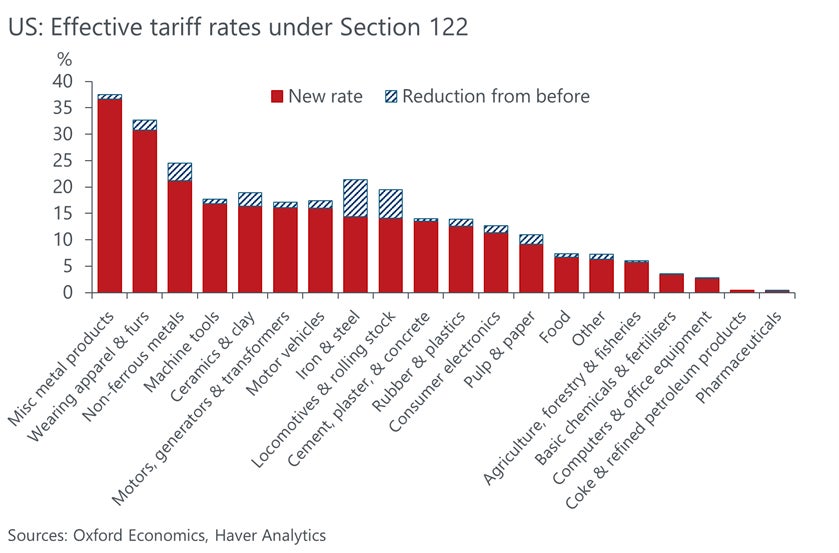
Analysis Results Highlights 1. Trump 2.0 Tariff Policy: A "Uniform 15% Tariff" with Mixed Fortunes Across Industries The uniform 15% tariff introduction being considered by the Trump administration is not expected to uniformly impact the manufacturing industry; rather, it suggests a potential for divergent outcomes depending on the sector.
・Potential for Cost Reduction: Sectors such as leather, apparel, and textiles may benefit from a reduction in tariffs from their current high levels (some exceeding 30%) to 15%, particularly for producers in Asian countries. ・Risk of Investment Suppression: On the other hand, concerns are raised that the institutional uncertainty arising from the expiration of the tariff law (Section 122) could suppress long-term capital investment by companies. [Figure 1] Changes in US Effective Tariff Rates with the Introduction of a Uniform 15% Tariff (Sector-Specific Forecasts)
2. Iran Situation and Energy Crisis: The Biggest Concern is Dependence on "Gas" The surge in crude oil and natural gas prices due to escalating Middle East tensions poses a risk of severe cost increases, particularly for "gas-intensive industries." ・Impact on the Chemical Industry: The chemical sector, which uses natural gas not only as an energy source but also as a raw material (feedstock), is analyzed to be the most heavily impacted by cost increases compared to other manufacturing industries. ・Changes in Regional Competitiveness: While operations in Europe and Asia may struggle, the chemical industries in China, which utilizes coal-based raw materials, and the US market, with its relatively stable price fluctuations, may experience a less significant impact. [Figure 2] Energy Intensity (per unit of GVA) and Fuel Composition by Major Industry
For more details regarding this report, please refer to the link below. Original (English) Report: Europe’s chemicals sector is especially exposed to the Iran conflict (oxfordeconomics.com) Latest Report and Webinar Information on the Middle East Situation (English): https://www.oxfordeconomics.com/iran-conflict-us-israel-iran-war-2026/ ■Monthly Updates Begin for Demand Forecast Data for Over 100 Industries in 77 Countries Worldwide
Immediate Reflection of Turbulent Global Affairs To assist clients in promptly reflecting rapid changes in the global economy into their business plans, Oxford Economics has enhanced the update frequency of data provided through its "Global Industry Service" to a monthly basis.
Key Features: ・Macro Indicators Enhancing Demand Forecasts: In addition to long-term data since 1980, monthly forecasts are provided for over 100 sectors in 77 countries and the Eurozone, extending to 2060 (covering production volume, investment, sales, profits, energy demand, and emissions). ・Risk Scenarios for Uncertainty: Analyzes the impact of major macroeconomic risks on the entire supply chain, presenting multiple scenarios for the next five years. ・Rapid Response to Significant Shocks: Quickly incorporates events affecting the global economy, such as tariff policies and the Middle East situation, into the model to update industry-specific forecasts. ・Consistency with Macroeconomics: All data is linked to our macroeconomic baseline, consistently reflecting the latest global economic conditions. Two-Week Free Trial Available A two-week free trial for this service is currently available. For details on service content and pricing, please feel free to contact us. Free Trial Here ■About Oxford Economics Oxford Economics is a macroeconomic research firm headquartered in Oxford, UK. As a leading company in global economic forecasting and quantitative analysis, our team of over 450 economists provides long-term economic forecasts for 200 countries, 8,000 cities, and 100 sectors based on our proprietary global economic model.
Contact Information for Inquiries Oxford Economics Japan K.K. Phone: 03-4588-2798 Email address: [email protected] Japanese Website: https://www.oxfordeconomics.com/ja/ English Website: https://www.oxfordeconomics.com/ Oxford Economics Japan K.K. Oxford Economics is a macroeconomic research firm headquartered in Oxford, UK. As a leading company in global economic forecasting and quantitative analysis, our team of over 450 economists provides long-term economic forecasts for 200 countries, 8,000 cities, and 100 sectors based on our proprietary global economic model.
FACT BOX
- Source: PR TIMES
- Category: News