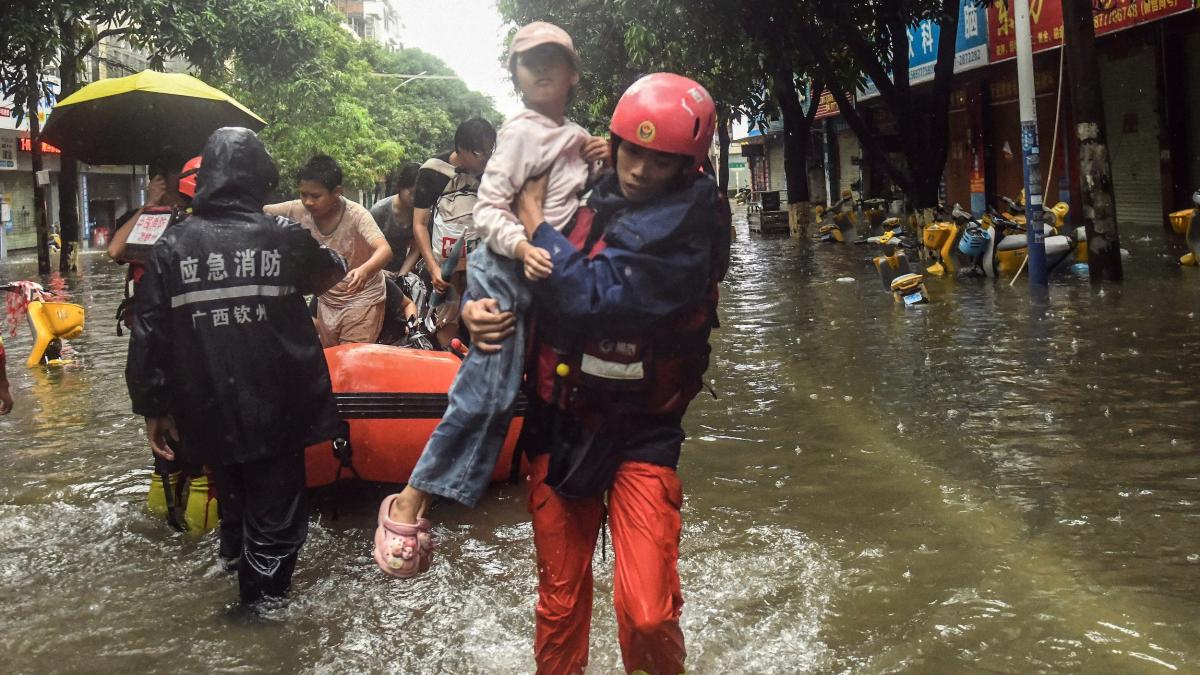
On Sunday (July 5), heavy rain began in Renhe Village, Gantang Town, Binyang County, Guangxi Zhuang Autonomous Region in southern China. Villagers were used to such weather. However, the rain did not stop, and water levels suddenly rose rapidly. By early Monday morning, floodwaters had reached knee-height; by daylight, the first floors of homes were completely submerged. "The water was extremely violent and came too quickly. Many people didn't even have time to grab food when they fled," a villager surnamed Zhou from Renhe Village told BBC. Ms. Zhou's family is among the tens of thousands displaced in Guangxi. Typhoon 'Maysak' (known as Typhoon Meisha in Taiwan) swept through the region over the weekend, causing rivers to overflow and dam embankments to burst. At least four people have died. The storm caused widespread flooding in Nanning City and surrounding villages, forcing some residents to wait for rescue on rooftops. The storm also triggered thunderstorms hundreds of kilometers away in central Hubei Province, even spawning tornadoes. Official media reported at least 17 deaths, hundreds injured, and tens of thousands evacuated. The destruction caused by days of extreme weather prompted Chinese President Xi Jinping to order full-scale disaster relief efforts. In China, widespread flooding due to typhoons at this time of year is not uncommon, and Maysak is the first typhoon to make landfall in China in 2026. Official media described its characteristics as "sudden and with strong short-term winds." According to forecasts, another storm—super typhoon 'Bavi'—is currently crossing the Pacific and is expected to hit China's eastern coastal regions later this week. Authorities in Nanning warned that "extremely heavy rainfall" could hinder rescue operations. Experts believe extreme weather linked to climate change is increasingly threatening the lives of Chinese citizens and economic development, especially the multi-trillion-dollar agricultural sector. "We couldn't save everyone" Residents in Guangxi told BBC that thousands remain trapped on rooftops due to the flooding, some in mountainous villages. Official statistics show about 60,000 people have been evacuated, with at least 90,000 affected. Ms. Zhou, currently in another province, said some of her family members remain trapped in their home in Renhe Village with limited food supplies. Her four-month-old niece has gone without milk for over a day. She said: "Other villagers retreated to this side of the road, to higher ground. They've mostly gathered here. But food supplies are nearly exhausted. There are many affected villages, and rescue personnel are insufficient. Our village is now in grave danger." Another woman, surnamed Huang from Yunbiao Town in Hengzhou City, said her village was submerged within just 10 minutes. She said: "Rescuers came, but they couldn't save everyone—there were too few personnel, and the lifeboats they brought were too small and couldn't reach distant areas." She added: "Most people can't contact their trapped family members. The internet and power are down." Official media continuously broadcast footage of rescue workers in life jackets and helmets using inflatable boats to carry out rescues. President Xi Jinping emphasized the need to carry out "injury treatment,安置 of affected people, and disaster prevention and relief work" to improve rescue effectiveness. Some residents also worry about snakes in floodwaters. Official media reported that in addition to wild snakes, the floods caused snakes to escape from some urban snake farms. In China, certain snake species are farmed for traditional medicine, food, and antivenom extraction. Ms. Huang provided BBC with a video from a villagers' WeChat group. The footage shows several residents nervously watching a large black snake slither across a mud-covered floor. View this post on Instagram BBC News Chinese (@bbcchinese) shared a post "Things started flying through the air" Meanwhile, in Hubei Province, at least two tornadoes formed, causing severe damage to multiple cities. Meteorological experts say this was triggered by the collision of cold air from the north and warm, moist air brought by Typhoon 'Maysak' from the south. Official media reported that tornadoes are rare in China, with the last recorded occurrence in 2021. Videos of the wind damage in Ezhou and Huanggang cities spread widely on Chinese social media. One video, reportedly filmed inside a restaurant, shows outdoor tables and chairs being tossed through the air by the tornado, with electrical sparks constantly flashing, and diners screaming in terror. Local media reported that a man in Huanggang, whose high-rise apartment window was shattered by strong winds, was blown out along with his furniture from the 12th floor. He is reportedly now in intensive care at a hospital. A student in Huanggang told BBC he initially thought it was "just a regular thunderstorm" until he saw "things flying through the air" outside his dorm window. He said: "Many students were cut by flying glass. Only when everything finally calmed down did I realize I had just experienced a disaster." Some parts of northern China have also recently experienced extreme weather. Official media reported that on Saturday, flash floods in Tongliao City, Inner Mongolia, killed two herders; record-breaking rainfall in Fushun City led to three deaths. In Fushun, the average rainfall from 01:00 to 07:00 local time "broke historical records." As residents in affected areas wait desperately for aid and rescue, many are most urgently concerned about the safety of their loved ones. Ms. Zhou from Renhe Village said she asked a friend to swim through the floodwaters to check on her relatives. She said: "Someone from our village swam down to check, and from a distance, confirmed that my father and others are currently safe. But they are surrounded by water." However, the whereabouts of an elderly woman and her two young granddaughters living nearby remain unknown. Ms. Zhou said, "Even if someone swims over, they can't see them. Completely invisible." Another young woman, who requested anonymity, told BBC she has been unable to contact her parents in Gantang Town for 24 hours. Her last update was that her parents were sheltering on the third floor of their home, but by then, floodwaters had already reached the second floor. She said: "I can't reach them. I don't know their situation. The last time I contacted them was Monday morning." "I'm just helpless and can't do anything."
FACT BOX
- Source: PR Times
- Category: News