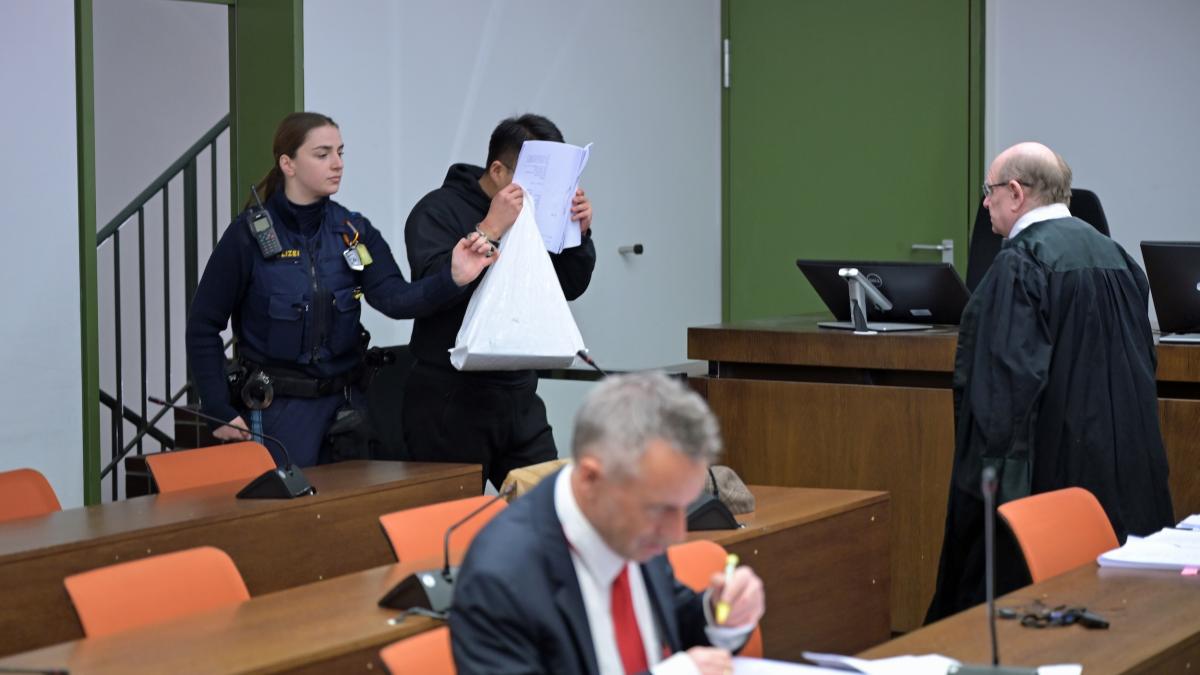
Warning: This report contains descriptions of sexual assault that may be disturbing to some readers. "Most people who read about this will think these people (the perpetrators) must be very scary, right? But actually, they are very normal people in their daily lives." Li Jing (pseudonym), 27, is the first victim in the German Chinese sexual assault case willing to share her experience. Her ex-boyfriend, Tong Z., was one of eight members of the Telegram "German Old Driver Driving School Group"—where members shared experiences and methods of drugging and raping women, and shared images of the crime process. (Note: According to the Berlin Court's request, the defendant's full name is not displayed, referred to as Tong Z.) According to the verdict, Tong Z. started committing crimes in 2019, committing 13 counts of voyeurism and 3 counts of sexual assault over five years, with at least nine victims. He repeatedly took nude images of Li Jing while she was asleep. Li Jing was unaware of the situation until Tong Z. was arrested and contacted by German police. An organization supporting sexual violence survivors told BBC Chinese that victims of drug-facilitated sexual assault, due to their inability to remember the process, experience stronger feelings of loss of control, more anxiety and fear, and find it harder to heal. After learning about the incident, Li Jing could not sleep, could not concentrate on work, and underwent a year of mental treatment. To stabilize her emotions, she had to take medication before the interview. But she still wanted to speak out. Li Jing clearly remembers that in the verdict, Tong Z. told the group members: "80% of women will not speak out after being raped." She wants to break this idea. "For me, what society can do is to expose these things and make them feel ashamed of these things." "This is a matter of probability," Li Jing recalled. "If the police had not asked me about this, I might have almost forgotten this person." In February 2025, she received a call from German police asking for assistance in the investigation. At the police station, she learned that the investigation was related to her ex-boyfriend Tong Z.—he was facing charges of sexual coercion, rape, and drugging. "I was really, really surprised," Li Jing said. The officer showed her photos, and she recognized the naked, sleeping person in the photos as herself. The officer asked her to recall the situation at the time, and Li Jing anxiously said, "I really don't remember." She and Tong Z. had been together since 2021, introduced by friends, and broke up the following year. At that time, Tong Z. was going to transfer to Berlin. In Li Jing's memory, Tong Z. was a clean and considerate boy who cooked, cleaned, and actively kept his distance from other women. "He would also act pitiful in front of me, send very cute emoticons, (I) never thought he was such a person," Li Jing said. Tong Z. is 26 years old, from Chengdu, Sichuan. He went to Germany to study in 2015 and was arrested in December 2024. According to the verdict provided by the Berlin First Court, he repeatedly took photos of women while they were sleeping or taking a bath and once drugged and raped a woman with mild mental disabilities. When Berlin police arrested him, they seized over 2TB of image data, condoms, women's underwear, syringes, and various prescription drugs from his residence. This was completely different from the Tong Z. in Li Jing's memory. After leaving the police station, Li Jing kept recalling her interactions with Tong Z. She checked their previous chat records and asked mutual friends: In their eyes, what kind of person was Tong Z.? In the verdict, Tong Z. confessed that he had no close friends, "Most of my free time is spent alone." He described himself as self-secluded, deliberately avoiding building intimate social relationships with others. However, in reality, he seemed not to be like that. 26-year-old Xiao Qing (pseudonym), who went to Germany in 2015, was Tong Z.'s language classmate. The two once shared an apartment with other Chinese students and saw each other every day. She recalled to BBC Chinese that Tong Z. was a bit shy but loved to smile, actively socialized, and was good at cooking, "He had a good relationship with everyone." But this might only be one side of Tong Z. In the "Old Driver" Telegram group, Tong Z.'s nickname was "God by day, devil by night." He privately chatted with group administrator Zhang DaPeng, claiming to have raped at least 18 women and stating that when the unconscious victims resisted during rape, he would become "extremely excited"—the more they resisted, the higher his sexual desire would rise. Magdalena Gebhard is the representative lawyer for one of the victims in Tong Z.'s case. She has previously handled multiple sexual violence cases but described to BBC Chinese, "I have never seen such large-scale, such blatant misogyny." "You can see the details, see how they talk about women. They treat women as a piece of meat, an object to discuss, and even do not treat them as human beings," Gebhard said. The Berlin District Court also described Tong Z.'s attitude as a disregard for women's personal dignity. Initially, Li Jing thought this was just Tong Z.'s personal crime, but as Zhang DaPeng's case was exposed and more people were arrested, she realized this was an "organized gang operation." A friend comforted Li Jing: "Be careful when looking for a partner next time." Li Jing felt secondary harm and took a long time to sort out her emotions. She realized that victims cannot avoid this by being careful. "This is a matter of probability. There is such a person in the crowd, and you might encounter him." Drug-induced amnesia brings a strong sense of loss of control. After learning about the incident, Li Jing's emotions often fluctuated. She could not sleep, could not concentrate on work, "I can't help thinking about this, can't help (go online) searching for this, and it occupies a lot of my time and energy." The psychiatrist told her that her nervous system was in an excited state. Li Jing forced herself to do yoga to escape reality during focused time. The service manager of the Hong Kong Sexual Violence Crisis Support Center "Wind and Orchid" told BBC Chinese that victims of drug-facilitated sexual assault, due to the loss of memory of the process, experience more anxiety and fear compared to general sexual assault victims. She explained that one way for survivors to repair trauma is to heal by telling their own stories, but victims of drug-facilitated sexual assault, due to their inability to remember what happened, experience a strong sense of loss of control. If the private images they were secretly filmed are spread, the victims will fall into a "never-ending state of fear." In 2022, a study on trauma caused by drug-facilitated sexual assault in the "European Journal of Psychological Trauma" further explained that the reason memory loss causes survivors to feel pain is that they repeatedly imagine the worst possible scenarios that could have occurred during the violation. The study pointed out that survivors will also feel "extreme shame, guilt, and self-blame" for not noticing the drugging situation, which will affect their ability to build intimate relationships with others in the future. In another case involving the main culprit Zhang DaPeng, the verdict mentioned the psychological state of many victims, and their trauma also became a factor for the court to increase the penalty. Zhang DaPeng had drugged and raped the same victim four times. The verdict stated that the victim, after learning of the crime, "often cried, suffered from insomnia, lack of concentration, fatigue, and lack of energy," and was always worried about whether the defendant had spread her nude images. Another victim had an 11-month-old baby. According to the verdict, during Zhang DaPeng's sexual assault, the victim's daughter was always by her side and woke up twice. But due to the influence of drugs, the victim was unaware of being sexually assaulted until the police notified her. The verdict pointed out that the victim had a huge sense of shame afterwards. She did not want to confide in friends or family, did not want to accept professional help. She blamed herself for not being able to fully protect her daughter; and worried that Zhang had given drugs to her daughter, fearing that the German Youth Welfare Bureau would "take her daughter away" after knowing. This victim now goes to work and takes care of her daughter as usual, but she suffers from severe sleep disorders. She said her life would never return to the state before the incident. Over a year since the incident was exposed, Li Jing is still undergoing mental treatment, but for her, this is an "active" act. "I don't want this thing to have too much impact on my life...... It may change my view on some things, but it should not dominate my life decisively." The Tong Z. case went to trial in the middle of 2025, and Li Jing has been closely following it. She looked up many similar news stories, and among them, she saw the case of Gisèle Pelicot from France. For many years, Gisèle's husband repeatedly drugged her and incited dozens of men to rape her. Gisèle eventually chose a public trial, letting everyone see her and the perpetrators. Gisèle once said, "I want to reverse the shame." Li Jing very much agrees, "This is something that Tong Z. has to reflect on and face every day, not me." But she understands that not every girl can be as brave as Gisèle, "think it through," "For young girls, this is a very......"
FACT BOX
- Source: PR Times
- Category: 社会問題