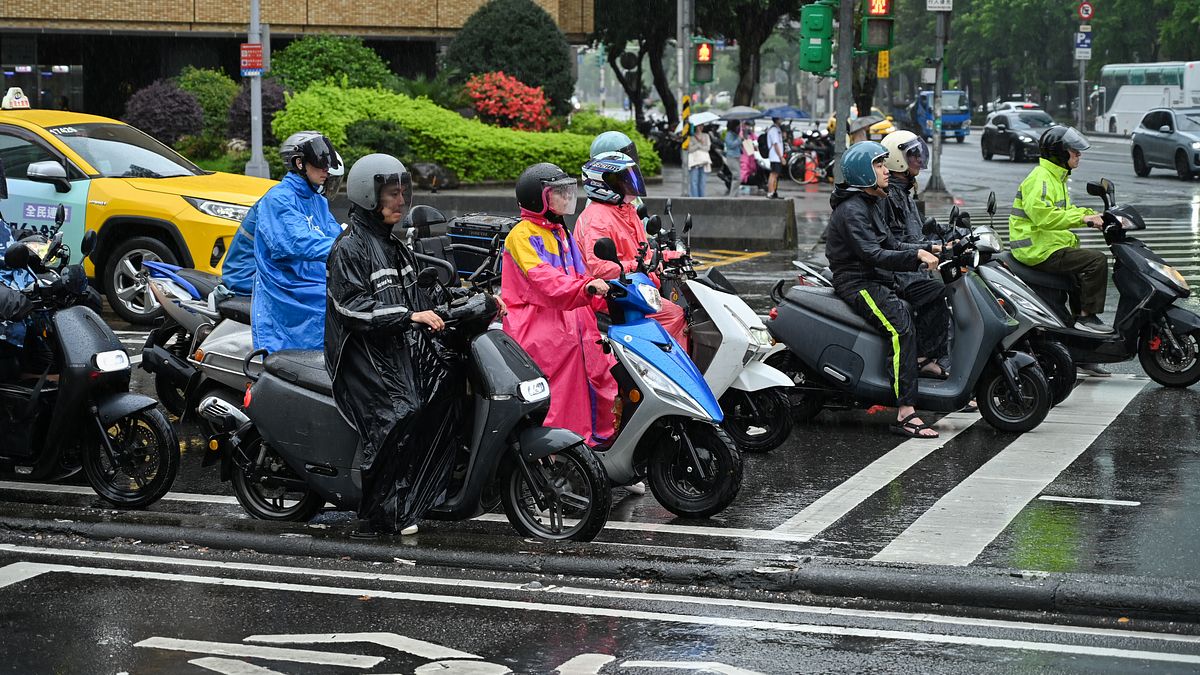
The threat from the powerful Typhoon Bavi continues to escalate. The Central Weather Bureau has officially announced that a sea typhoon warning will be issued at 2:30 PM today (9th), with a land warning expected tomorrow morning. As the typhoon's storm zone approaches northern Taiwan, the public's top concern is whether there will be a typhoon holiday tomorrow. In response, New Taipei City Mayor Hou You-ih provided a specific timeline today. He emphasized that Keelung, Taipei, New Taipei, and Taoyuan—forming a shared living zone—will use a joint decision-making platform to conduct thorough data-driven discussions and cross-jurisdictional coordination, with a final decision to be announced to citizens by 8 PM tonight. Hou stressed that the city government's immediate priority is to fully implement typhoon preparedness and minimize potential damage.
New Taipei and Taipei have a well-established decision-making mechanism for work and school suspension. Hou, reflecting on his 16 years of disaster response experience, stated clearly regarding the current forecast for Typhoon Bavi: "We will use the Ji-Bei-Bei-Tao platform to conduct full discussions and communication, and officially report our decision to the public by 8 PM."
The city's typhoon response team is closely monitoring Bavi's latest path and impact minute by minute, preparing comprehensively for potential urban disasters caused by strong winds and heavy rainfall.
To prevent a repeat of the flooding disaster caused by Typhoon Saudel, Mayor Hou personally visited Wanli and Jinshan this morning to supervise river dredging and flood control work. He acknowledged that Typhoon Bavi is approaching with great force, and its massive wind field will bring extreme winds and torrential rains to northern Taiwan—precisely why New Taipei City must act in advance and closely monitor local typhoon preparedness.
Hou pointed out that Wanli and Jinshan suffered severe flooding during Typhoon Saudel. Rivers such as Yuantan Creek, Jinbaoli Creek, and Huangxi were overwhelmed by sudden downpours, causing floods to engulf homes and roads. Although post-disaster reconstruction projects are "mostly complete," long-term river整治 projects are still under procurement and construction. Therefore, Hou visited Yuantan Creek and Maleng Creek today to inspect typhoon preparedness and the latest progress in river dredging, urging full sediment removal to minimize damage from Typhoon Bavi and ensure the safety of citizens' lives and property.
Q: What are the criteria for typhoon-related work and school suspension? According to the Executive Yuan's "Regulations on Suspension of Work and Classes During Natural Disasters," local governments base their decisions not solely on whether a typhoon makes landfall, but on a comprehensive assessment of weather forecasts, actual disaster conditions, and traffic safety. Key criteria include: Wind criteria: If, within 4 hours, the typhoon's storm radius is forecasted to pass through an area with average wind speeds of Beaufort 7 or higher, or gusts of Beaufort 10 or higher. Rainfall criteria: If rainfall reaches the thresholds set by each county/city and has caused or may cause disasters. Special circumstances: Even if wind and rain do not meet the above standards, local governments may still legally suspend work and classes if terrain, transportation disruptions, flooding, or landslides pose safety risks.
Q: Who decides on work and school suspension? Decisions for public agencies and schools within each county (including special municipalities) are generally made solely by the respective county mayor. However, due to vast geographical areas where mountainous and flat regions may experience vastly different weather, counties may flexibly authorize township, town, or city mayors to make local decisions.
Q: When are suspension announcements made and how are time periods defined? Announced by 10 PM the previous night: "Full-day suspension" runs from midnight to 11:59 PM; "morning suspension" from midnight to the end of morning classes. Announced by 4:30 AM on the day: "Full-day suspension" starts at 8 AM and ends at 11:59 PM; "morning suspension" from 8 AM to the end of morning classes. Segmented suspension: "Afternoon suspension" runs from the usual afternoon start time (typically 1:30 PM) to 11:59 PM; "evening suspension" from 6 PM to 11:59 PM.
Q: What if work/school suspension decisions differ between residence and workplace/school? If any one of the following—residence, commute route, or workplace/school location—announces suspension, the individual may legally refrain from attending.
Q: Do employees receive pay during typhoon leave? Under current Taiwanese regulations, typhoon leave is classified as a "temporary work stoppage due to force majeure." Therefore, the law does not mandate employers to provide paid leave during typhoon holidays. In other words, if employees choose not to come to work due to safety concerns, employers are legally allowed to withhold that day's wages. However, while employers may withhold wages for safety-related absences, they must not deduct full-attendance bonuses, reduce salaries, mark absences as unexcused, or count the day as personal leave.
Civil Service Agency Work/School Suspension Information: https://www.dgpa.gov.tw/typh/daily/nds.html
FACT BOX
- Source: PR Times
- Category: News