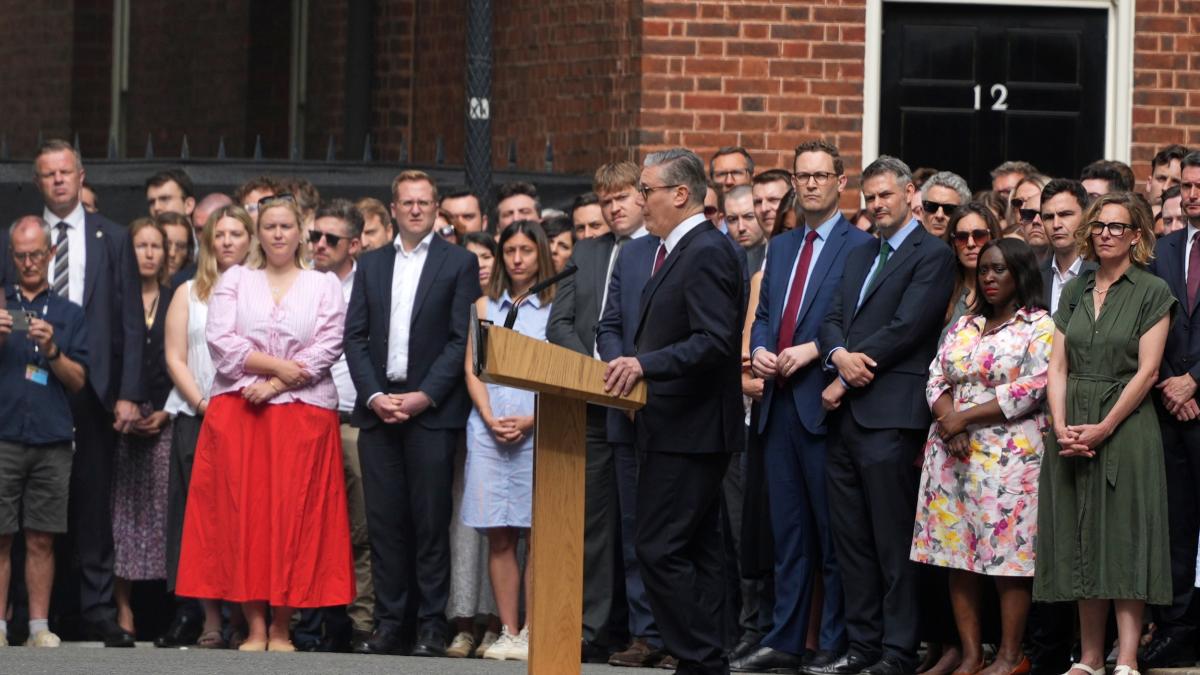
The UK is about to welcome yet another new prime minister. Since the Brexit referendum, political stability has been elusive, and national strength has continued to decline. Six years have now passed since the UK formally left the EU, and recent public opinion shows a clear shift. According to the latest YouGov poll from June, 55% of Britons now support rejoining the European Union, compared to 34% who oppose it—a net support of 21%. If a new government were genuinely interested, could the UK rejoin the EU?
Article 49 of the Treaty on European Union states that any European country meeting the criteria can apply to join. In theory, the UK is not permanently disqualified due to its previous departure. By submitting a new application, it could restart the entire accession process—potentially not much slower than Ukraine’s current path.
Yes, it would be a reapplication—not a simple return. Some in the UK naively believe that, as a former member, rejoining would be like 'coming home,' with past status automatically restored. However, the EU treaties do not provide for 'restoration of membership.' The UK would have to go through the full accession process again.
The EU requires new members to meet criteria including democracy, rule of law, human rights, a market economy, and the capacity to implement all EU laws. For many candidate countries, fulfilling these conditions involves long and difficult reforms. For the UK, most of these are not an issue. But this does not mean the path is obstacle-free—it would be a naked diplomatic bargaining game.
First, any new member must gain unanimous approval from all 27 existing member states. France, Spain, Ireland, Hungary—each has veto power. Every government could use the negotiations to extract maximum concessions for its own national interests.
More importantly, the UK cannot assume it will regain all its former special privileges. Before Brexit, the UK was the EU’s most independent member: it retained the pound, did not join the Schengen Area, and enjoyed a budget rebate negotiated during the Thatcher era. These were the results of decades of political compromise, not automatic rights. The UK once had the leverage to demand such exceptions, but if it reapplies tomorrow, the EU has far less incentive to offer them.
Put differently: if a country can leave the EU for years and then return without cost, retaining all prior rights, other members will rightly ask: What is the cost of leaving? How is stability maintained? Should there be no penalty? In international relations, the concept of 'credible commitment' matters. A country is only a reliable partner if others believe its promises will hold over time. But does the current UK government still have that credibility? If not, why should the EU grant exemptions?
Looking deeper at the polls, there’s a revealing detail. While net support for rejoining stands at +21%, and 57% of Britons now believe the 2016 Brexit decision was wrong, support drops to 35%—and opposition rises to 43%—if rejoining requires giving up past privileges like keeping the pound or staying out of Schengen. The +21% becomes -8%. If the UK government rashly pushes for rejoining without securing favorable terms from the EU, it risks both diplomatic failure and public backlash. Escaping the current gloom will not be easy.
*The author is a Hong Kong-based scholar of international relations and currently an Associate Professor at the Center for Taiwan-Hong Kong International Studies, National Sun Yat-sen University.
FACT BOX
- Source: PR Times
- Category: Survey