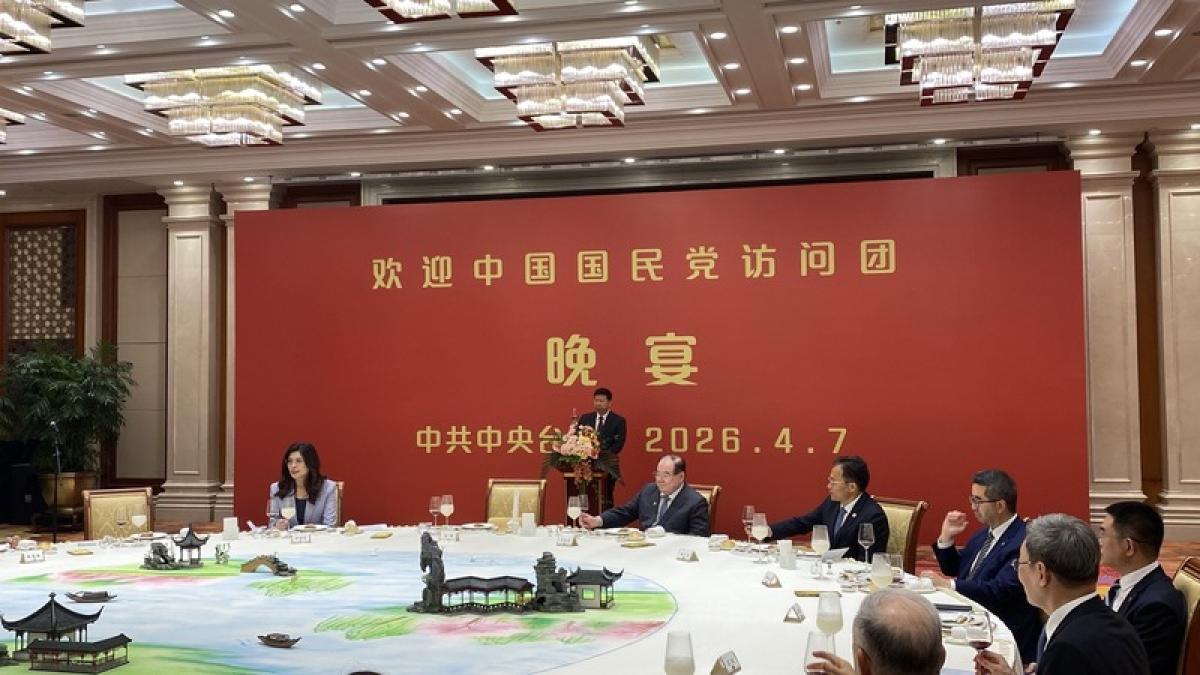
It has been three months since Kuomintang (KMT) Chairperson Cheng Li-chun led a delegation to visit mainland China. At the time, Cheng raised the banner of cross-strait peace, and her proposed 'peace framework' received a positive response from Beijing's top leadership. In response, the mainland announced a series of 'Ten Measures for Taiwan,' briefly injecting a thawing hope into the frozen cross-strait relations. However, as time has passed, this highly anticipated 'peace framework' remains a castle in the air, with no tangible cross-strait benefits felt by the public or grassroots industries. Frankly speaking, the external reason for its lack of effectiveness lies in the DPP government's deliberate obstruction and passive handling. The ruling authorities, adhering to the political correctness of anti-China resistance, have adopted a stance of non-action, non-cooperation, and non-dialogue toward the ten measures released by the mainland, even labeling them as a 'united front conspiracy,' causing all projects involving public authority negotiations to stall completely. However, the KMT cannot entirely shift the responsibility onto the ruling party. As time goes on, scholars and public opinion have begun to scrutinize this 'peace framework' and have identified its fatal flaw: the lack of a complete narrative and actionable implementation methods. If there is only a grand vision without a practical path, the peace framework will ultimately become nothing more than a political slogan. Facing the cross-strait crisis and public anxiety, the KMT, as the largest opposition party, cannot remain content with merely performing ceremonial gestures during its visits to the mainland but must demonstrate responsible party strength. To this end, the author proposes the following four concrete suggestions, hoping the KMT can deepen and implement this peace framework. First, promote unilateral openness by the mainland and deepen grassroots social communication. Regarding the ten measures for Taiwan proposed by the mainland, since the DPP government is unwilling to cooperate, the KMT should adopt a 'dual-track advancement' strategy. First, actively urge the mainland to 'implement first' measures that do not require Taiwan's official authority and fall within the mainland's unilateral jurisdiction, to demonstrate sincerity. Scholars generally recommend that the mainland prioritize the following three unilateral openings: Fully simplify approval processes for Taiwanese business operations and employment; fully implement mutual recognition of Taiwan Compatriot Passes and mainland resident ID cards in public service systems (such as high-speed rail, hospitals, electronic payments), eliminating cumbersome manual verification. Expand cross-strait youth internship and entrepreneurship subsidy mechanisms: unilaterally lower the thresholds for Taiwanese youth applying for scientific research funds and cultural-creative subsidies. Unilaterally ease green channel customs clearance for high-quality Taiwanese agricultural, fishery, and food products: implement more favorable inspection and quarantine standards at specific ports to directly benefit Taiwanese farmers. As for items involving cross-strait public authority where the DPP refuses to cooperate (such as full resumption of flight routes and mainland tourists visiting Taiwan), the KMT should not remain passive but should transform passivity into proactivity, actively engaging with domestic shipping associations, tourism industry associations, agricultural and fishery associations, and grassroots citizens. By directly communicating with them, the KMT can convert the genuine public desire for exchanges into concrete policy recommendations and collectively pressure the DPP government to break the deadlock of 'no official contact, marginalization of civilians.' Second, eliminate distrust and fear by establishing military and international space norms. The long-standing 'distrust' and 'fear' among the Taiwanese people toward the mainland regime is the greatest obstacle to cross-strait peace, rooted in the suppression of international living space and the normalization of military threats across the Taiwan Strait. If the KMT wants to establish a peace framework, it must directly confront this pain point. Regarding international living space, the KMT should systematically compile, through think tanks, a list of international non-governmental organizations (NGOs) that are not under UN jurisdiction and do not involve sovereign state status. Examples include humanitarian organizations related to the Red Cross, international single-sport federations, non-governmental environmental and medical rescue organizations, etc. The KMT should use this list to negotiate with the mainland and relevant NGOs/NPOs, urging the mainland to demonstrate the magnanimity of a great power by ceasing obstruction and granting Taiwan more international exchange space without involving sovereignty disputes, allowing Taiwan's professional capabilities to contribute internationally. On military security, facing the normalization of Chinese military exercises, joint combat readiness patrols, and military aircraft and vessels routinely crossing the median line and circling Taiwan, the KMT must express serious concern to the mainland and propose concrete military conduct norms. For example: Advocate establishing a civilian 'military security early warning mechanism' across the strait: through think tanks or retired generals, establish unofficial dialogue channels to promote 'non-confrontation, non-provocation, no targeting' conduct rules when military aircraft and vessels encounter each other in the public seas and airspace of the strait. Push for establishing 'buffer safety zones' for military exercises: require the mainland to proactively avoid sensitive airspace near the median line and important sea lanes around Taiwan during exercises and combat readiness patrols, reducing the risk of accidental clashes and spiraling hostility. Third, ensure academic exchange safety and eliminate fears of personal freedom. Academic exchanges are a bridge for mutual understanding between the two sides, but in recent years, scholars and students from both sides have frequently faced political interpretations and security threats during exchanges, causing a chilling effect. The KMT should propose concrete suggestions and strongly urge both governments to prioritize the 'protection of personal safety for academic and civilian exchange personnel' as the top底线. Both sides should establish mutual notification and legal assistance mechanisms. Regardless of whether in Taiwan or the mainland, scholars engaged in normal academic fieldwork, historical data review, or conference speeches should have their personal freedom and freedom of speech institutionally protected. Under no circumstances should either side infinitely expand academic views into national security threats. Only then can healthy dialogue among intellectuals on both sides be restored. Fourth, expand cultural, educational, and sports exchanges and oppose 'entrapment-style' law enforcement. Cultural, religious, and sports exchanges belong to the least politically sensitive yet most emotionally unifying areas for grassroots people on both sides and should be granted the greatest tolerance and freedom. However, both sides have currently erected high legal barriers: Taiwan has the 'National Security Act' and 'Anti-Infiltration Act,' while the mainland has the 'Anti-Secession Law' and 'Ethnic Unity Law,' causing cultural and religious groups and young students traveling between the two sides to live in fear. The KMT must issue a stern appeal to the ruling authorities on both sides: do not use national security as an excuse to infinitely expand legal interpretations and harm innocent exchange personnel. More importantly, the principle of the rule of law lies in 'predictability.' If either side believes certain exchange activities are illegal, they must provide clear, public regulations and guidance 'in advance,' rather than using the malicious 'entrapment' or 'retrospective punishment' approach—allowing relevant individuals to enter smoothly and then arresting or restricting their departure without warning. Such law enforcement practices will completely destroy the remaining trust between the two sides and push public sentiment further apart. Learn from historical experiences to construct the theory and timeline of a peace framework. From world history, peaceful coexistence or integration after national division has never been achieved overnight. Whether it is the 'Basic Treaty' between East and West Germany during the Cold War or the turning point from confrontation to peace agreements between North and South Korea, they all prove that peace must be built on a theoretical framework of 'acknowledging reality, shelving disputes, and institutional engagement.' If Cheng Li-chun's peace framework is to be convincing, it must draw from these historical experiences, construct a complete 'peace theory framework,' and propose clear short-, medium-, and long-term approaches and goals: Short-term approach (functional integration, 1-2 years): Aim for 'civilian-first, livelihood-priority.' Implement the above-mentioned unilateral openings for grassroots agriculture, fisheries, and youth employment across the strait; promote regular, unrestricted exchanges between religious and cultural circles; restore mutual trust in academic and youth exchanges across the strait and establish an academic safety net. Medium-term negotiation (institutional construction, 3-5 years): Aim to 'reduce military risks and expand international participation.' Promote civilian military safety conduct rules across the strait to reduce the frequency of aircraft circling Taiwan; facilitate Taiwan's participation as a non-governmental organization or observer in non-UN international economic, trade, and professional organizations; jointly develop non-political legal mutual assistance and economic and trade dispute arbitration mechanisms across the strait. Long-term goal (constructing a peace agreement and co-prosperity framework, over 5 years): On the basis of accumulating sufficient mutual trust, construct a 'cross-strait co-prosperity framework.' Without changing Taiwan's democratic and free system and respecting the will of the Taiwanese people, formally sign a cross-strait peace agreement to ensure permanent peace in the Taiwan Strait through institutionalized treaties, end the state of military confrontation across the strait, and achieve the historic goal of mutual benefit and win-win outcomes. Cross-strait peace is not begged for, nor shouted into existence with slogans. Three months after Cheng Li-chun's visit to the mainland, this peace check must not become a bad debt. The KMT must shoulder the opposition party's responsibility for discourse, elevating the 'peace framework' from an idea to an actionable white paper. By actively negotiating unilateral openings with the mainland, fighting for military security and international space for Taiwan, ensuring the safety of civilian exchanges, and proposing a clear short-, medium-, and long-term blueprint, the KMT can truly convince the Taiwanese people: the KMT's peace framework is a truly viable, visible, and beneficial path to cross-strait redemption. *Author is a retired teacher
FACT BOX
- Source: PR Times
- Category: News