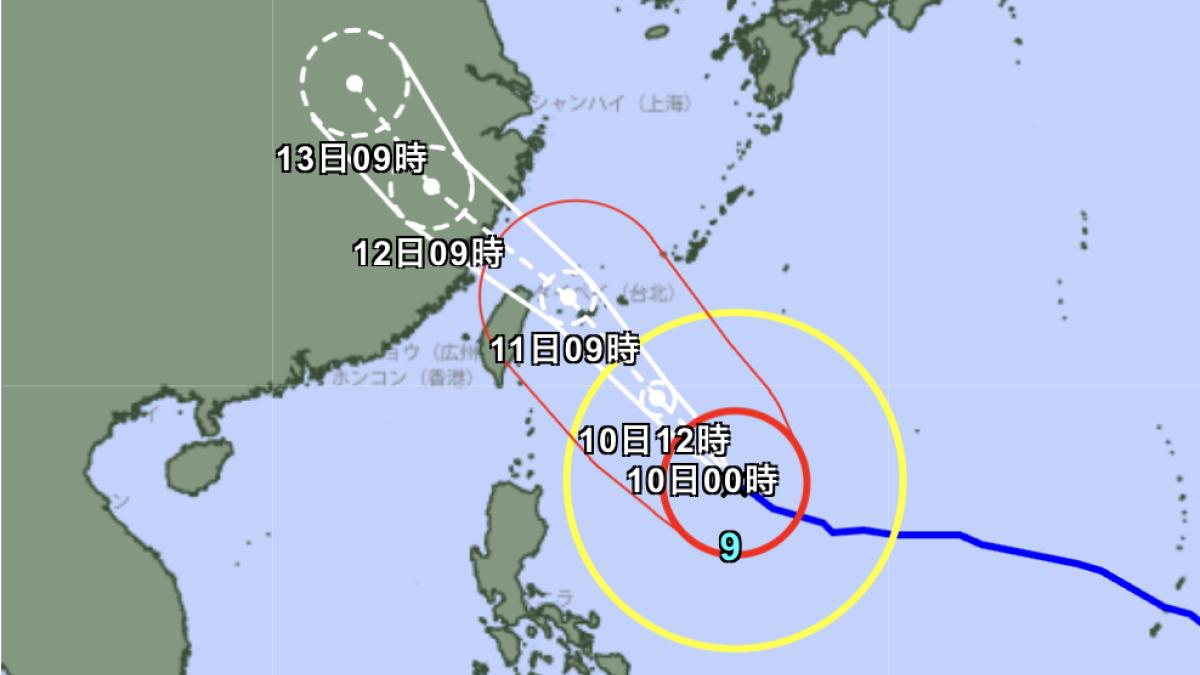
Typhoon Bavi (Typhoon No. 9), with a circulation diameter of up to 1,000 kilometers and classified by the Japan Meteorological Agency as a 'large and intense typhoon,' is predicted to 'strike directly' the waters off northern Taiwan and the Okinawa region. Ishigaki Island, Miyako Island, and Yonaguni Island will approach the storm’s danger zone on the 10th. Taiwan’s Central Weather Administration emphasized to Reuters that, in terms of wind field and storm size alone, Bavi will be the largest typhoon to hit Taiwan in nearly four decades.
Reuters reported on the 9th that although Bavi slightly weakened overnight, sustained wind speeds near its center still approach 200 km/h. Due to Bavi’s exceptionally large wind field, meteorological agencies worldwide have issued urgent warnings urging residents to stock up on supplies. U.S. commercial weather forecasting firm AccuWeather and other experts warn this storm could become the most destructive super typhoon in the Asia-Pacific region since Typhoon Kong-rey in 2024.
Taiwan’s Central Weather Administration told Reuters that Bavi could be the largest storm to approach Taiwan’s vicinity since 1987, noting that typhoons of such massive scale have been extremely rare in recent years. China’s National Meteorological Center (NMC) predicts the typhoon, roughly the width of France, will pass over the sea north of Taiwan before making landfall along the Fujian coast on the evening of the 11th.
Citing academic perspectives, Reuters highlighted that China, Japan, and Taiwan are increasingly exposed to destructive extreme weather. The anticipated return of El Niño in 2026 could further elevate sea temperatures, potentially triggering more frequent and intense typhoons. Jason Nicholls, an expert at AccuWeather, warned: 'Although Bavi’s wind speeds have slightly decreased, it remains an extremely threatening and dangerous storm during its impact on Taiwan and eastern coastal China from the 10th to the 13th.'
Suao Fishing Port Overcrowded, Japan Airlines Cancels Okinawa Flights
With the danger zone approaching, Suao Port in northeastern Taiwan has taken on a wartime atmosphere, with thousands of fishing boats crowding the harbor to take shelter. Local residents are lining up to collect sandbags from municipal authorities, while farmers rush to harvest their first rice crop before heavy rains arrive.
Chen Ming-hui (Chen Ming-hui, phonetic translation), a 60-year-old captain of a 3-ton fishing vessel, told Reuters while inspecting his boat’s anchor lines at the harbor, 'I hope the typhoon’s path shifts further north, avoiding a direct hit on Taiwan.' Recalling past devastating storms, he said floods had submerged the town and even sunk fishing boats. 'Don’t be fooled by the current good weather—this kind of massive typhoon is the most terrifying.'
The Japan Meteorological Agency (JMA) has issued strong warnings for the Sakishima Islands in Okinawa Prefecture, including Miyako, Ishigaki, and Yonaguni Islands, advising residents to prepare for potentially destructive conditions from Friday (10th) to Saturday (11th), including violent winds capable of collapsing homes, landslides, flooding, and storm surges. Coastal areas must remain vigilant against massive waves up to 10 meters high. Japan Airlines (JAL) announced it has preemptively canceled 48 domestic flights on July 10 (Friday) connecting Naha, Miyako, and Ishigaki airports in Okinawa with Kagoshima and its outlying islands, affecting an estimated 7,610 passengers.
Dr. Xiangbo Feng of Imperial College London analyzed: 'We must remain highly vigilant toward Bavi. It lingered over the open Pacific for an extended period, intensifying by absorbing vast energy from warm seawater and accumulating enormous moisture.' Dr. Feng emphasized: 'The destruction it could cause upon landfall or near-coastal approach could be catastrophic. Even a minor deviation in Bavi’s path could result in significantly different impacts across regions.'
China Recently Hit by Typhoon Maysak
Prior to Bavi’s arrival, China was struck by Typhoon Maysak (known as Typhoon Meisa in Taiwan). Maysak ravaged Guangxi, with its residual circulation even triggering inland tornadoes in Hubei Province. According to Chinese state media, flooding caused by Maysak submerged Guigang Zoo in Guangxi, leading to over 100 animals escaping en masse. Escaped animals included two zebras, four porcupines, dozens of parrots, two North American raccoons, and eight pheasants.
China’s state-run Global Times reported that three lions at Guigang Zoo drowned, though villagers successfully rescued a sika deer. While brown bears and wolf packs narrowly avoided drowning, their health conditions have severely deteriorated after the floodwaters receded.
FACT BOX
- Source: PR Times
- Category: News
- Organizations: AccuWeather