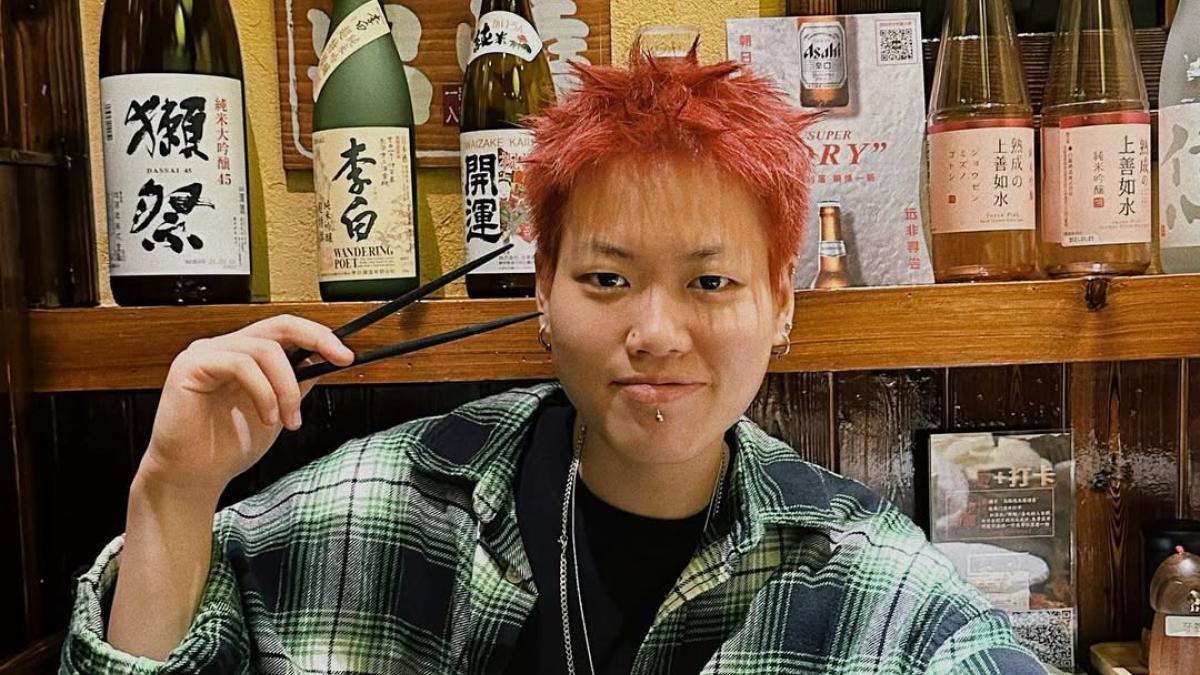
"Should Chen Tudou win a Cross-Strait Peace Award?" — In March this year, Taiwanese netizens were abuzz discussing a Chinese social media star. Chen Tudou, 26, known for her exaggerated facial expressions and humorous short videos, has gradually risen from mainland Chinese platforms to fame in Taiwan. Her Instagram account now has nearly one million followers. Last year, she released her single "Ms. Potato," a catchy tune that quickly spread among young people in Taiwan.
Her online popularity has translated into real-world events. In June, Chen Tudou was invited to perform at the Taichung Spring Wave Music Festival, and in early July, she held her first fan meeting in Taipei. However, public sentiment began to shift. Many netizens raised questions, pointing out that China has been cracking down on LGBTQ+ communities — even banning citizens from attending Pride parades abroad — yet Chen Tudou was allowed to travel to Taiwan for events. This has led to speculation that she may be on a 'united front' mission.
BBC Chinese interviewed fans and scholars in Taiwan to understand why Chen Tudou is popular and why this Chinese LGBTQ+ influencer faces skepticism amid tense cross-strait relations.
Who is Chen Tudou?
Chen Tudou, whose real name is Chen Xiaozhen, was born in 1999 in Shanwei, Guangdong, China. Her signature look includes wide eyes and pouting lips. In her short videos, she often dances with exaggerated expressions, acts out everyday scenarios, and comically reenacts scenes from TV dramas. One of her most famous clips parodies online influencer Zhou Yuan’s advice on how to “send your gaze outward” and “form an X with your body” to attract men. That video has been viewed over 11 million times on Instagram.
Kobe (pseudonym), a 21-year-old university student from Taipei, has been watching Chen’s videos for three years. He doesn’t consider himself a “super fan,” but says he always stops to watch and like her content when it appears on his feed. “It’s that kind of ‘dry meme’ (nonsensical humor) vibe,” he says.
Currently, Chen Tudou has over 1.4 million followers on Douyin (TikTok’s Chinese version) and over 960,000 on Instagram. In an interview with a Taiwanese entertainment outlet, she said that before becoming a content creator, she worked behind the scenes as a director, taught dance, ran a street stall, and delivered food. She began filming videos during her lunch breaks, handling everything from shooting to posting by herself.
Some Taiwanese netizens feel a sense of familiarity with Chen Tudou — her mannerisms resemble those of popular Taiwanese entertainer Xia S, and her accent even sounds Taiwanese. In the comments under her interview video, users wrote, “She speaks so Taiwanese,” and “I can’t believe she’s not from Taiwan.” Some note that she’s from the Chaoshan region, whose dialect shares tonal similarities with Taiwanese Hokkien.
In March, Chen Tudou released her single "Ms. Potato," which sparked a viral trend on Taiwanese social media. The repetitive, catchy rhythm paired with dance moves earned her many fans in Taiwan. The song was even covered by Taiwanese celebrity Hsin-Ya An, the Passion Sisters cheerleading squad of the CTBC Brothers baseball team, and the Japanese dance group Avantgardey, further boosting her visibility.
As the song gained popularity across the strait, a Taiwanese netizen on Threads wrote: “Shouldn’t Chen Tudou win a Cross-Strait Peace Award?” The post received over 90,000 likes, with one comment noting, “She always replies to Taiwanese fans in traditional Chinese characters.”
Is Her LGBTQ+ Persona a United Front Tool?
But in April, when Chen Tudou was announced as a performer at the Taichung Spring Wave Music Festival, online discussions began questioning her background and motives — particularly her identity as an LGBTQ+ creator.
Fan Kobe says Chen not only makes him laugh but also changed his stereotypes about lesbians. “I used to think ‘T girls’ (tomboys) were arrogant and impolite, but Chen Tudou is the complete opposite — she’s full of contrast.”
Chen Tudou has never explicitly stated her sexual orientation in her videos, but with her buzz cut, androgynous style, and frequent collaborations with other queer creators — such as videos of best friends gossiping or checking out hot guys — her identity is clear. On her social media, she has also shared photos celebrating anniversaries with her girlfriend.
Yet some Taiwanese netizens are skeptical. “In China, just talking about LGBTQ+ rights gets your account banned, yet they allow an influencer to export a ‘queer IP’ overseas to attract Taiwanese attention. Isn’t the political agenda obvious?”
Deng Zinuo, a 21-year-old Chinese LGBTQ+ rights activist now in Canada, told BBC Chinese that as a transgender person, she has witnessed China’s increasing suppression of LGBTQ+ voices since 2021. Yet Chen Tudou’s public LGBTQ+ account “survives and thrives,” even allowing overseas travel. “This itself is a phenomenon that needs explaining,” she said.
In July 2021, multiple LGBTQ+ student groups’ WeChat public accounts at Chinese universities were shut down, and content deleted. LGBTQ+ NGOs were forced to rename themselves, removing the word “tongzhi” (comrade). In 2023, Beijing LGBT Center, China’s largest LGBTQ+ nonprofit, ceased operations due to “force majeure.” In 2025, the LGBTQ+ information platform “Tongzhi Voice,” with nearly 2 million followers, was forcibly renamed on Weibo.
Deng, who started making educational LGBTQ+ videos on Bilibili in 2019, had her account banned in 2021. She was arrested in 2023 on charges of “picking quarrels and provoking trouble” and detained until 2025. She also knows of Chinese friends who attended Pride events in Bangkok and were later questioned by police and schools. BBC Chinese could not independently verify these incidents.
“We’ve personally experienced it — any NGO or independent account, once it reaches a certain scale without aligning with the official narrative, faces bans, censorship, or summonses. An independent IP like Chen Tudou cannot survive without complying with the CCP’s narrative,” she said.
Deng emphasized she isn’t targeting Chen Tudou personally — she’s happy to see LGBTQ+ creators gain attention — but worries that Taiwanese audiences might get the wrong impression: “Do they now think China’s LGBTQ+ environment is actually good?”
In contrast, Taiwan was the first country in Asia to legalize same-sex marriage, and societal acceptance of LGBTQ+ people is relatively high. In 2024, drag queen Nymphia Wind performed at the Presidential Office. According to a 2025 poll by Taiwan’s LGBTQ+ group Rainbow Coalition, over 40% of people have LGBTQ+ friends or family.
Mike, a 28-year-old from Taipei, also watches Chen Tudou’s videos. He says her makeup and style clearly signal her LGBTQ+ identity — and this has slightly changed his view of China. “I vaguely knew about China’s ‘sissification ban’ and restrictions on male idols appearing too feminine, but seeing Chen Tudou continue creating on platforms makes me think maybe China does accept LGBTQ+ artists or influencers. Maybe it’s more open than I thought.”
University student Kobe shares this sentiment. He regularly uses mainland platforms like Xiaohongshu and Douyin and observes that Chen isn’t the only LGBTQ+ influencer — many men dress as women to parody female roles. “I feel like this (LGBTQ+) might not be a big issue there, since they’re not getting arrested.”
Some mainland netizens argue that China allows LGBTQ+ influencers only if they “perform as clowns” — satisfying public curiosity about minorities — not those who advocate for rights.
Chen Yining, Distinguished Professor at National Chengchi University’s College of Communication and International Affairs, said if China is using Chen Tudou as a united front strategy, “the authorities are indeed very smart.”
She explained that China may not tolerate LGBTQ+ influencers who share hard truths or demand rights, but someone like Chen Tudou, who showcases soft power and cultural appeal, is “the most approachable figure for Taiwanese people.” “If she embodies an identity that Taiwanese can认同 (identify with), then her united front power is naturally stronger.” However, Chen emphasized there is currently no evidence linking Chen Tudou to united front activities.
Scholars: Skepticism Is a Democratic, Rational Response
Regarding Chen Tudou’s visit, Mike said he wasn’t surprised — it’s likely arranged by her agency. “As long as it’s legally permitted and she’s here for cultural activities, it shouldn’t be a major issue.”
On the united front debate, Mike said he won’t over-worry but will observe her words and actions after arrival to judge.
Chen Shimin, Associate Professor of Political Science at National Taiwan University, analyzed that Chen Tudou’s fan base, while growing, isn’t “extremely large” yet. Her appeal, he said, is primarily due to her artistic creativity.
He pointed out that her visit was approved by Taiwan’s Mainland Affairs Council and Immigration Agency, and so far, she has not made “any political or united front statements that harm Taiwan.”
FACT BOX
- Source: PR Times
- Category: News