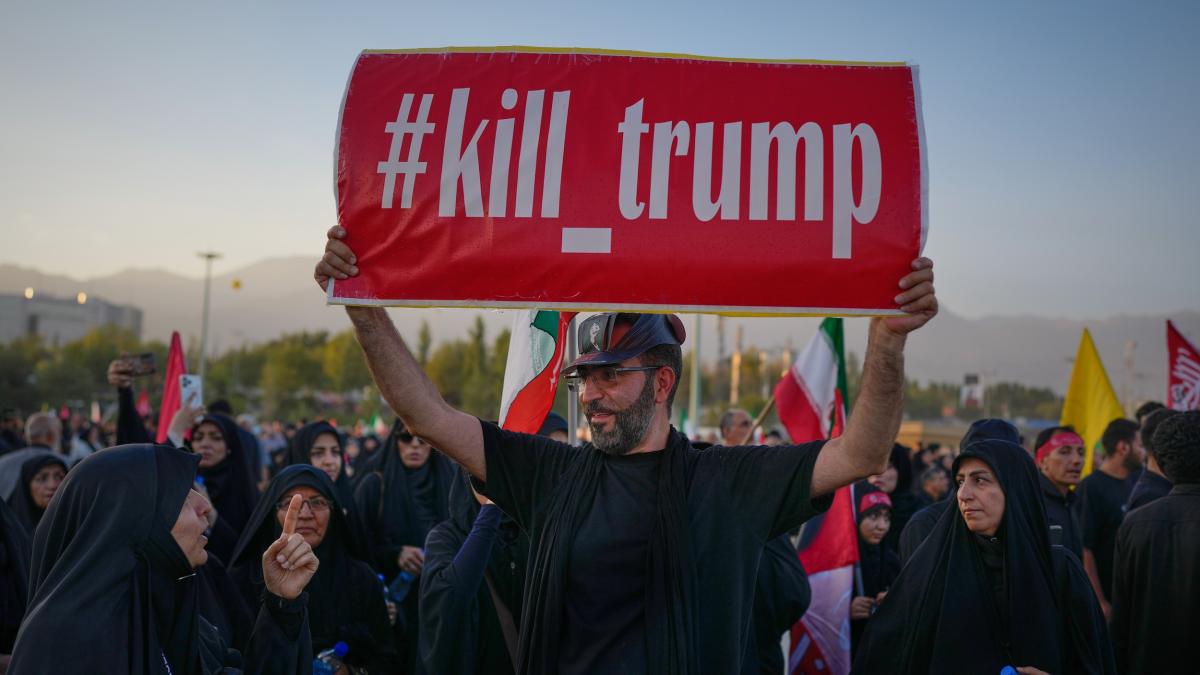
Donald Trump's recent statements on Iran and the possibility of a negotiated agreement must be taken seriously, as he is the President of the United States. Below are his remarks made at the NATO summit in Turkey.
'I don’t want to deal with them anymore. They are scum. Do you know what scum is? They are scum. They are sick people. They are led by sick people. And they are cruel, violent.'
'If they have nuclear weapons, they will use them. As far as I’m concerned, it’s all over.'
But will this be his final word on the matter? Certainly not. On this war and the ongoing negotiation of a Memorandum of Understanding (MOU), he has continued to comment repeatedly. His statements have oscillated between declaring victory, threatening to obliterate Iranian civilization, and supporting negotiations.
Later, he intensified his threats, stating that the U.S. 'might well hit them again tonight,' adding: 'I gave them a little warning ahead of time. We will hit them hard again tonight.'
The United States undoubtedly has the capability to severely damage Iran. However, what the U.S. has so far failed to achieve is breaking the Iranian regime’s determination to uphold its core demands—most importantly, control over shipping in the Strait of Hormuz.
Underlying his recent series of aggressive statements is an implicit truth: negotiations will continue. Talks were temporarily suspended as Iran held multi-day funeral ceremonies for its former Supreme Leader, Ayatollah Ali Khamenei, who was reportedly killed on February 28—the first day of the war—by Israeli and U.S. strikes.
When asked whether the mutual attacks between the U.S. and Iran—and the extension to some of America’s Gulf Arab allies—meant negotiations were over, Trump, referring to his chief negotiators Steve Witkoff and Jared Kushner, said: 'I don’t care. They can talk. But I think they’re wasting their time.'
He then described the Iranian regime as: 'They’re just a bunch of liars.'
This can also be interpreted as another admission: as U.S. President, no matter how much Trump blusters, he has no better option than negotiation. The U.S. and Israel attempted to destroy the Tehran regime but ultimately failed.
However, the negotiation process is extremely fragile. A mediator involved in the talks described the current situation as 'definitely a setback.' The atmosphere is reportedly 'extremely tense.'
This is diplomatic language meaning that recent events have created a deeply hostile backdrop for negotiations between two nations that fundamentally distrust each other and do not believe the other will honor any agreement.
The core of the recent military exchanges between Iran and the U.S. lies in the Tehran regime’s determination not to return to the status quo before the U.S. and Israeli attacks on February 28.
The regime is determined to maintain control over the Strait of Hormuz. With the ability to block vessels carrying critical global supplies—including one-fifth of the world’s oil and gas—it holds the global economy hostage.
This is a far more practical weapon than the mere prospect of attempting to develop nuclear weapons.
Iran will not agree to relinquish control over the Strait of Hormuz. Precisely for this reason, it is willing to risk jeopardizing the MOU—despite the many potential benefits it offers Iran—to make one point clear: the situation cannot return to how it was before. To defend what it sees as its strategic rights in the strait, it is prepared to gamble on the continuation of war.
The failure of the U.S. and Israel to destroy the Tehran regime has strengthened its confidence. The funeral ceremonies for the slain Supreme Leader demonstrated that the Islamic regime still enjoys solid domestic support.
Domestic opposition forces have not disappeared. However, the regime brutally suppressed street protests in January, killing thousands, causing opposition groups to remain subdued.
Mediators believe that if the escalation of conflict between the two sides can be halted, it may still be possible to reach an agreement with Iran to restore shipping through the Strait of Hormuz. This would have to be part of a broader agreement, including the unfreezing of Iran’s overseas assets, allowing Iran to sell oil, and, most crucially for the regime, recognition of Iran’s jurisdiction over the strait.
In exchange, Iran must accept limits on uranium enrichment, allow UN inspectors to return, and account for what Trump called the 'nuclear dust' stockpile—meaning uranium already enriched to near-weapons-grade levels.
However, events over the past day have shown just how difficult this will be.
FACT BOX
- Source: PR Times
- Category: News