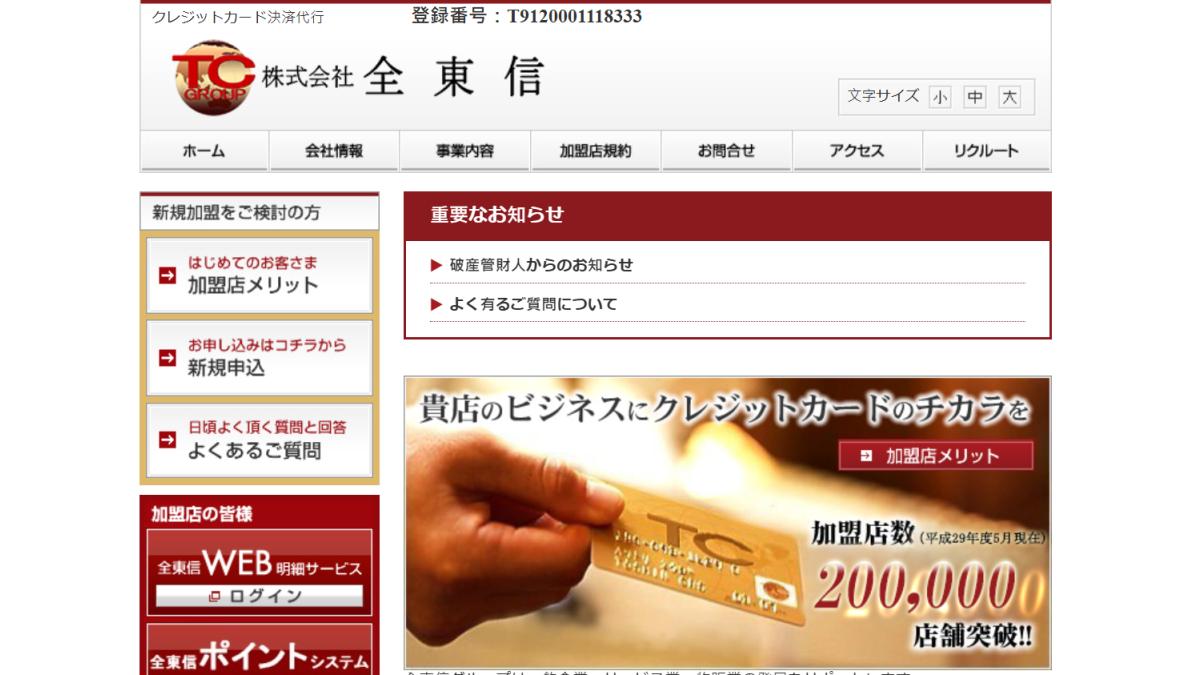
Japan's credit card payment processing company 'Zentoshin' has collapsed and entered bankruptcy proceedings on the 6th. The company's total liabilities amount to approximately ¥1.259 trillion (about NT$24.9 billion), making it the largest bankruptcy case in Japan in 2026.
According to reports from NHK, the Sankei Shimbun, and the Yomiuri Shimbun, Zentoshin is a credit card payment processing company headquartered in Chuo Ward, Osaka City. The company's business model involved advancing sales revenue to merchants such as restaurants on behalf of credit card companies, allowing them to receive funds earlier than the standard payment date, in exchange for service fees. Through this model, Zentoshin expanded its network of affiliated stores, reaching as many as 200,000加盟店 by 2018.
However, the bankruptcy trustee stated that due to the growing popularity of smartphone payments, market competition intensified around 2015, and merchants increasingly demanded lower fees, leading to a deterioration in the company's cash flow.
According to bankruptcy filings obtained by Tokyo Shoko Research, 63 financial institutions still hold unrecovered loans to Zentoshin. Among these institutions, about 30 are banks, with the remainder primarily credit unions and other financial cooperatives.
Following the court's order to commence bankruptcy proceedings against Zentoshin, regional financial institutions with business ties have issued statements indicating they may be unable to recover their claims.
With Zentoshin's bankruptcy, merchants' unreceived sales revenue is now at risk of being entirely lost, particularly affecting individually operated restaurants and small businesses.
In response, Economic and Industrial Minister Ryosei Akizawa announced at a press conference after the cabinet meeting today that 'special consultation desks' will be established at 378 government-affiliated financial institutions nationwide. Additionally, eligibility criteria for the 'Safety Net Loan' program offered by the Japan Finance Corporation will be relaxed to support merchants' cash flow.
Furthermore, to prevent a chain of bankruptcies among small and medium-sized enterprises (SMEs) holding receivables from Zentoshin, the Ministry of Economy, Trade and Industry (METI) has initiated procedures to apply the 'Safety Net Guarantee No. 1' measure.
At the press conference, Minister Akizawa stated, 'We will take comprehensive measures to ensure that businesses' cash flow and operations remain unaffected.'
Additionally, in response to this incident, METI is currently considering the special activation of the 'Full Credit Guarantee System,' under which the government would fully guarantee loans that merchants apply for from financial institutions, beyond their regular financing limits.
Reports indicate that Zentoshin, heavily reliant on bank loans, allegedly engaged in improper accounting practices to inflate its financial statements, including overstating its deposit balance by approximately ¥17 billion (about NT$3.3 billion) and failing to record ¥217 billion (about NT$4.3 billion) in unpaid amounts owed to加盟店 as liabilities.
It is believed that this financial misconduct may have been ongoing for at least 20 years.
On the other hand, according to the bankruptcy trustee, between October 1st and 5th, the company processed approximately 20,000 transactions with a total value of about ¥5.3 billion (approximately NT$1 billion). There are concerns that the total liabilities and number of creditors may continue to increase, particularly expanding the impact on individually operated restaurants and merchants.
FACT BOX
- Source: PR Times
- Category: News