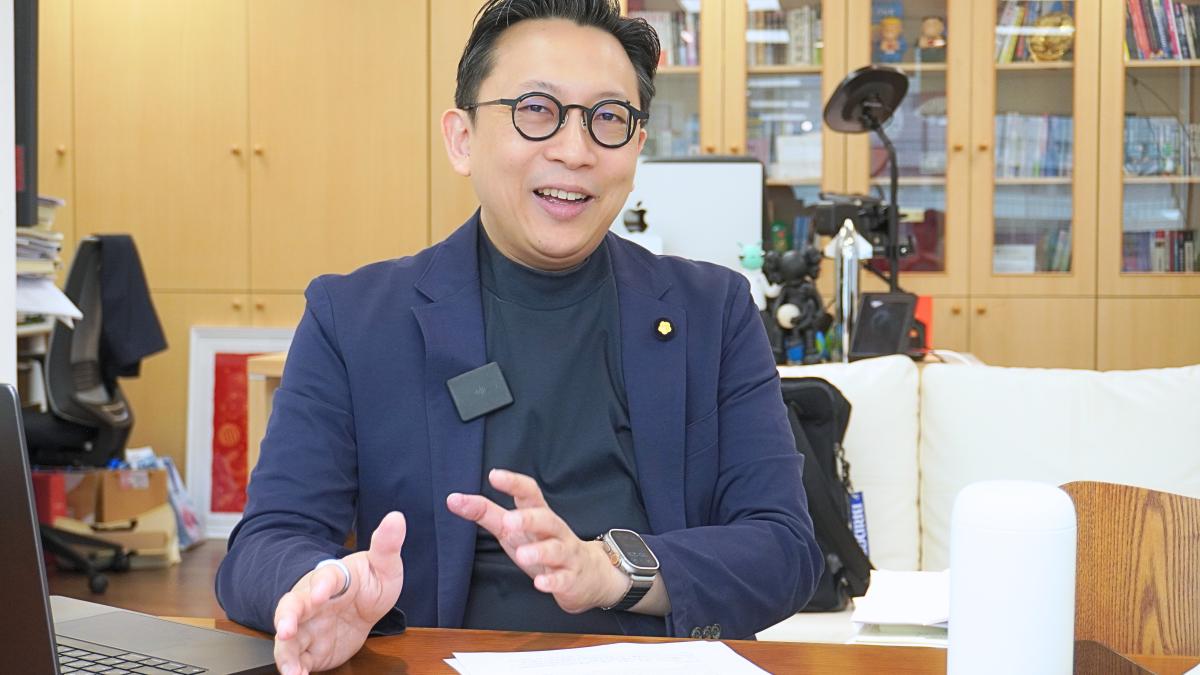
The Legislative Yuan passed the Virtual Asset Service Act (Virtual Asset Service Act) in a third reading on June 30. This marks the end of the transitional period for Taiwan's virtual asset industry, which was only managed under the Anti-Money Laundering Act, and the beginning of the pre-approval era. This bill is one of the committee versions proposed by Legislator Ge Ru-Jun and 19 other committee members on March 20 this year, which was reviewed and passed in a third reading after being merged with the versions of the Finance Committee and the Executive Yuan. For Ge Ru-Jun, who has long been involved in AI governance, network security, and digital infrastructure, this moment marks the end of a 10-year wait. In an exclusive interview with The Storm Media, Ge Ru-Jun said, "There's only one word to describe it, finally. The third reading passage is Taiwan's 'clarity moment.'" He believes that the true significance of this law is not just supervision, but completely removing the stigma that digital assets have long carried, and removing the biggest institutional obstacle for his long-advocated national Bitcoin strategy reserve. He emphasized that Taiwan will not miss the next wave of the digital financial era. The Legislative Yuan passed the Virtual Asset Service Act in a third reading on June 30. (Screenshot from the National Assembly Channel) Ten years of observation comes to an end: VASP moves from registration to licensing According to the FSC's press release, the Virtual Asset Service Act clearly classifies virtual asset service providers (VASPs) into seven categories: exchanges, trading platforms, transfer agents, custodians, underwriters, lenders, and others. It requires businesses to meet legal thresholds in terms of capital, the qualifications of responsible persons and business personnel, internal control and audit systems, cybersecurity management, virtual asset listing and delisting review mechanisms, and the separation and custody of customer assets. During the transition period, existing businesses that have completed anti-money laundering registration must apply for a license from the FSC within 12 months after the new law comes into effect and obtain a license within 21 months. If necessary, they can extend it by up to 3 months, but only once. The analysis by Deloitte Touche Tohmatsu also pointed out that this represents Taiwan's VASP supervision officially moving from a single aspect of "anti-money laundering" to a complete framework of "business supervision + investor protection + financial stability." In the interview, Ge Ru-Jun recalled that Taiwan was actually an early participant in blockchain technology. Between 2010 and 2014, local developers were active in the open-source community, participated in Bitcoin hackathons, and won multiple awards. From 2014 to 2016, the model of being able to purchase Bitcoin at convenience stores once made Taiwan an international topic. He admitted that after 2016, the government's regulatory attitude became more conservative, "which was actually not very healthy for developers, local exchanges, and technology enthusiasts like me." (Related report: Exclusive | Bitcoin as Strategic Reserve? BPI Expert Tells Taiwan: Look Past the Volatility) Dual safeguards for stablecoins: Central bank approval and FSC approval are both necessary The new law has a dedicated chapter regulating stablecoins. According to the FSC's explanation, issuing stablecoins within Taiwan requires both the approval of the central bank and the FSC. Issuers must maintain full reserve assets and deposit them in trust, conduct regular audits and information disclosure, and may not pay any form of interest or income to holders. Notably, Ge Ru-Jun was particularly concerned about the transition of existing international stablecoins during the review process. He was concerned that if stablecoins like USDT and USDC, which are already widely circulated in the market, were immediately cut off after the new law came into effect, it would impact the existing transaction order. The final text therefore retains the flexible wording "unless otherwise specified by the competent authority" and requires the FSC to work with the central bank to formulate relevant rules, reserving a buffer space for existing market activities. In the interview, Ge Ru-Jun revealed that he and a representative of the Bitcoin Policy Institute (Bitcoin Policy Institute) had a closed-door meeting with the vice president and vice chairman-level officials of the central bank. He said they were surprised to find that the central bank's knowledge depth and positive thinking about virtual assets far exceeded their original expectations. He emphasized that the central bank will still decide on the timing and specific asset categories on its own, "but at least the current atmosphere is open and constructive." (Related report: Exclusive Interview: AI Agent Era Arrives, Bitcoin Becomes New National Hedge Favorite? BPI Expert: Don't Just Look at Volatility, Look at Strategic Value) Penalties are fully increased: Manipulation can result in up to 10 years imprisonment and a fine of 200 million NT dollars In terms of market order, the new law clearly prohibits fraudulent or manipulative behavior in virtual asset prices, supply and demand, etc. Violators can be sentenced to more than 3 years and less than 10 years imprisonment, and fined between NT$10 million and NT$200 million. Those who operate VASP businesses without permission can be sentenced to up to 7 years imprisonment and fined up to NT$100 million, which is significantly heavier than the current anti-money laundering law's penalty of less than 2 years imprisonment and a maximum fine of NT$500,000. Notably, the new law also explicitly allows traditional financial institutions to apply to engage in virtual asset-related businesses if they meet the FSC's qualification requirements. Bitcoin Reserve Vision: A Second Line of Defense Against Geopolitical Risks For Ge Ru-Jun, the most profound strategic significance of the new law lies in paving the way for national Bitcoin reserves. In the interview, he argued that in the face of Taiwan's unique geopolitical situation, national resilience cannot rely solely on military defense and traditional economic strength, but also needs to establish digital asset resilience that is not subject to third-party freezing and can be independently verified. "Relying solely on gold or dollar assets may not be flexible enough in extreme situations," he said. He quoted the core spirit of Bitcoin - "Don't trust, just verify" and pointed out that the new law includes provisions encouraging the government not to sell confiscated Bitcoin at will. "This is not yet an official national reserve policy, but it is the first step towards accumulation," he said. This claim is consistent with his position when he asked the government to take stock of the amount of Bitcoin it holds during the general questioning last November. The explanatory notes of the new law also stipulate that if the property of the victim is a virtual asset, it should be returned or confiscated in its original form in principle. (Related report: Exclusive Interview: BPI Crypto Expert Warns: If the Taiwan Strait is Blocked, Gold Can't Be Moved, Dollars Are Unreliable, Only Bitcoin Can Move) Semiconductor supply chain pre-deployment: Stablecoin adoption rate quietly rises Ge Ru-Jun pointed out in the interview that even before the new law was passed, about 5% of financial transactions in Taiwan's supply chain and semiconductor industry had adopted stablecoins, and another 4% of companies were actively planning to introduce them. This observation is similar to the survey results released by the Taiwan External Trade Development Council on September 10 last year, with 5.2% already adopting stablecoins and 4.2% planning to introduce them. The combined application ratio of nearly 10% shows that stablecoins have crossed the experimental stage and entered the initial stage of application in trade settlement, with overseas Taiwanese businesses having an even higher usage rate. Ge Ru-Jun believes that leveraging Taiwan's global position in advanced chip manufacturing, this first-mover advantage has the opportunity to allow Taiwan to take a leading position in Asia in the fields of real asset tokenization (RWA) and supply chain finance. The Taiwan External Trade Development Council released survey results similar to those of last year on September 10, with 5.2% of Taiwanese manufacturers already adopting stablecoins and 4.2% planning to introduce them. (From the official website of the Taiwan External Trade Development Council) (Related report: Exclusive | Bitcoin as Taiwan's Last Reserve: A Defense Expert's Warning) Next step timeline: Derivatives guidelines and New Taiwan Dollar stablecoins The Legislative Yuan simultaneously passed a resolution requiring the FSC to submit a plan for virtual asset derivative products within one year. In the interview, Ge Ru-Jun expected that the detailed rules for New Taiwan Dollar-denominated stablecoins could be released as early as the end of 2026 to the beginning of 2027, at which time banks and licensed VASP operators could apply for issuance. He also mentioned that Taiwan currently only allows qualified investors to purchase overseas Bitcoin ETFs through sub-custody channels, and domestic Bitcoin ETFs have not yet been approved, but this will be a future point of observation. A call to young engineers: Rules are set, now it's your turn At the end of the interview, Ge Ru-Jun turned the topic to talent. He believes that Taiwan has engineering strength comparable to TSMC, and now is the best time to move from experimentation to real application under clear regulations. He also threw out a more long-term imagination: when humanity moves towards interstellar civilization, blockchain-style value transfer technology will eventually become an indispensable infrastructure outside the earth.
FACT BOX
- Source: PR Times
- Category: 法律