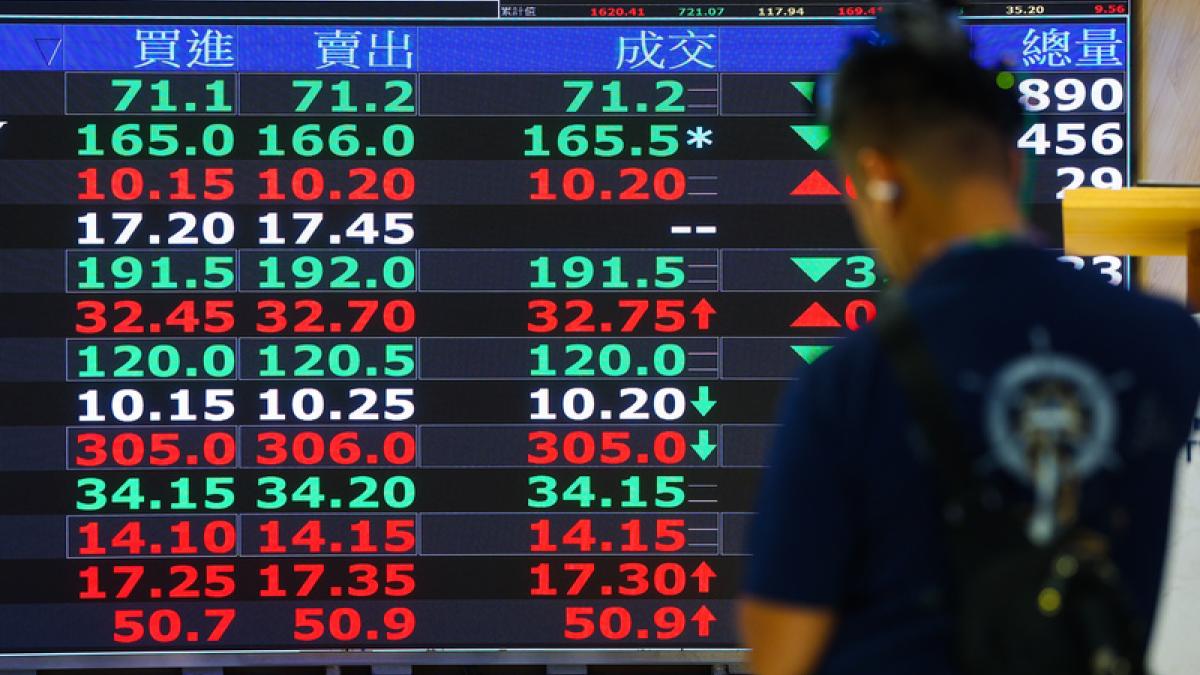
This week, Asian stock markets plunged, with South Korea's market triggering a full-market circuit breaker due to excessive declines, temporarily halting trading. On the program 'Yahoo Feng Xiang Long Feng Pei,' veteran media figure Chen Feng-hsin explained that the market is currently in a short-term adjustment phase of a 'top-heavy, bottom-weak' structure. The sharp drop in Asian equities, coupled with volatile swings in Korean stocks, has raised questions about whether the AI dividend has ended—this will depend on global tech sentiment, centered on South Korea's stock market.
What is 'Top-Heavy, Bottom-Weak'?
Chen Feng-hsin explained that the AI boom has forced traditional cloud software service providers to heavily invest in Asian semiconductor supply chain companies to build data centers, gradually turning into an arms race. While Asian semiconductor suppliers have reaped substantial profits, the profitability models and payback periods of these capital-intensive firms remain questionable in the eyes of the market. This has led to eroding free cash flows and even debt accumulation.
Chen pointed out that such gains are subject to wave-like corrections based on valuation levels. In the first half of the year, Asian tech hardware stocks—including South Korean and Taiwanese equities and the Philadelphia Semiconductor Index—rose significantly. The recent decline is a short-term correction driven by profit-taking after strong gains and capital rotation, not a reversal of the AI trend. Therefore, the trend is expected to continue until at least 2027. As long as the monthly 'New Orders Index' does not decline, there is no need to worry about hardware tech profitability and upward momentum.
Chen: Korean Market Panic Spreads to Global Hardware Tech Stocks
Regarding the South Korean market, Chen noted that Samsung and SK Hynix saw explosive profits and stock price surges in the first half due to memory chip demand. To address the long-standing 'Korea Discount' issue—where Korean stocks trade at a valuation discount—the government implemented sweeping reforms. However, these reforms were too aggressive, causing financial leverage to rise too quickly.
Chen cited extreme examples such as significantly loosening ETF single-stock holding limits and heavily promoting 2x leveraged ETFs on single companies—'crazy phenomena' that have made Korean stocks prone to 'soar when rising, crash when falling,' frequently triggering market circuit breakers. As a result, South Korea has become the global 'sentiment center for tech stocks.' When Korean markets turn fearful or optimistic, that sentiment spreads and amplifies across global hardware tech stocks.
When Will the Short-Term Correction End? Chen: When Korean Markets Stabilize
Chen stated that the short-term structural adjustment tied to the 'top-heavy, bottom-weak' phase will conclude when the South Korean market stabilizes. Investors should monitor Korea's intraday performance. Although market direction takes time to transmit to Taiwan, Korean market trends still offer significant reference value.
FACT BOX
- Source: PR Times
- Category: News
- Products / services: ETF