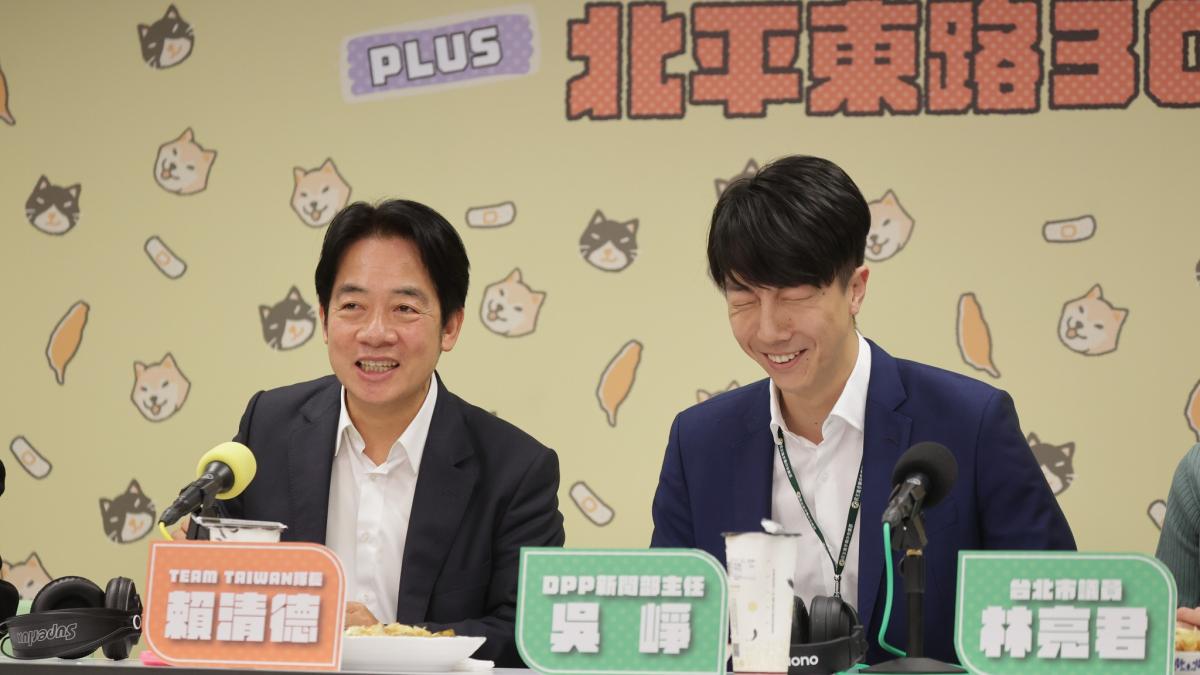
The cancer-causing oil scandal continues to escalate, with DPP spokesperson Wu Cheng retorting, 'It's not like I forced you to eat it,' instantly igniting public fury and drawing widespread online backlash. The DPP is not only arrogant but unmatched in its skill at dodging responsibility and its thick-skinned resilience. The moon may wane, but its light remains unchanged; a sword may break, but its strength endures—throughout its history, the DPP's arrogance has remained consistent. Arrogance has become habitual, trickling down from top to bottom. DPP Secretary-General Hsu Kuo-yung once snapped at reporters, 'Speak more respectfully to the minister!' Interior Minister Liu Shih-fang refused to appear on the legislative podium to respond to questioning by Legislative Yuan member Lee Chen-hsiu, a mainland-born spouse. Former Premier Su Tseng-chang once shouted at opposition lawmakers during a legislative clash, 'What are you yelling about!' He also used mocking metaphors like 'a monkey's red behind' to refer to then-legislator Chiang Wan-an, turning legislative questioning into 'counter-questioning' through ridicule and humiliation. 'It's not like I forced you to eat it.' Wu Cheng's remark is not merely an expression of arrogance—it reflects the ruling party's attempt to evade responsibility during a food safety crisis. On critical livelihood issues such as food safety, energy, and housing prices, whenever the public raises concerns, DPP officials habitually shift blame to the opposition, local governments, or even accuse Beijing of spreading 'rumors'—such as claims about sprouted potatoes or U.S. peanuts entering Taiwan—seeking to defuse crises through political means. Recall the 2014 Tainted Oil Scandal involving Ting Hsin, when then-Tainan Mayor Lai Ching-te condemned the 'central government pushing responsibility to local authorities,' and then-DPP Chairperson Tsai Ing-wen declared, 'If you really don't want to take responsibility, let us govern.' That same year, a DPP campaign ad featured a street vendor lamenting, 'Barrel after barrel of oil they said was safe ruined our hard work,' accompanied by the slogan 'Replace them if they fail.' Former Premier Jiang Yi-huah apologized twice and bowed deeply at a 90-degree angle in the legislature, while then-Minister of Health and Welfare Chiu Wen-ta and Food and Drug Administration Director Yeh Ming-kung both resigned. In contrast, under the DPP government, no one has faced administrative accountability. When the opposition demanded Premier Cho apologize in the legislature, he retorted, 'Is this a special report or a special apology session?' The central government even suppressed local authorities, criticizing Taichung for quickly releasing information on tainted oil distribution. Today, the DPP government first separates central and local responsibilities, then drags local governments into sharing blame, ultimately adopting the pattern of 'credit to the center, blame to the locals'—a tactic repeated from last year's African swine fever outbreak to this year's cancer oil scandal. We must ask: Can the DPP government truly be called an 'accountable government'? Japanese-American political scientist Francis Fukuyama, in his seminal work The Origins of Political Order, argues that a mature modern political order requires three institutions: 1) a state capable of implementing policies; 2) the rule of law that constrains rulers; and 3) accountability mechanisms that compel the government to respond to the people. 'Accountable government,' according to Fukuyama, is not merely about holding regular elections, but ensuring that those in power respond to societal needs and can be removed or sanctioned for policy failures. Fukuyama's concept of accountability is not a one-time electoral verdict, but continuous constraint through law, institutions, and social norms during daily governance. The DPP government does apologize and revise policies, but its fundamental flaw lies in reducing accountability to three cheap tactics: First, linguistic accountability replacing institutional accountability—officials apologize for 'inappropriate wording' or 'negative public perception' without addressing policy responsibility. Second, technical responsibility replacing political responsibility—blaming frontline staff, local governments, contractors, or information gaps, while department heads remain in office. Third, passing the buck to local governments and Beijing—blaming 'foreign disinformation,' cognitive warfare, or cross-strait suppression. After the signing of the U.S.-Taiwan Trade Agreement (ART), rumors swirled about loosening restrictions on sprouted potatoes and zero-tariff U.S. peanuts entering Taiwan. The government failed to allay public anxiety, with President Lai claiming these were 'rumors from the mainland.' Political science generally divides accountability into two types: 'vertical accountability,' where the public punishes the government through elections, media, and public opinion; and 'horizontal accountability,' where the legislature, judiciary, oversight bodies, audit agencies, and independent institutions constrain executive power during its term. As Fukuyama emphasizes, accountability should not wait for elections but operate continuously through legal, institutional, and social constraints. Fukuyama notes, 'The failure of democracy lies not in ideas, but in execution... The inability to achieve accountable government stems from weak institutions, corruption, incompetence, or a combination of all three.' By this standard, Taiwan's 'vertical accountability' is relatively strong, with fierce electoral competition. However, 'horizontal accountability' often becomes politicized and tribalized. The ruling party frames legislative oversight as political obstruction, while the opposition turns oversight tools into political attacks. Executive agencies first assess the political affiliation of questioners before deciding whether to respond. In the Chung Lien Oils case, Premier Cho Jung-tai and Health Minister Shih Chong-liang appeared before the legislature to report and answer questions. (Central News Agency) The toxic oil crisis has raged for over half a month, yet the Lai administration focuses not on solutions but on provoking conflict, shifting blame to the Blue-White coalition and local governments, attempting to resolve the food safety crisis through political tactics. The public still does not know where the tainted oil originated or how to protect themselves. The absurdity of Wu Cheng's 'No one forced you to eat it' lies in its substitution of public governance with personal choice—a political tactic known as 'responsibility individualization.' It packages systemic risks as individual judgment errors, frames regulatory gaps as consumer carelessness, and rewrites policy failures as excessive public expectations. The government retains the power to set rules, allocate resources, and disseminate information, yet outsources all consequences to the people. If Wu Cheng can say, 'I didn't force you to eat it,' then the people must ask: 'We didn't force you to govern either—so why do you still have the audacity to stand there and talk?' The most extreme example of 'arrogant blame-shifting' is the Chernobyl nuclear disaster. Declassified documents show Soviet leaders knew early on that reactor design flaws contributed to the accident but focused blame on on-site operators and suppressed information to protect the regime's image. When a regime views admitting error as more dangerous than the disaster itself, governance's primary goal shifts from protecting people to protecting the government from accountability. Blame the squirrels for blackouts, the virus for pandemics, the people for toxic oil, and Beijing for sprouted potatoes—the central government is never wrong. Arrogant blame-shifting has become the norm. By Fukuyama's standards, the DPP government is far from an 'accountable government.' On July 25, people will take to the streets. It is the arrogance of the Lai administration that forces citizens into protest. And Tsai Ing-wen's famous words will echo once more among the crowd: 'If you really don't want to take responsibility, let us govern!'
FACT BOX
- Source: PR Times
- Category: News