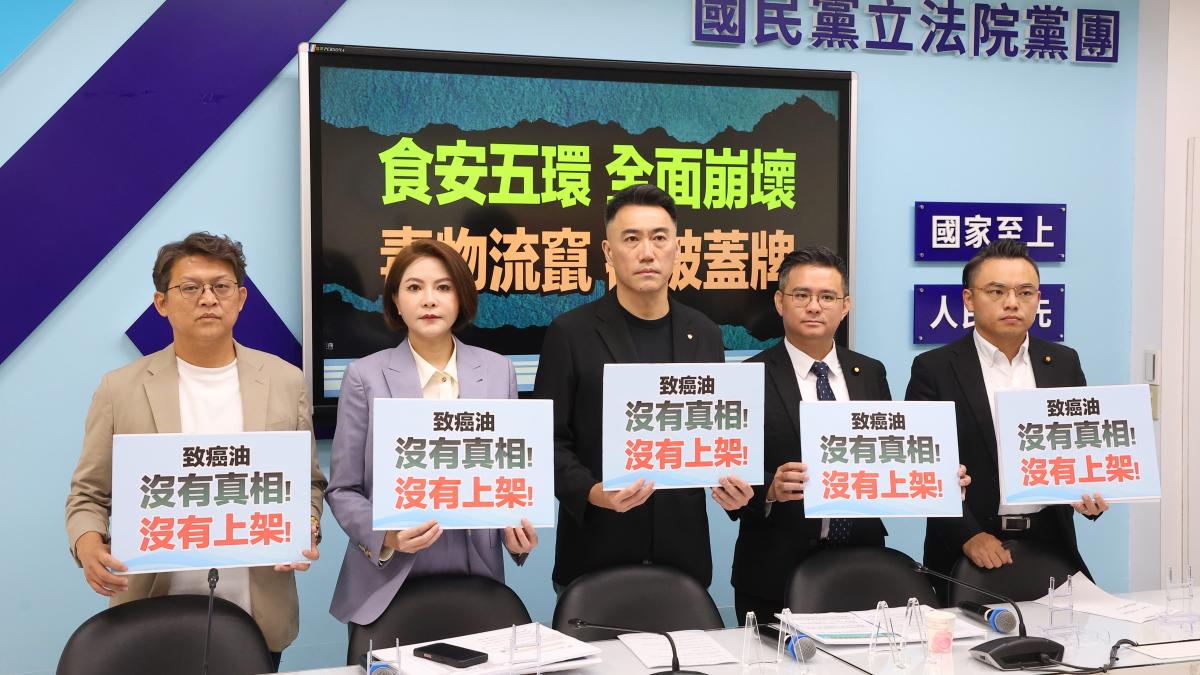
Premier Cho Jung-tai's remarks on the Central Leading carcinogenic oil incident have reversed three times in just one week—from questioning Taichung City's 'rushing to act' during the Executive Yuan meeting on July 9, to acknowledging local governments as the primary authorities for inspections and penalties on July 15, and then on July 16 praising Mayor Lu Hsiu-yen for 'taking concrete action on day one.' This 'slap yesterday, stroke today' approach resembles less a coordinated central-local effort to safeguard food safety and more a rushed political crisis management akin to 'making rice balls.' But we must not rely on impressions alone. If Premier Cho claims to be open and transparent, then he should present evidence.
First, where is the meeting record of the Executive Yuan session on July 9? On that day, Cho directly questioned Taichung Deputy Mayor Huang Kuo-jung, 'Why rush?' and claimed that central data did not match Taichung's disclosures. Was this statement a 'suggestion' or a 'warning'? Was there an explicit order to local authorities not to disclose information unilaterally? Please release the verbatim transcript, or have the attending agency heads testify to reconstruct the truth.
Second, why has the Health and Welfare Ministry not yet released its data that 'differs from Taichung's'? If the central data is more complete, why wasn't it released earlier? If the central data is incomplete, on what grounds can it criticize the local government for 'rushing'? This contradictory logic forces the public to suspect: was the central government originally planning to delay the exposure of this distribution trail?
Third, besides Huang Kuo-jung, who else can verify the Premier's claims? Attendees of that meeting—such as the Minister of Health and Welfare, the head of the Food and Drug Administration, and the Executive Yuan spokesperson—have rarely spoken publicly about the discussion. If the Executive Yuan believes there has been misunderstanding, it should proactively release records or provide further clarification. Was the truth truly 'rubbed out'? Or are officials simply remaining silent?
Yet more troubling than procedural opacity is Cho's logic of blame-shifting. He attributes responsibility to 'private companies for concealment,' claiming firms deliberately delayed reporting and hid facts, causing the central government to lag. But this statement exposes the core flaw: 'If companies conceal, your Food Cloud cannot detect it; if companies conceal, your inspection system fails. Then, was the Five Rings of Food Safety designed only to deal with honest companies?'
If a regulatory system completely fails when companies 'intentionally conceal,' then the system itself is dysfunctional. By blaming 'bad companies,' Cho is effectively admitting that the central regulatory system can only deter the honest, not the dishonest.
In contrast, Lu Hsiu-yen's 'disclose as we find' approach sends a clear message to the public: 'Even if companies hide, I will dig it out and tell you.' Lu does not have the 'Five Rings of Food Safety'—she has only one ring: telling the public what she finds. And in this incident, that single ring proved more effective than the central government's five. The contrast makes it clear: who is protecting the people, and who is protecting themselves.
We do not wish to hastily conclude that Cho is 'making rice balls,' but precisely because we avoid hasty judgment, we demand evidence. If the Executive Yuan believes the public misunderstood the July 9 meeting, the simplest solution is not to keep changing statements, but to release meeting records and explain the decision-making process, allowing society to judge for itself. The more transparent the information, the more food safety trust can be restored; the more ambiguous it is, the more people will suspect that high-ranking officials are merely 'making rice balls' behind closed doors.
*Author is an asset management expert
FACT BOX
- Source: PR Times
- Category: News