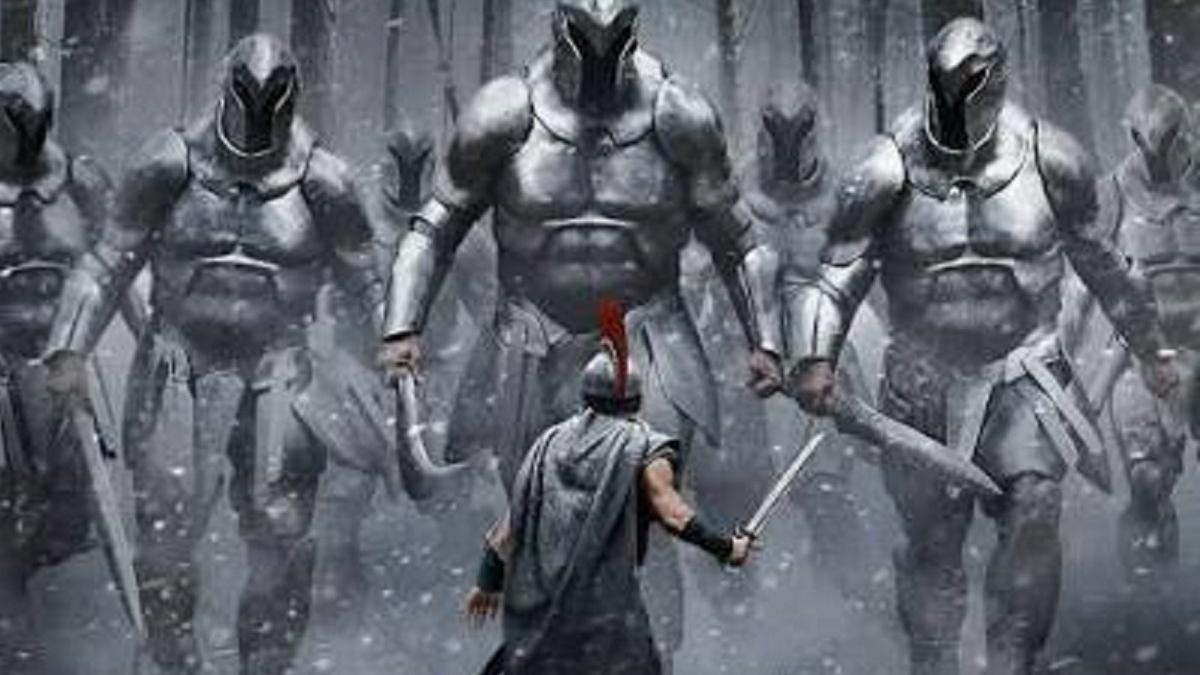
I confess, I am a fan of Noah's Odyssey movie. If it weren't for his work, I wouldn't have watched 'Odyssey' (The Odyssey). On the surface, 'Odyssey' depicts Odysseus' (Odysseus, played by Matt Damon (Cantonese version Matt Damon)) arduous journey home after the Trojan Horse massacre, and his wife Penelope's (Anne Hathaway (Cantonese version Anne Hathaway)) and son Telemachus' (Tom Holland (Cantonese version Tom Holland)) loyal and unyielding wait at home. To put it bluntly, this is just a story of a scumbag who takes advantage of being away from home to pick up women (and has to be a goddess Calypso (played by Salma Hayek (Cantonese version Charlize Theron))), and then returns to his chaste wife, a male fantasy. (In the movie, Odysseus also confesses: he lost his way on his way home.) This myth is very popular and has been made into a movie more than five times. The key is, why can a scumbag succeed, and why do people become addicted while feeling reasonable? The purpose of the Oedipus complex is to maintain patriarchy. As is well known, Freud was obsessed with ancient Greek mythology—otherwise, how would he name the famous Oedipus complex after Oedipus and narcissism after Narcissus? Interestingly, he did not analyze 'Odyssey' in detail from a psychological perspective. (Note: The analysis of the mainstream Freudian school and the focus of the movie are the same, focusing on the hero's insistence on returning home—superego—control over the id's willfulness—namely, facing the sea nymphs Sirens. There are also commentators who use the hero's arduous journey to metaphor Freud's own painful experience of creating and promoting psychoanalysis.) From Freud's theory to view 'Odyssey', the main axis of the story is the Oedipus complex (and penis envy). In Homer's original work, the protagonist meets his deceased mother Anticleia (this plot is deleted in the movie), and reconstructs and reproduces his own Oedipus complex; while the mother dies because of her obsession with her son, it is she who uses the worship (of the penis she helped produce) to make herself a complete (male) person (this is the mentality of contemporary mommy's boys, and it basically explains the conflict between mothers-in-law and daughters-in-law). In other words, the Oedipus complex and penis worship are two sides of the same coin. However, why does the goddess Athena (played by Diane Kruger (Cantonese version Diane Kruger)) try her best to help Odysseus? The answer is the same as the Oedipus complex—penis worship. It should be emphasized: Freud was very fond of Athena—there was a small bronze statue of Athena on his desk. He followed the tradition of Greek mythology, regarding Athena as the guardian of wisdom—although, according to him, she lacked the 'spear' (phallic image). (Jana Funke 2019) Athena was born from the head (brain) of her father Zeus, symbolizing that she inherited her father's wisdom—yet, she is not male, lacking a penis, is an incomplete (male) god; so, she is always just an auxiliary role—helping males overcome difficulties (Odysseus), defeat evil (for example, in another myth, she helped Perseus with a trick to kill the Gorgon). Even though she is a goddess, she still cannot be self-sufficient and needs to borrow the protection of the weak to satisfy her penis worship. She is also the perfect mother in the Greek hunting mythology, always cunningly protecting and taking care of various 'sons'. Isn't Odysseus and Perseus (unconsciously) projecting their Oedipus complex onto Athena? Therefore, although Athena appears in the movie as the image of Odysseus' guilt, his guilt is not only from the massacre but also comes from beheading the statue of Athena (the ideal mother). First kill the birth mother, then behead the ideal mother, and the mother is permanently absent; this also makes Odysseus regard all women around him as substitutes (circulating signified) for the absent mother (a signifier). Special attention should be paid to: Athena saves Odysseus from the sea—while Freud believes that in dreams, when a woman (such as Athena) saves a man (such as Odysseus) with no blood relation from a shipwreck (a metaphor for amniotic fluid), she already regards him as her own son. (Sigmund Freud 1958) In short, in the story of 'Odyssey', the Oedipus complex marginalizes women and consolidates phallocentric patriarchy. The Oedipus complex is irreplaceable in Greek mythology. The most classic and shocking is 'Antigone' (strangely, this story has only been made into a movie twice. Noah should consider it). The protagonist Antigone is a woman born to Oedipus and his mother/wife. After her birth mother hanged herself and Oedipus blinded himself, Antigone took care of her father/brother Oedipus. After Oedipus died, she tried to bury the corpse of Polynices, the son (brother/nephew) born to Oedipus and his mother (is this a bit like the plot of the movie 'The Great Flood' (2025)?). Even though Antigone knew that this not only violated the law and faced the death penalty, but would also sacrifice her marriage; she still insisted that burying the corpse was the decree of Zeus (that is, what is now called morality, the whole Odyssey emphasizes the sacred authority of Zeus' decree). In the end, she was arrested while burying her brother's corpse and eventually died. And King Creon, who insisted on sentencing her to death according to the law, also died with his whole family (including Antigone's fiancé, Creon's son Haemon). The legal interpretation of the story is the 'law vs. morality' debate that was popular in the early 20th century (see the Hart vs. Fuller debate). The ending of 'Antigone' reminds us that when faced with a choice between law and morality, being obsessed with either side is a dead end. In fact, how can the law have no moral component—both are part of the composition of the symbolic order. Recall once: if the fundamentalist Christians in Hong Kong had not firmly opposed, would the Legislative Council have already legislated to recognize overseas legal same-sex marriages? (Zhao Wenzong 2026) We should focus on discussing the ultimate values behind the establishment and operation of the symbolic order (including laws)—that is, what is the master signifier that dominates? Is it still patriarchy? Is it still the Oedipus complex? The law in Antigone's context is of course patriarchal. Creon refused to yield because he did not want to set a precedent of 'obeying women', believing that to be the performance of a weak man. In other words, Antigone knew that resisting Creon's law was to cut herself off from the symbolic order, the result could only be death. (Žižek 1992) Therefore, it is worth examining in depth Antigone's motivation—why did she want to take care of her father/brother? Why did she, even at the risk of death and not marrying, want to bury her brother/nephew? If Athena can naturally inherit her father's wisdom; Antigone would certainly also inherit her father/brother's incestuous desire. Her insistence on burying Polynices (object of desire) is fundamentally to compensate for her regret of not being able to bury Oedipus (another object of desire). (Oedipus only allowed the king of Thebes to witness his death. It must be added: when Freud was old and had cancer, he called his daughter Anna—who is also a famous psychoanalyst—Antigone; the psychological motivation of the two is too obvious—daughter wants to be the continuation of the father; the father dreams of becoming Oedipus.) Her (continued) existence will fundamentally undermine the blood order on which patriarchal society depends for survival. (Judith Butler 2000: 6, 7) Butler believes that Antigone's desire (which Butler calls the 'Antigone complex') breaks the previous program that desire must have a specific object; (Judith Butler 2000, Cecilia Sjöholm 2002) but I believe that Antigone's incestuous desire is a variation of the Oedipus complex, only the object of incest is no longer limited to the mother—for Antigone, the object of incestuous desire can be Oedipus (father/brother) or Polynices (brother/nephew). Lacan reminds us that desire is like a symbol, the relationship between the signifier and the signified will not be fixed but only random, the object of desire will never be stable and frozen (Jacques Lacan 2017)—again, to explain with an old example: will you not change your choice of dinner tonight? Do you always know in advance which YouTube channel you want to watch? Even if you are very sure at the beginning, will you change in the middle? No matter who the object is, the Antigone complex strongly questions the existence of patriarchal bloodline society; so she never felt that she was breaking the law until her death, because she never submitted to patriarchy. Her desire and behavior are taboo for patriarchy. Imagine, when society begins to accept that families can be near relatives, same-sex three generations plus one artificially reproduced child plus one adopted child, will conservatives go crazy, thinking that the world is in chaos and the end of the world? The death of the entire Oedipus family is also a natural consequence. From the perspective of Lacan's theory, the Antigone complex is also jouissance—human beings have the desire to break taboos, (mistakenly) believing that they can restore the lost self and make themselves complete through the process of breaking taboos. Knowing that it is forbidden but still doing it, knowing that it will lead to death but still taking risks, all for the pleasure of challenging the symbolic order and the authority system. From this perspective, let's revisit 'Othello': since the Oedipus complex is so powerful and hegemonic, then, Odysseus' son Telemachus...
FACT BOX
- Source: PR Times
- Category: 社会問題