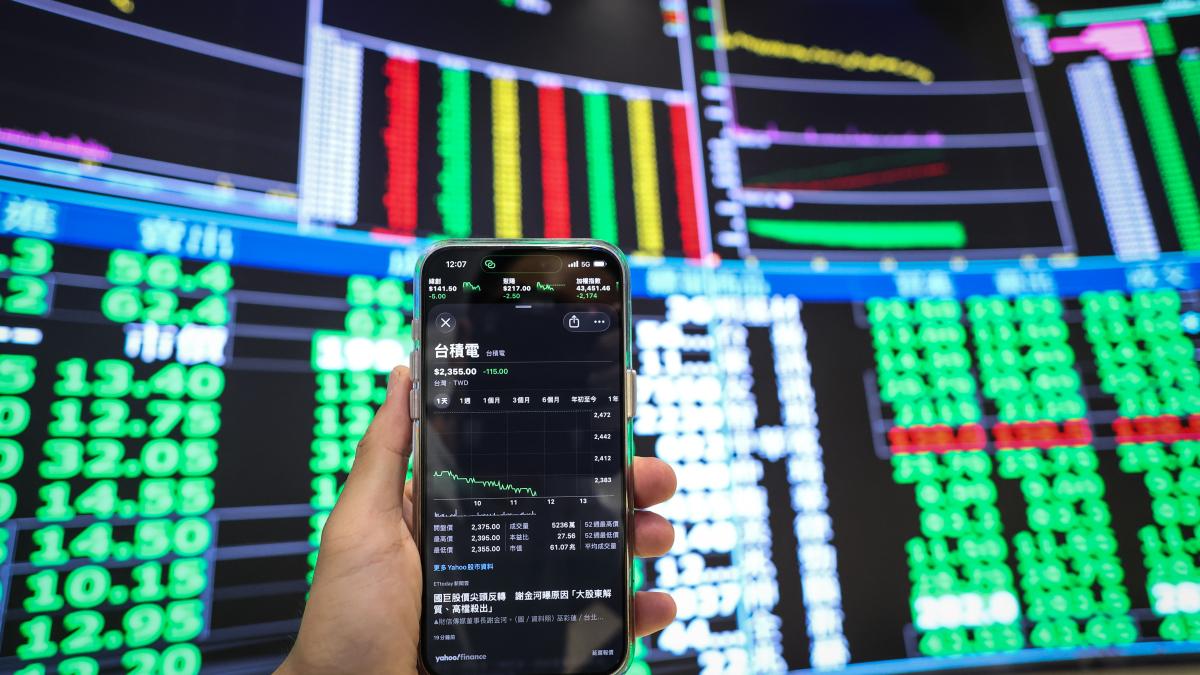
Amid falling U.S. semiconductor stocks and heavy selling pressure following TSMC's earnings call, Taiwan's stock market experienced an epic crash on the 17th. The weighted index plunged 2,953.71 points, or 6.47%, closing at 42,671.27—breaking below the quarterly moving average and setting a new record for the largest single-day point and percentage drop in Taiwan's stock market history.
In response, writer 'Plawang Island' posted on Facebook on the 17th under the title 'Epic Taiwan Stock Market Crash—Recalling Hsu Kuo-yung's Boast,' noting that the 'epic collapse' recalls DPP Secretary-General Hsu Kuo-yung's boast in May: 'The stock market is rising; haven't you profited?' What was once a bold statement has now become a bitter confession.
How did Taiwan's stock market close on the 17th? It crashed nearly 3,000 points, with TSMC plunging sharply.
The 17th became a 'Black Friday' for Taiwan's stock market, dropping nearly 3,000 points. Panic selling swept through the market, leaving many investors exclaiming, 'Never seen anything like this in my life.' Heavyweight stocks were hit hardest. TSMC (2330), the world's leading foundry firm that had just reported strong earnings the previous day, closed down 7.29%, with its share price crashing to NT$2,990, dragging the overall market index down by over 1,000 points. Other major electronics giants such as MediaTek, Foxconn, Quanta, Delta Electronics, and ASE Holding also declined together. AI servers, IC design, advanced packaging, and memory-related sectors faced broad pressure, with electronics stocks becoming the primary force dragging down the market.
When will Taiwan's stock market reach 50,000 points? Investors' cries of despair echo on Black Friday.
In the first half of this year, Taiwan's stock market continued to surge, prompting many to ask when it would hit 50,000 points. Plawang Island pointed out that the market's sharp correction has left investors devastated, serving as a societal warning that 'the stock market is like a seesaw.' Young people, facing low wages and unaffordable housing, are flooding into the stock market in a distorted gamble for quick wealth, hoping to ride the market past 50,000 points. This frenzy accelerates wealth concentration and widens the wealth gap. However, not everyone can afford to surf the stock market wave, nor can everyone profit from investing. Yet Hsu Kuo-yung previously claimed, 'When the market rises, everyone benefits. The government uses stock gains to expand social welfare, and youth can also gain.'
Plawang Island further argued that with the market now crashing, many investors are trapped in losses, and young day traders may immediately face debt. Their stock market dreams have shattered. Hsu's boast of 'everyone profits from stocks' now sounds especially ironic. Ironically, when the market rises, 'everyone profits,' but when it crashes, the government uses public deposits, pension funds, and other four major funds to prop up the market—creating the reality of 'everyone loses when the market falls.'
DPP Secretary-General Hsu Kuo-yung speaking on the stock market earlier. (Photo credit: Liu Wei-hung)
Is Taiwan suffering from 'Dutch Disease'? Experts and scholars issue warnings.
Plawang Island concluded that while a thriving stock market is a national blessing, Taiwan's market—where '70% are SMEs'—relies on just one company or one industry to support half the trading volume, indicating a distorted industrial environment. Experts and scholars have repeatedly warned of Taiwan's 'Dutch Disease'—an economic imbalance. If a nation's industries cannot develop evenly and national income does not rise broadly, people relying on low wages and stock market gains are like a thin horse being propped up with injections—an unfortunate reality. 'The entire public should awaken!'
FACT BOX
- Source: PR Times
- Category: News