The pen name Shangguan Ding is legendary, though I never read his early wuxia novels that once shook the literary world. Instead, I became a devoted fan after listening to the radio drama adaptation of his political sci-fi novel 'Reform'! Two years later, the historical wuxia novel 'The Demon Blade and the Heavenly Sword,' which traverses from late Ming to early Qing dynasties into the modern business world, was also adapted into a thrilling radio drama, once again captivating me completely. So when I recently spotted Shangguan Ding’s new book 'The New Game' at a bookstore, my eyes lit up, and I immediately devoured it!
The story begins at an elementary school in Japan, and readers only later discover that 'The New Game' is the third installment following 'The Drifter' and 'Reform.' Survivors from the planet Semeki, located 1.58 light-years from Earth, now begin their new lives in Japan, mainland China, and the United States. Meanwhile, on Earth, AI robotics technology is advancing rapidly. When AI neural networks mutate, they not only read human dreams but also execute actions from those dreams. How can a series of mysterious murders be solved? After finishing it in one sitting, I was utterly awed by Shangguan Ding. I deeply admire his creative energy—releasing a new book every one or two years, each spanning over a hundred thousand characters. When the author agreed to an interview, I, as a fan, was overjoyed!
👉 Listen to Zhao Xinping’s podcast 'Life is Never the Same' featuring Shangguan Ding (approx. 43 minutes)
Writing 180,000 Characters in Five Months—Injured His Hand
Two years ago, after completing 'Taiwan’s 'Ukraine Plan',' 80-year-old Shangguan Ding thought it would be his final novel. But two years later, 'The New Game' was born. He laughs, 'After finishing 'Taiwan’s 'Ukraine Plan',' I really felt that at over eighty, I should retire my pen. But changes in global affairs stirred new reflections. I decided to write again because I realized AI will transform humanity’s future. As someone who constantly feels deeply, when ideas surge, I feel compelled to write. This time, I won’t say this is my last book.'
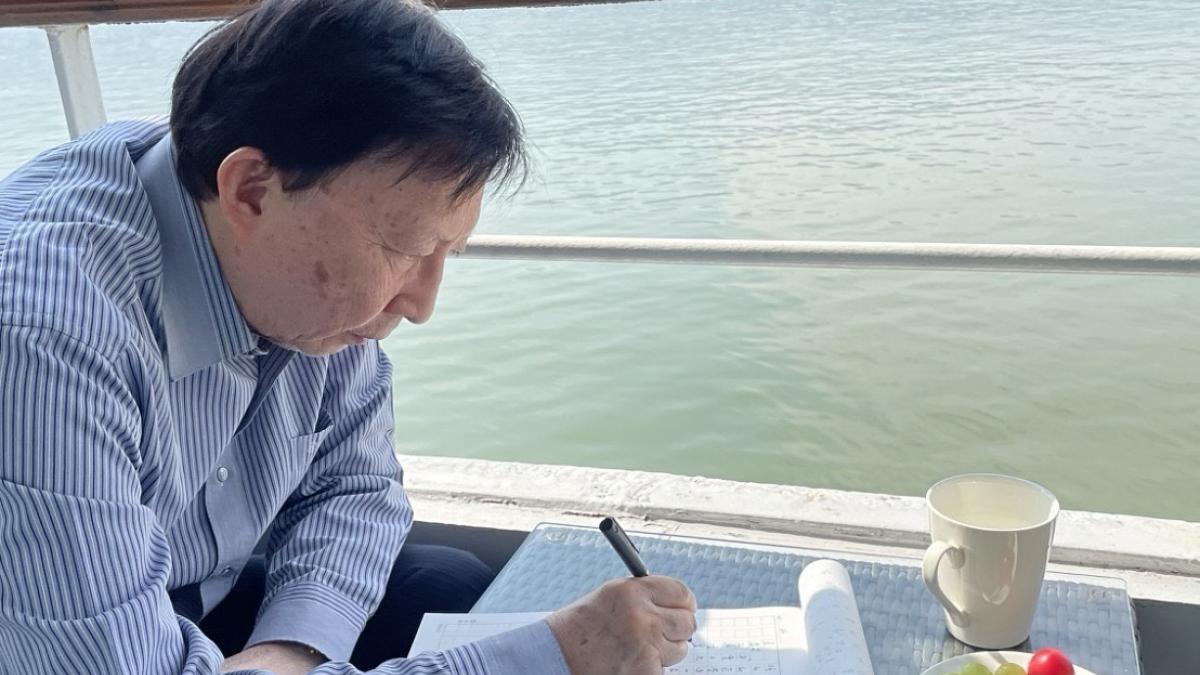
When inspiration strikes, he grabs his pen immediately. He still writes by hand, faster than typing. He completed the 180,000-character 'The New Game' in just five months. Because he writes so quickly and has always pressed hard while writing, he injured his wrist but continued writing after applying medicine.
Shangguan Ding writes feverishly when inspiration hits, and his handwriting is faster than typing. (Provided by Liu Zhaoxuan)
Though 'The New Game' is the final chapter following 'The Drifter' and 'Reform,' all three novels are independent and can be read separately without confusion. The plot unfolds through several main characters, each driving their own storylines, which eventually converge toward the eagerly awaited conclusion. The AI technology in the book touches on human thought and consciousness. When humans forget their dreams, AI robots remember and execute them. Is the robot the murderer or the murder weapon? Shangguan Ding stages a debate in the book, with scholars and experts deeply discussing the issue, leading to the story’s resolution. He says he didn’t initially plan this structure—it naturally emerged as he wrote.
For the AI technology sections, Shangguan Ding consulted his daughter, who teaches at Stanford University. His novels often include technological elements, such as biotechnology in 'Reform.' He says these are based on his expertise and common sense, enhanced by imagination. 'Many parts are fantasy. The technology in my novels is actually romantic—you don’t feel it’s rigid. It’s always intertwined with humanity.'
Interestingly, his novels seem to predict the future. Recent discussions about the revival of Japanese militarism were prefigured in 'The New Game.' 'From Taiwan' somewhat foreshadowed Ukraine’s later war, and 'Taiwan’s 'Ukraine Plan'' was seen as presaging Taiwan’s future. He says that writing about current affairs naturally extends one’s thinking beyond the present. 'If you only write about what you see now, you might as well read the news instead of novels.'
'Returning to the Scene' with 'The Sword of Dao'—A Unique Writing Experience
The pen name 'Shangguan Ding' originated from the three Liu brothers co-writing wuxia novels. After Liu Zhaoxuan went abroad in 1966, writing paused. In 1968, his younger brother Liu Zhaokai also left, and since it was common then to write under others’ names with little legal oversight, they specially published a newspaper notice stating that anyone using 'Shangguan Ding' henceforth was definitely not them.
In 2014, Shangguan Ding returned—this time as Liu Zhaoxuan’s solo creation. He holds a special affection for 'The Sword of Dao,' his first full-length historical wuxia novel after returning, a writing experience he still cherishes. 'The Sword of Dao' is rich in historical content, guided by history itself. Though he felt his pen was dull at first, it grew smoother as he wrote. He meticulously studied the Ming Dynasty’s Jingnan Rebellion and related geography, even finding an ancient Ming map that helped him depict Nanjing with such accuracy that even native Nanjing friends were impressed. While writing, he felt as if he had entered Ming-era Nanjing, becoming historical figures like Emperor Jianwen Zhu Yunwen and Emperor Yongle Zhu Di. He wrote 3,000 sheets of manuscript—900,000 characters—in one breath. 'A friend joked, was Emperor Jianwen possessing you? I really felt like I became him. It was a deeply immersive experience. 'The Sword of Dao' didn’t feel like writing a novel, but like recording the process.'
During the fifteen months writing 'The Sword of Dao,' he wrote even while traveling abroad. His wife described him as like a faucet—once turned on, the words gushed out, and could be turned off and on again. He believes he’ll never replicate this experience. Reflecting later, he found it unbelievable. 'With history as the warp and wuxia as the weft, it was the historical foundation that made the writing so smooth.' The 3,000 handwritten manuscript pages of 'The Sword of Dao' are now preserved at the Taiwan Literature Museum.
'The Sword of Dao' was written on 3,000 sheets of 300-character manuscript paper, and all character illustrations were hand-drawn by Shangguan Ding. (Provided by Liu Zhaoxuan)
The 'Post-Production' Phase of Long Novels—A Joy for the Author
After 'The Sword of Dao,' Shangguan Ding’s writing method changed completely. He writes wherever inspiration strikes, then 'post-produces' the entire work at the end. 'When I have inspiration and want to write a certain scene, regardless of whether it’s early or late in the story, I write it first. After writing tens of thousands of characters, I set it aside and later rethink the entire structure—what goes first, what goes last. Of course, I add or delete parts to make it flow naturally. This post-production process itself brings much joy. So in writing novels, you ask how I structure? I jump between these two extremes, completely different experiences. But for an author, constantly giving myself such pleasure and surprise is why I continue writing even at my age. I even hesitate to say 'The New Game' is my last, because the urge to write still comes.'
For the political sci-fi novel 'The Drifter,' Shangguan Ding starts with Sima Qian of the Western Han Dynasty. Moved by Sima Qian’s tragic castration and his monumental 'Records of the Grand Historian,' Shangguan Ding specially visited Sima Qian’s tomb in Hancheng, Shaanxi. This trip greatly helped his writing. 'The Demon Blade and the Heavenly Sword,' an alternative time-travel novel spanning six centuries from late Ming to modern times, connects stories across Japan, China, and Taiwan through a blade and a sword. It’s a work Shangguan Ding particularly loves. While writing, he recalled his mother Zhong Wanfang often claiming descent from Zheng Chenggong. He researched it and discovered Zheng Chenggong’s fourth uncle, Zheng Hongkui, fled Qing soldiers to Hengyang, Hunan, changing his surname to Zhong. His mother was indeed a descendant. He said joyfully, 'After both Hunan Zhong and Fujian Zheng descendants compared genealogies, they confirmed they are one family. Now we are connected.'
From Three Brothers Collaborating to Solo Writing
Looking back, writing wuxia novels in high school was kept secret from their parents. The nineteen-year-old elder brother Liu Zhaoli wrote romantic scenes between protagonists, fifteen-year-old younger brother Zhaokai handled fight scenes, and seventeen-year-old him 'bridged the middle.' Each wuxia novel was about 30,000–40,000 characters. They discussed the plot in advance, each writing about 10,000 characters. 'When sending to print, we’d briefly discuss and make minor adjustments. We were so in tune, and our writing styles were similar.'
They initially found it fun, but after entering university, increased commissions and deadlines brought pressure. They originally wrote wuxia novels to earn pocket money, and later funded their own overseas studies.
Now only Liu Zhaoxuan continues writing. 'The New Game' is his eighth novel since returning. He says, 'I’ve never considered myself a literary figure. I don’t. I see myself as a storyteller.'
Has this imaginative writer found new inspiration recently? 'I’ve been thinking—maybe I’ll return to history again. I want to write about historical matters…'
I asked, 'Writing must have definitely changed your life?' He replied, 'Writing novels is so much fun! I feel my mind can roam in another realm~'
Shangguan Ding releases new book 'The New Game,' interviewed on Zhao Xinping’s 'Life is Never the Same' program. (Provided by author)
👉 Listen to Zhao Xinping’s 'Life is Never the Same' (approx. 43 minutes)
FACT BOX
- Source: PR Times
- Category: News