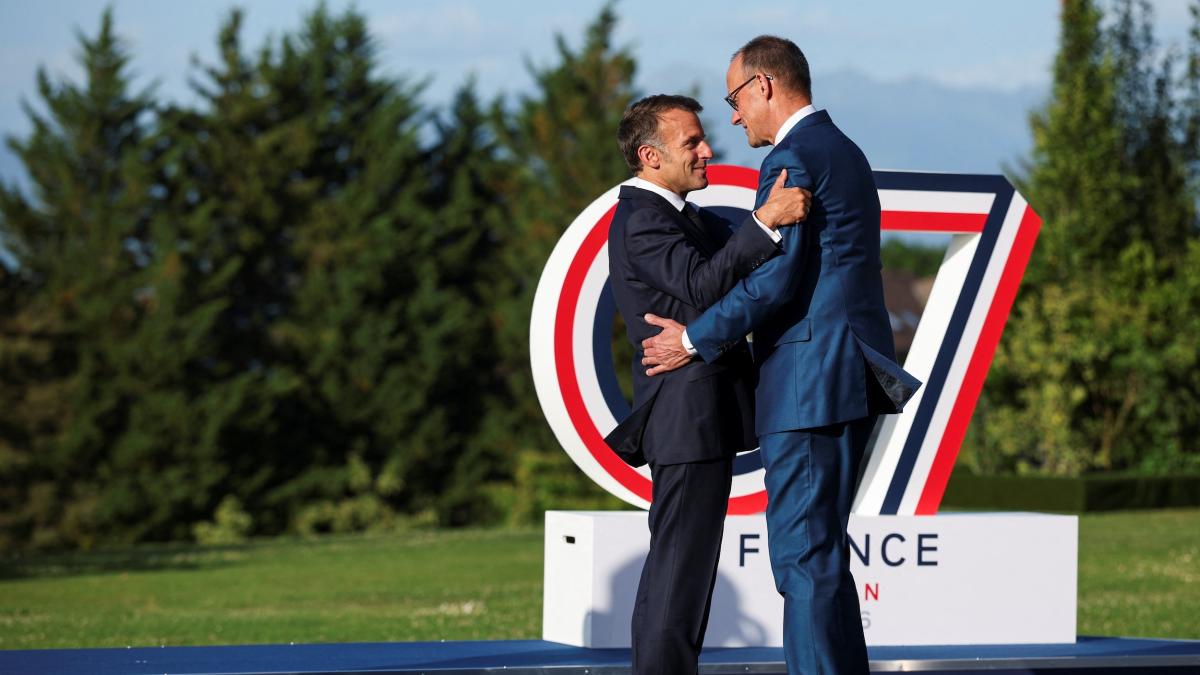
German Chancellor Merz called on the Chinese government to liberalize the yuan exchange rate during the German-French Ministerial Council meeting. He and Macron stressed the desire to resolve differences through dialogue, but warned they would no longer tolerate distorted competition that harms European industries and employment.
The German-French Ministerial Council meeting was held last Friday (July 17) in Brühl, North Rhine-Westphalia, Germany. On the issues of Chinese overcapacity and the yuan exchange rate, the leaders of both countries showed an unexpectedly unified stance. Both accused China of gaining unfair competitive advantages in its competition with the European Union and criticized the current situation of the EU's daily trade deficit with China, which reaches 1 billion euros.
"Either engage in dialogue or liberalize the exchange rate."
Merz stated: "I cannot accept the current situation because it comes at the expense of European job opportunities, and the damage is one-sided." On Friday, Merz urged the Chinese government to either initiate dialogue on these issues or liberalize the yuan exchange rate.
Previously, he stated that the yuan exchange rate has been artificially undervalued by up to 30%, significantly lowering the prices of Chinese export products.
Merz said: "Only when a currency is freely convertible can its true internal and external value be revealed. If the Chinese government believes the current value of the yuan is reasonable, there is no reason not to liberalize the yuan exchange rate and make it freely convertible."
Macron also mentioned the undervaluation of the yuan, arguing that China uses this to artificially depress the prices of its exported goods.
He pointed out that China also possesses massive overcapacity created through substantial subsidies, which is primarily directed toward the European market—such as in the automotive industry.
Not seeking decoupling, but calling for swift protective measures
Macron urged the EU to make decisions quickly, stating that it cannot wait 18 months to take countermeasures. He announced that Germany and France will develop a joint defense agenda by the end of this year. This work will clearly proceed in parallel with discussions within the EU. The EU plans to decide this autumn whether to introduce new trade defense tools into its common trade policy.
The joint statement adopted at the ministerial meeting did not explicitly mention China.
However, Macron stated at a press conference that the scale of subsidies China provides to its industries is eight times that of OECD countries, and therefore Europe must respond.
Merz emphasized that he does not want a new trade conflict with China, but rather seeks open dialogue with China on these imbalances that harm European industrial interests. He noted that China also depends on the European market, which has 450 million consumers.
In the past, Germany was seen as one of the countries within the EU blocking stricter trade measures against China, such as opposing tighter restrictions on Chinese car imports.
But since the beginning of this year, Germany, once the "export champion," has also seen a significant expansion in its trade deficit with China.
Macron also stressed that he is not against China and does not want to "decouple" from China. However, he stated that China itself protects its own interests in trade policy, and the U.S. protects its domestic market—"Therefore, we in the EU must do the same."
DW Chinese has an Instagram! Search for dw.chinese to see more in-depth and accessible图文 and video reports.
© 2026 Deutsche Welle Copyright: All content in this article is protected by copyright law. Unauthorized use without special authorization from Deutsche Welle is strictly prohibited. Any improper actions will result in compensation and criminal prosecution.
FACT BOX
- Source: PR Times
- Category: News